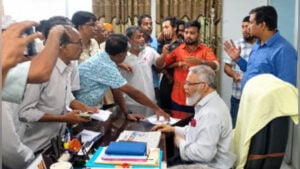
Human Rights Watch (HRW) has condemned the arrest of around 290 supporters of the Jatiya Samajtantrik Dal (Jasad) from a meeting in Dhaka on 26 September, describing the incident as the latest example of what it called continuing restrictions on civic and political rights in Bangladesh.
In a statement issued on Monday, the international rights organisation said police detained the Jasad supporters after members of the Bangladesh Nationalist Party’s (BNP) youth wing, Jubo Dal, alleged that the gathering was a ‘secret’ meeting of the Awami League. Twenty-seven of those arrested were later sent to remand by a court over allegations that they had chanted ‘Joy Bangla’, a slogan associated with the Awami League and its political movement.
Jasad has been a member of the 14-party alliance led by the Awami League. The Awami League remained in power from 2009 until the fall of its government in 2024 following a student-led mass movement. Since the change in power, political gatherings and activities involving individuals associated with the former ruling party have become a subject of heightened scrutiny.
HRW also referred to two other arrests linked to alleged Awami League gatherings. On 26 September, police detained 12 Awami League activists in Barishal over allegations that they had held a ‘secret’ meeting to plan acts of sabotage. Two days later, another 15 people were arrested in Dhaka under the Anti-Terrorism Act over similar allegations.
According to HRW, those detained in the two incidents said they had gathered to mark the birthday of former prime minister Sheikh Hasina. The organisation’s account places the arrests within a wider debate over how authorities are handling political activity involving supporters of the former government.
The rights group said the BNP-led government came to power promising to restore human rights and the rule of law. Yet, it argued, people perceived as opponents of the government have also been detained, while some protective measures proposed during the interim government period have not been maintained.
HRW also highlighted serious allegations of human rights abuses during Sheikh Hasina’s tenure, including extrajudicial killings, enforced disappearances, torture and arbitrary detention. The organisation stressed, however, that abuses committed under a previous government cannot justify restrictions on freedom of expression or freedom of association under the current administration.
The latest criticism therefore centres not only on the individual arrests but also on the broader question of political rights during Bangladesh’s period of political transition. HRW’s position is that accountability for past abuses and protection of civil liberties in the present should be pursued simultaneously.
The arrests of Jasad supporters have also raised questions about the treatment of political gatherings and the threshold for criminal proceedings against participants. While allegations of unlawful activity can be investigated, human rights organisations have repeatedly argued that political affiliation or peaceful participation in a meeting should not, by itself, become grounds for detention.
Against this backdrop, HRW’s statement calls attention to the need for due process, freedom of expression and the right to peaceful political organisation as Bangladesh continues to navigate its post-2024 political landscape.