Concerns over maritime security in the strategically vital Strait of Hormuz are mounting as the war between the United States and Iran continues. A series of ship sinkings, attacks and fires has been reported in and around the waterway in recent days, raising questions about the safety of commercial shipping and whether Tehran is adopting a new strategy to exert pressure on Washington.
On Thursday, 15 October, Iranian state television reported that an oil tanker caught fire in the Gulf of Oman after allegedly attempting to enter a restricted area. Citing the Iranian military, the report claimed that the vessel had switched off its tracking system and was trying to enter an area where access was prohibited.
The circumstances surrounding the fire remained unclear. There was no immediate confirmation of how the blaze started or who was responsible. The United States Central Command (CENTCOM), which oversees American military operations in the Middle East and is enforcing a blockade on Iranian ports, did not immediately comment on the incident.
The latest developments have fuelled speculation about Iran’s approach to the strategic waterway. Reports citing Iranian sources have suggested that Tehran may be seeking to disrupt shipping through the Strait of Hormuz to keep global oil prices elevated. Such a strategy could potentially increase political pressure on US President Donald Trump ahead of the American midterm elections. However, the reported strategy has not been independently confirmed.
Pezeshkian warns of Iran’s deepening crisis
Alongside the military confrontation, Iranian President Masoud Pezeshkian has voiced concern over the country’s domestic situation. In a speech broadcast on state television on Thursday, he said Iran was experiencing its most difficult circumstances since the Islamic Revolution of 1979.
Pezeshkian accused Washington of attempting to provoke public anger by making life increasingly difficult for ordinary Iranians. He argued that economic hardship, war and external pressure could encourage social unrest, which the United States might then seek to exploit for political purposes.
“Over the past 48 years since the revolution, we have never faced sanctions, war and crises as severe as those we are experiencing now,” Pezeshkian said, according to the state broadcaster.
He alleged that Washington wanted to increase public frustration and hardship in order to trigger demonstrations and destabilise the country. The United States did not immediately respond to his remarks.
The conflict between Iran and the United States has continued since 28 February, following US and Israeli strikes that killed Iran’s Supreme Leader, Ayatollah Ali Khamenei, according to the report. The confrontation has extended beyond military targets, affecting regional security, commercial shipping and energy markets.
Two commercial vessels sink near the strait
The latest maritime incidents have added to concerns about the risks facing commercial vessels operating near one of the world’s most important shipping routes.
Maritime security officials told Reuters that two commercial vessels sank in separate incidents on Tuesday after being struck by projectiles resembling missiles or other forms of ammunition. According to their accounts, both ships went down within the 24-hour period leading up to Wednesday.
Attacks in the surrounding waters had also increased during the preceding ten days, the report said. The incidents have heightened concerns among shipping operators about the safety of crews, cargo and vessels travelling through the region.
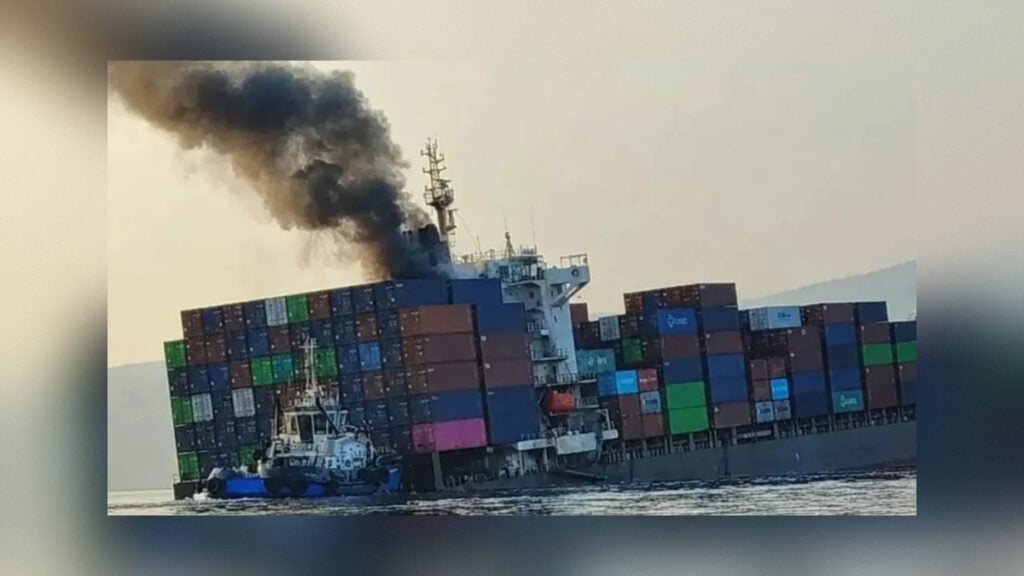
One of the ships was the Singapore-flagged GFS Pride, a small container vessel with a capacity of 2,824 twenty-foot equivalent units (TEU). The Maritime and Port Authority of Singapore said in a statement on Wednesday that the vessel caught fire after an attack on Tuesday and subsequently sank.
All 21 crew members were safely evacuated. Although the successful evacuation prevented further loss of life, the incident highlighted the dangers faced by commercial shipping amid the continuing conflict.
The second vessel was the Antigua and Barbuda-flagged Cape Dao. According to information held by the International Maritime Organization (IMO), the ship was struck by a projectile on 23 September. One crew member was killed in that incident, while the remaining personnel were evacuated safely.
The vessel subsequently sank near the Strait of Hormuz. Its management was handled by Pioneers Shipmanagement FZE, a company based in the United Arab Emirates. The company did not immediately comment on the reported sinking.
Growing toll on commercial shipping
Records maintained by the IMO have documented ship sinkings in the region since the war began on 28 February. According to the information cited in the report, the GFS Pride and the Cape Dao were the second and third vessels to sink during the conflict.
The incidents underline the growing risks to commercial shipping in waters that are essential to international trade. The Strait of Hormuz connects the Persian Gulf with the Gulf of Oman and the wider Arabian Sea, making it a critical passage for oil and other energy shipments from major Gulf producers to global markets.
Any sustained disruption to traffic through the strait could have consequences far beyond the immediate conflict zone. Shipping companies may face higher insurance premiums, increased operating costs and pressure to reconsider routes or delay voyages. Disruptions could also affect the reliability of energy supplies and contribute to volatility in international oil prices.
For countries heavily dependent on imported energy, prolonged instability in the region could translate into higher import bills and additional pressure on domestic fuel prices. The extent of any impact would depend on the scale and duration of the disruption, as well as the availability of alternative supplies and transport arrangements.
The latest incidents have also raised questions about the effectiveness of existing maritime security measures. Establishing responsibility for individual attacks remains essential, particularly when competing claims emerge during an active conflict. Without clear evidence, it remains difficult to determine whether the incidents form part of a coordinated strategy or represent separate episodes of violence.
For now, the combination of ship sinkings, unexplained fires, military operations and rising tensions has left commercial shipping facing an increasingly uncertain environment. Whether the situation leads to a sustained disruption of the Strait of Hormuz will depend on developments on the battlefield, the response of the United States and its regional partners, and the prospects for reducing tensions with Tehran.