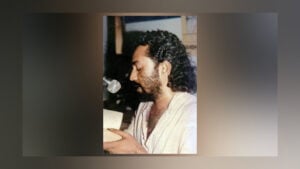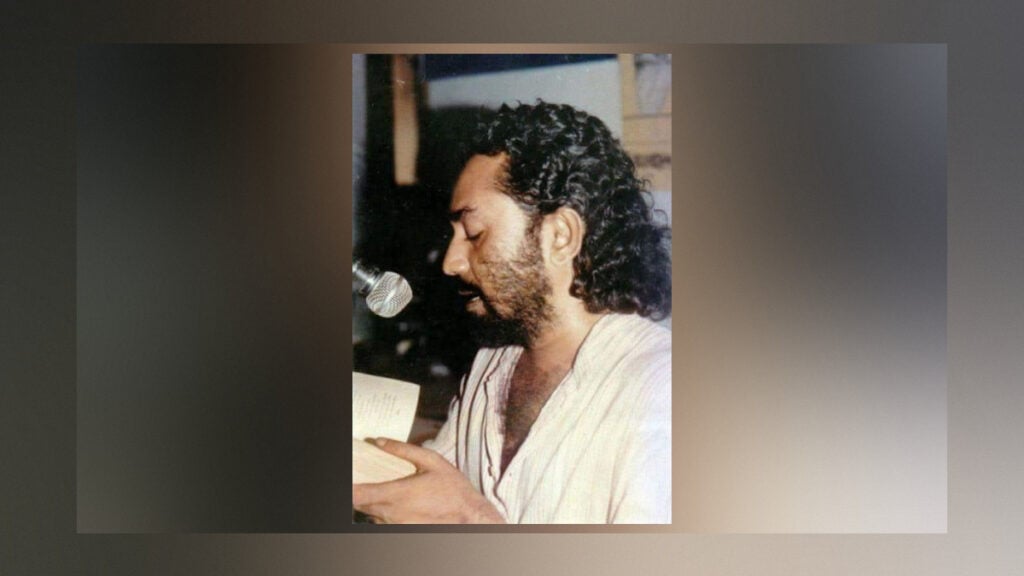
Some stars in the sky of Bengali literature shine far beyond their own time, illuminating the minds and hearts of generations to come. Rudra Mohammad Shahidullah was one such figure—a fiery, passionate poet whose work brought together love and rebellion, dreams and sorrow, human aspirations and resistance to oppression. He was a fearless voice of youth, an uncompromising critic of injustice and a distinctive presence in modern Bengali poetry.
Born on 16 October 1956 and passing away on 21 June 1991, Rudra left behind a literary legacy that continues to resonate with readers. On the occasion of his birth anniversary, he is remembered with profound respect as a poet who transformed personal emotion and collective anguish into powerful expressions of love, dissent and humanity.
Poetry Fueled by Love, Rebellion and Conscience
Rudra began writing poetry during a period of considerable social and political upheaval in Bangladesh. The country was still grappling with the promises and disappointments of independence, while aspirations for freedom, resistance to authoritarianism and concerns about social injustice shaped public life. His poetry emerged from this turbulent landscape, giving voice to the hopes and frustrations of a generation unwilling to accept injustice in silence.
During the 1980s, Rudra became one of the poets whose recitations and powerful delivery captured the imagination of young people. His words were direct, emotionally charged and accessible, yet they carried a depth that extended well beyond their apparent simplicity. His poetry did not merely seek beauty in language; it challenged readers to question their surroundings, confront uncomfortable truths and remain attentive to the suffering of others.
One of his widely recognised poetic passages reflects the disillusionment that followed the struggle for independence:
“The field from which the call for freedom arose,
has now become a marketplace for narcotics.”
The lines evoke the painful contrast between the ideals that inspired the Liberation War and the social realities that emerged afterwards. They express disappointment at the erosion of those aspirations and a longing for a society founded on justice, dignity and equality.
For Rudra, independence was not simply the achievement of territorial sovereignty. It also carried the promise of a more humane social order, one in which people could live with dignity and without exploitation. His poetry repeatedly returned to the gap between that promise and the realities confronting ordinary people.
His celebrated poem Batase Lash-er Gandha (The Smell of Corpses in the Air) offers an equally haunting expression of violence, death and endangered humanity. Its title evokes a world in which the consequences of bloodshed have become almost inseparable from everyday life. The image of death lingering in the air becomes a metaphor for a society haunted by violence and the unresolved wounds of its history.
The words, “Even today, I smell the stench of corpses in the air,” carry a force that reaches beyond the poet’s personal experience. They suggest an enduring moral reckoning with violence, a cry from the conscience and a search for truth and justice amid suffering.
The continued relevance of such imagery lies in its refusal to allow the past to disappear into comfortable silence. Rudra’s poetry asks readers to consider the human cost of political conflict and the responsibility of each generation to confront injustice rather than become accustomed to it.
A Short Life, an Enduring Literary Legacy
Rudra Mohammad Shahidullah was born on 16 October 1956 in Barishal, where his father was posted at the time. His ancestral home was in Mithakhali village in Mongla, Bagerhat district.
His interest in literature and culture developed early. He attended Dhaka West End High School, completing his secondary education in 1973, before passing his higher secondary examinations in 1975. He subsequently studied Bengali at the University of Dhaka, where he completed both his honours degree and postgraduate studies.
Despite his relatively short life, Rudra established a distinctive place in Bengali literature. His writing reflected an unusual ability to move between intimate personal feelings and wider social concerns, combining lyrical sensitivity with an uncompromising awareness of injustice.
Among his notable poetry collections are Upadruto Upakul, Fire Chai Swarnagram, Manusher Manchitra, Chobol, Golpo and Diyechhile Shokol Akash. These works reflect different dimensions of his creative personality, from the vulnerability of the individual to the struggles of people living amid social and political uncertainty.
His contribution was not confined to poetry. He also wrote stories, verse dramas and songs, demonstrating a creative range that extended across several literary forms.
One of his best-known songs, Bhalo Achhi Bhalo Theko, remains particularly cherished. Its emotional appeal rests on its gentle expression of affection, separation and remembrance. The song continues to evoke the bittersweet feelings associated with love and loss, offering a softer counterpoint to the anger and defiance that characterise much of his poetry.
This combination of tenderness and rebellion is central to Rudra’s literary identity. He could express the delicate emotions of a lover with the same intensity with which he condemned exploitation and social decay. His work therefore resists any narrow categorisation. He was neither exclusively a poet of romantic longing nor solely a voice of political protest. He was both, and his writing drew much of its power from the tension between these dimensions.
In Rudra’s hands, love was not detached from the world beyond the individual. Human affection, personal freedom and social justice often appeared as interconnected aspirations. The ability to express such concerns without losing the emotional immediacy of poetry helped distinguish him from many of his contemporaries.
Personal Relationships and the Pain of Separation
Rudra’s personal life also attracted public attention, particularly his marriage to writer Taslima Nasrin. The couple married in 1981, and their marriage ended in 1986.
Although this chapter of his life has remained a subject of discussion, his literary significance extends far beyond the details of his relationships. His enduring importance rests primarily on the quality of his writing, his interpretation of the society in which he lived and his commitment to human freedom.
Personal sorrow frequently found expression in Rudra’s poetry, but it rarely remained confined to the boundaries of individual experience. Love, disappointment, longing and separation became emotions through which readers could recognise aspects of their own lives.
This capacity to turn private pain into a shared human experience is one of the defining strengths of his work. His poems can feel deeply personal while simultaneously speaking to wider questions of identity, dignity and the fragility of human relationships.
His romantic writing does not simply celebrate love as an idealised emotion. It also acknowledges its uncertainties, its wounds and the memories that survive after relationships have ended. In this respect, his poetry captures the contradictions of human experience with unusual directness.
A Voice That Death Could Not Silence
Rudra Mohammad Shahidullah died on 21 June 1991, at the age of 34, leaving behind a profound sense of loss in Bangladesh’s literary community. His death brought an end to a life of considerable creative promise, but it did not diminish the power of his work.
His poems, songs and recordings of recitations continue to reach new audiences. For younger readers, his writing offers both an introduction to a distinctive poetic voice and an invitation to question the social realities around them.
His work remains relevant because the concerns at its heart have not lost their urgency. The relationship between freedom and responsibility, the persistence of inequality, the consequences of political violence and the importance of human dignity continue to shape public debate. Rudra’s poetry provides a language through which these concerns can be examined and felt.
In Mithakhali, his ancestral village in Mongla, Bagerhat, the Rudra Smriti Sangsad has been established to preserve his memory and literary heritage. Such efforts help maintain a connection between the poet’s life, his work and the communities that continue to honour him.
His contribution to Bengali literature also received formal national recognition when the Government of Bangladesh awarded him the Ekushey Padak posthumously in 2024. The honour acknowledged his lasting contribution to the country’s cultural and literary life.
Yet official recognition represents only one aspect of a poet’s legacy. Rudra’s more enduring achievement lies in the continuing affection of his readers, the emotional force of his writing and his ability to make successive generations reflect on the relationship between art, conscience and society.
Remembering a Poet of Defiance and Humanity
Rudra Mohammad Shahidullah’s poetry reminds us that independence is more than the possession of a homeland. It also embodies the promise of dignity, rights, freedom of thought and justice. A nation may win its political freedom, but preserving the ideals that inspired that struggle remains an ongoing responsibility.
On his birth anniversary, Rudra deserves to be remembered as a poet who knew how to love deeply, dream boldly and protest fiercely when those dreams were betrayed. His rebellious voice continues to challenge complacency, while his poems of love and separation retain their power to move readers with their tenderness and melancholy.
He understood that poetry could be both an expression of the heart and an act of resistance. His words could comfort those experiencing personal loss while confronting a society that had grown indifferent to suffering. That dual capacity gave his writing its distinctive emotional and moral force.
Rudra is no longer here to recite his poems, but his voice survives in the words he left behind. His questions continue to trouble the conscience; his defiance continues to offer courage in the face of injustice; and his songs continue to stir memories of love, longing and the passage of time.
As long as the people of Bangladesh cherish the promise of freedom, challenge injustice and seek a more humane society, Rudra Mohammad Shahidullah will remain a relevant and compelling presence in the nation’s literary imagination.
On his birth anniversary, we offer our deepest respect to a poet whose work united rebellion with tenderness, protest with compassion and personal emotion with the collective aspirations of a people.
The poet may be gone, but his words remain alive—in the air, in the memory of his readers and in every voice that refuses to remain silent in the face of injustice.