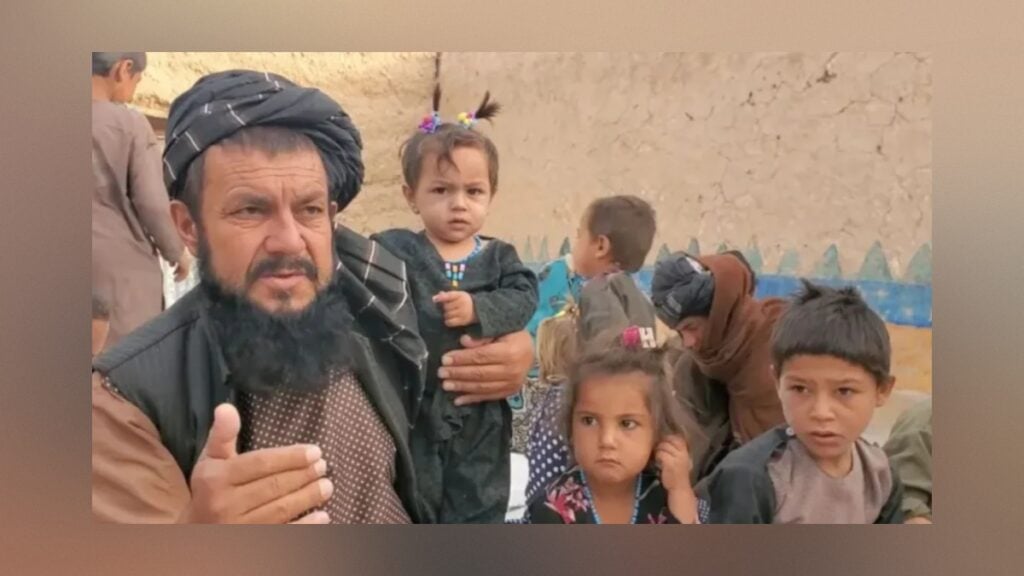
The family’s circumstances were highlighted in a report by Khaama Press Agency published on Tuesday, 20 October. The account illustrates the daily challenges faced by Sadiq as he tries to provide food, shelter and education for his children with an income that falls far short of what the household requires.
Sadiq has also spoken about the difficulties of managing such a large family. Remembering every child’s name is not always easy, he said. Sometimes, when the family gathers for a meal, he counts the children to check whether everyone is present. On occasion, he discovers that one is missing because the child is elsewhere.
According to the report, Sadiq and his wives have lost 14 children over the years, adding another painful dimension to the family’s history.
Meagre Earnings Struggle to Cover Household Costs
Sadiq works at a car showroom, where he earns around 1,000 Afghanis whenever a vehicle is sold, according to his account. His earnings are insufficient to cover the needs of a household comprising dozens of children and four wives.
To help make ends meet, several of his children also work. Some collect paper and plastic to be used as fuel. Their contribution reflects the financial pressure on the household, where even basic necessities remain difficult to secure.
The family generally prepares two meals a day: breakfast and dinner. Two of Sadiq’s wives take responsibility for cooking. During winter, family members eat together inside the house, while in summer they gather in the courtyard.
Providing enough food for everyone is not always possible. The shortage of money means that some children sometimes go to sleep hungry, according to the report.
The family’s living conditions are equally challenging. Sleeping arrangements are inadequate, and six or seven people sometimes have to share a single thin blanket. Such overcrowding can make it difficult for family members, particularly children, to obtain sufficient rest and maintain personal comfort.
The house itself lacks conventional doors and windows in its rooms, with thin curtains used in place of doors. The bathing area also serves as a place to wash clothes and dishes and is sometimes used as a toilet.
These conditions raise concerns about privacy, sanitation and the difficulties of maintaining a hygienic living environment for such a large number of people.
Education Remains a Major Challenge
Despite the family’s financial difficulties, Sadiq has tried to send his children to school. However, the cost of education remains a significant obstacle.
Supporting dozens of children through education requires money for school supplies, clothing and other essential expenses. When household income is already insufficient to provide regular meals, meeting these costs becomes particularly difficult.
Some of Sadiq’s children have taken up work to help support the family. Balancing these responsibilities with education may therefore be challenging. Without adequate support, children from financially vulnerable households can face barriers to regular schooling and the opportunities that education can provide later in life.
Sadiq himself cannot read or write. Nevertheless, he wants his children to have access to education and hopes they will be able to build better futures than the circumstances in which they are growing up.
Religious Motivation Behind His Large Family
Sadiq said his decision to have a large family was motivated by a desire to increase the number of followers of the Prophet Muhammad (peace be upon him). However, he has acknowledged the practical difficulties associated with raising so many children.
The scale of his family has occasionally led to embarrassing moments. According to the report, he once mistakenly gave a different girl’s name when speaking to a religious leader at a wedding ceremony.
He also frequently addresses his children as “my son” or “my child” when he cannot recall their individual names.
The report states that Sadiq was 20 when he married for the first time. He said he had to save money before each subsequent marriage to meet the financial requirements associated with the bride’s marriage payment or mahr.
His four wives were between 13 and 16 years old when they married him, according to the report. Their ages at marriage raise concerns about child marriage and the wider social and health implications of girls entering marriage during adolescence.
Concerns Over Child Marriage and Maternal Health
Child marriage can disrupt girls’ education, limit their independence and expose them to significant health risks, particularly when pregnancy occurs at a young age.
Adolescent pregnancy is associated with increased risks for both mothers and babies. Repeated pregnancies can also place considerable physical demands on women, especially when they have limited access to adequate nutrition, medical supervision and postnatal care.
Access to healthcare remains a challenge in various parts of Afghanistan, particularly in remote communities. Limited medical facilities and financial constraints can make it harder for families to obtain essential maternal and child health services.
The report does not provide detailed medical information about Sadiq’s wives, so their individual health circumstances remain unclear. However, the family’s situation highlights broader concerns about access to healthcare, reproductive health information and support for women and children in economically disadvantaged communities.
Appeal for Government and Humanitarian Support
Sadiq has appealed to the Afghan government, aid organisations and businesspeople for assistance in supporting his family. His immediate priorities are straightforward: ensuring that his children have enough food and giving them the opportunity to receive an education.
The challenges facing his household extend beyond the number of people it contains. Limited income, inadequate sleeping arrangements, poor sanitation and restricted access to education combine to make daily life difficult.
For children, growing up in such circumstances can mean going without basic necessities and facing obstacles to their development. Assistance with food, housing, education and healthcare could help ease some of the pressures on the family.
Sadiq’s story offers a glimpse into the difficulties of raising a very large family with limited resources. It also highlights the importance of access to education, maternal healthcare and support for vulnerable households.
For now, his hopes remain focused on the essentials: enough food for everyone at home and the chance for his children to attend school. Whether those hopes can be realised will depend in part on the assistance available to a family struggling to meet even its most basic needs.