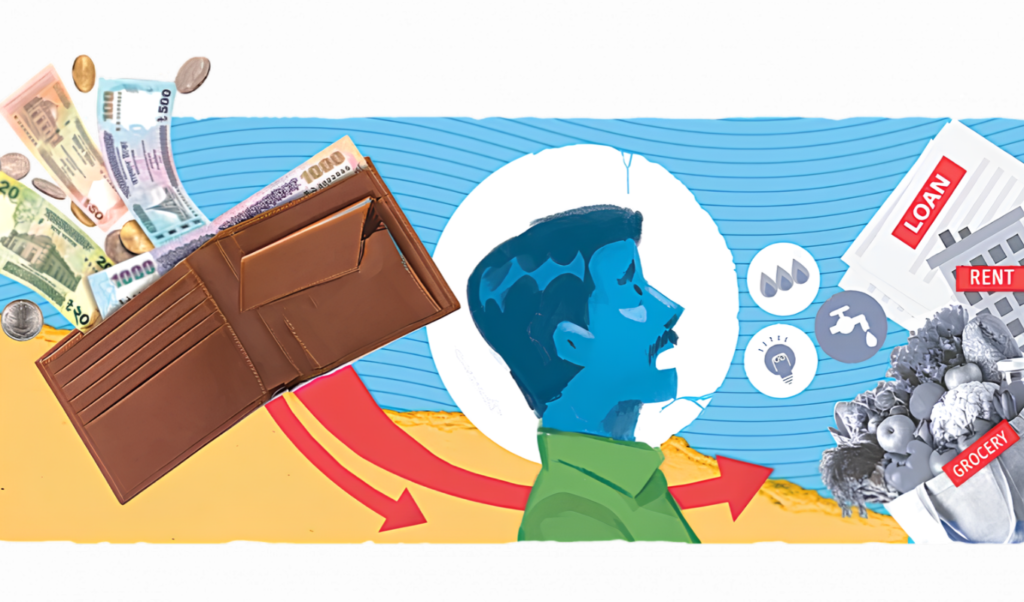
Salaried employees across Dhaka are finding it increasingly difficult to survive on their monthly earnings, with skyrocketing living costs forcing many to deplete their savings and resort to high-interest loans long before the month ends.
Anas Ahmed, a private sector employee in the capital, aims to save 5,000 taka each month. In reality, relentless daily expenses force him to dip into those funds routinely. By the 25th of most months, his account runs empty. To survive the remaining days, he borrows between 5,000 and 10,000 taka through mobile financial service platforms. These loans come with three-month repayment tenures and steep interest rates. Clearing them from the next month’s salary severely strains his upcoming budget.
“Every day expenses are rising, but our salaries remain stagnant,” Anas explained. “Our company gives an annual increment of 2,000 to 4,000 taka at best, which is nowhere near enough to offset the rising cost of living.”
Niloy, another corporate employee, shared similar frustrations. He noted that prices are climbing at such a pace that taking on a secondary source of income feels essential. Finding the time or realistic opportunity to work a second job alongside a demanding primary career, however, is a formidable hurdle.
Anas and Niloy reflect a broader trend across urban Bangladesh, where middle- and lower-income households are pushed into financial vulnerability.
Official macroeconomic statistics confirm the daily struggles of consumers. According to the Bangladesh Bureau of Statistics (BBS), overall inflation rose to 8.34 percent in September 2026, up from 8.26 percent in August. Food inflation surged from 7.02 percent to 7.22 percent during the same period, while non-food inflation edged down slightly from 9.32 percent to 9.3 percent.
For the twelve months leading up to September 2026, the average inflation rate stood at 8.65 percent, compared to 9.45 percent in the preceding twelve-month period. A moderating inflation rate does not mean prices are dropping; it simply indicates that prices are rising at a slightly slower pace. Consequently, families continue to pay significantly higher prices for basic goods and services.
Mahtab Uddin, an assistant professor of economics at the University of Dhaka and honorary research director at the South Asian Network on Economic Modelling (SANEM), highlighted the policy missteps behind this ongoing crisis. He noted that while nations such as the United Kingdom and India raised interest rates aggressively to curb inflation, domestic monetary controls were neither tightened sufficiently nor deployed in a timely manner. Continuous liquidity support to struggling banks and expansive fiscal spending amplified inflationary pressures.
He added that structural weaknesses in tax collection and heavy spending on mega infrastructure projects strained public finances further, making inflation control even more difficult for authorities.
Inflation inevitably strikes low-income households hardest because food and utilities devour the majority of their income. When real wages fail to keep pace with inflation, families are forced into painful compromises. Households cut back on nutrient-dense foods like meat, fish, and fresh fruit, or slash spending on their children’s education. These choices have long-term consequences on public health, educational attainment, and socio-economic mobility.
The BBS Wage Rate Index indicates that national wage growth stood at 7.9 percent in September 2026. With general inflation at 8.34 percent, wage growth trailed inflation by 0.44 percentage points. Average income growth is failing to match the rising cost of living.
The strain extends beyond full-time workers to students reliant on family allowances. Abdullah Al Mahmud, a private university student, spends at least 200 taka daily on fuel for his motorcycle, while commuting via the Metro Rail costs 240 taka. Every journey requires strict financial calculation. Mahmud observed that many of his peers regularly borrow money toward the end of the month, only to repay it upon receiving their allowances, plunging straight back into deficit.
Mahtab Uddin noted that weak collective bargaining power prevents workers from demanding wage adjustments. Unlike workers in the UK who organize sector-wide strikes for fair pay, Bangladeshi employees lack organized representation. In a labor market where labor supply vastly exceeds demand, securing inflation-indexed pay increases remains exceptionally difficult.
Discretionary spending also plays a role. Untracked daily micro-expenses—such as dining out, online shopping, or casual tea breaks—accumulate rapidly. A modest expenditure of 100 taka per day adds up to 3,000 taka over a month.
Budgeting alone cannot resolve structural wage deficits. Data from the International Monetary Fund’s (IMF) October 2026 Asia and Pacific Regional Economic Outlook revealed that youth unemployment among tertiary-educated individuals in Bangladesh stands near 29 percent. Furthermore, automation and artificial intelligence could erode total labor demand by an additional 2 percent.
Personal financial management can help mitigate some immediate pressure. Mumitul Mimma, a Dhaka-based journalist, managed to curb impulse spending by maintaining a strict expense journal. Tracking every purchase enabled her to identify unnecessary outlays and structure a realistic budget.
Similarly, Manjura Akter, a teacher at Mohammadpur Government High School, emphasized the importance of saving first rather than saving what remains. She advised setting aside funds immediately upon receiving salary payments into monthly deposit schemes or pension accounts, alongside maintaining a dedicated emergency buffer.
Practical budgeting strategies offer valuable tools, but their efficacy depends on earning a living wage. When essential costs like rent, basic food, and transport exhaust an entire paycheck, budgeting cannot substitute for structural economic reform, wage growth, and effective inflation control.