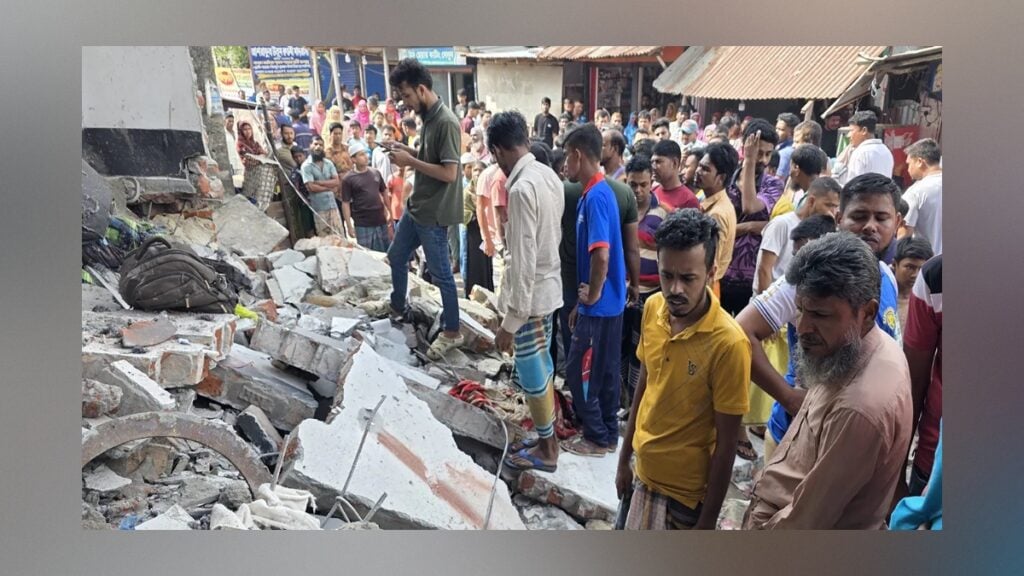
The incident occurred at around 7.15am on 30 October at a three-storey building in the Naojor area of Gazipur. The victim, identified as Sakib, died at the scene following the explosion, which caused extensive damage to the doors and windows of the room above the septic tank.
Sakib was originally from Bauphal upazila in Patuakhali district. He worked at a local garment factory and lived in a rented room on the ground floor of the building.
According to local residents and Fire Service officials, most of the construction work on the three-storey building had been completed. However, a room built directly above the septic tank had been rented out to garment workers as accommodation.
Sakib and his roommates were inside the room on Friday morning when a loud explosion suddenly occurred. Initial assessments suggest that gases accumulated inside the septic tank may have triggered the blast. The force of the explosion was strong enough to leave the room’s doors and windows badly twisted and damaged.
The incident caused panic in the surrounding neighbourhood. Local residents alerted the emergency services, prompting a rapid response from firefighters.
A team from the Gazipur Chowrasta Modern Fire Service station arrived at the scene shortly after receiving the report and began rescue operations.
Rajib Hossain, a warehouse inspector at the Fire Service, confirmed the incident. He said the preliminary assessment indicated that gas accumulated inside the septic tank had caused the explosion. He also pointed out that a room had been constructed over the tank and rented out for residential use.
Following the rescue operation, firefighters recovered Sakib’s body and handed it over to Basan Police Station for the necessary legal procedures.
Officer-in-Charge of Basan Police Station Harun-or-Rashid said the body had been sent to the mortuary of Shaheed Tajuddin Ahmad Medical College Hospital for a post-mortem examination.
The two injured individuals were receiving treatment at a local clinic. Their identities and the extent of their injuries were not immediately disclosed.
Police said an investigation was under way to establish the precise circumstances surrounding the explosion. The possibility of accumulated gas inside the septic tank triggering the blast is being considered as part of the initial assessment. Further findings are expected after the investigation.
Safety concerns over septic tank construction
The incident has raised concerns about safety standards in residential buildings, particularly in densely populated industrial areas such as Gazipur, where thousands of garment workers live in rented accommodation close to their workplaces.
Septic tanks are used to collect and treat domestic wastewater. During the decomposition of organic waste, gases such as methane and hydrogen sulphide can be produced. Methane is highly flammable and can create an explosion risk if it accumulates in an enclosed space and comes into contact with an ignition source. Hydrogen sulphide, meanwhile, is toxic and can pose serious health risks.
Proper ventilation, appropriate construction standards and regular maintenance are essential to reducing these hazards. Septic tanks also require safe access arrangements and should not be treated as ordinary spaces suitable for residential construction without proper technical assessment.
For workers who move to industrial centres in search of employment, affordable accommodation is often a major concern. However, low-cost housing can become dangerous when buildings are constructed or converted without adequate attention to structural and environmental safety.
The death of Sakib has once again highlighted the importance of ensuring safe living conditions for industrial workers. Investigators will now need to establish whether construction practices, the placement of the rented room or inadequate safety arrangements contributed to the tragedy.