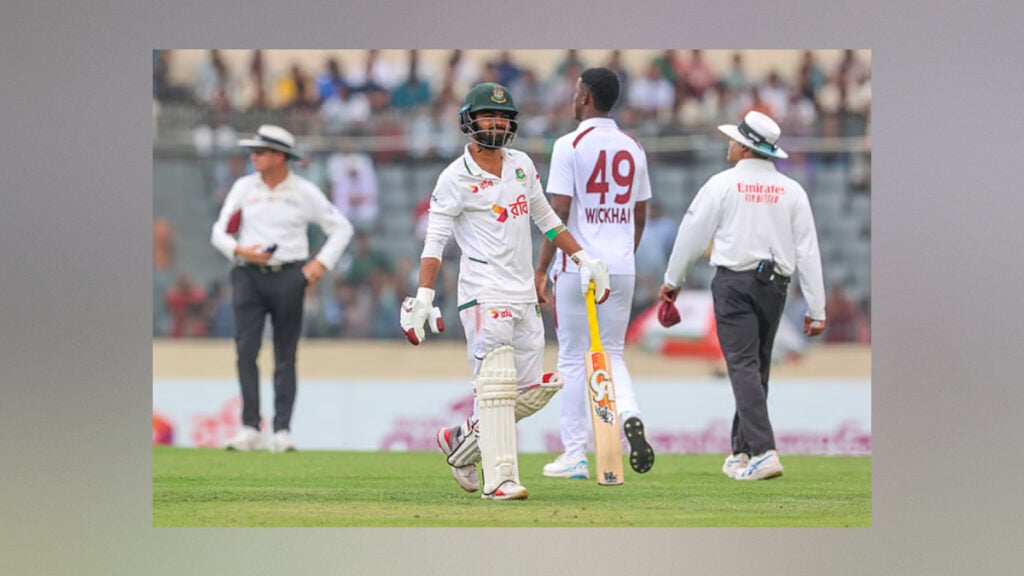
Bangladesh’s defeat to the West Indies in the Mirpur Test has raised serious questions about more than the performances of captain Najmul Hossain Shanto, Litton Das and their team-mates. Indecision, inadequate preparation and questionable planning all contributed to the disappointing result. While the players struggled on the field, decisions taken by the team management and the Bangladesh Cricket Board (BCB) before the match also came under scrutiny.
Over the past year, Bangladesh had begun to identify a more convincing approach to Test cricket. The plan was to play on sporting pitches, give the batters an opportunity to build competitive totals and then rely on the pace attack to put opposition sides under pressure. Spinners remained part of the strategy, but fast bowling had increasingly become one of Bangladesh’s principal strengths in the longest format.
Bangladesh’s batters, too, had generally appeared more comfortable against pace than spin. Statistics from Mirpur over the previous five years illustrate the difference, albeit a relatively narrow one. Bangladeshi batters had lost 80 wickets to spin bowling during that period, compared with 73 against pace.
The latest Test against the West Indies exposed that vulnerability once again. Of Bangladesh’s 20 wickets across the two innings, 16 fell to West Indian spinners. The figures underlined how effectively the visitors exploited a weakness that has troubled Bangladesh for some time.
Captain Najmul’s own comments reflected the uncertainty surrounding his side’s ability to handle different types of bowling. Asked whether Bangladesh’s batters were more comfortable against spin or pace, he replied: “Sometimes they play spin well, sometimes pace.”
That answer raised an obvious question: why did Bangladesh opt for a spin-friendly surface at Mirpur when their batters have repeatedly struggled against that type of bowling?
Najmul was asked about the pitch selection several times. His response remained broadly consistent: the decision had been made after considering the strengths and weaknesses of both teams. That explanation may have been accurate, but it did little to address concerns about when the decision was taken and how thoroughly the team had prepared for the conditions.
There were indications before the match that the management had spent considerable time debating the nature of the surface. The initial preference appeared to be for a sporting wicket, but the final preparation moved towards a more spin-friendly track. Such a late shift suggested that the planning process lacked clarity and sufficient preparation.
The outcome made the decision even harder to justify. Although the surface was expected to assist spin, Bangladesh’s bowlers struggled to make the most of it. Even on the fourth day, West Indian batters appeared reasonably comfortable against the home side’s spinners.
After the match, Najmul acknowledged that his bowlers had failed to identify the correct lengths consistently. Had they managed to do so, he suggested, Bangladesh could have applied greater pressure on the visitors.
This exposed a fundamental contradiction in the home side’s approach. Bangladesh’s batters were vulnerable against spin, while their own spinners failed to dominate on a surface prepared to offer them assistance. The decision to pursue spin-friendly conditions therefore raises legitimate questions about whether the team had the necessary skills and preparation to benefit from them.
Preparation was another significant concern. Six members of Bangladesh’s playing XI had been involved in a tri-nation series in the United Arab Emirates, featuring Afghanistan and Zimbabwe, before returning for the Mirpur Test. Once they arrived in Bangladesh, the entire squad had only two days of collective training.
That left little time for players to recover, work on their technique or adjust to the conditions expected in the Test. The situation was made more complicated by the involvement of several cricketers in the auction for a domestic tournament. Some players reportedly hurried from the event to join the team’s training session.
Their subsequent performances also raised questions about their readiness for the demands of Test cricket. A number of batting decisions, particularly shots played without adequately assessing the match situation, suggested a lack of composure and judgement. Test cricket requires patience, concentration and an understanding of changing conditions. Those qualities appeared to be missing at crucial moments.
International cricket has become increasingly congested, leaving teams with limited opportunities for rest and preparation. However, managing players’ workloads and establishing priorities are essential responsibilities for any cricket board.
The West Indies Test series should have been a major priority for Bangladesh. Winning both matches would have strengthened the country’s prospects of reaching the World Test Championship final. With such an important opportunity at stake, the scheduling and preparation of the Test squad deserved particular attention.
Instead, several players had to return from the intense heat of the UAE after playing matches in the tri-nation series just two days before the Test began. They were given little opportunity to recover before being expected to compete in the longest format.
The tri-nation tournament involving Afghanistan and Zimbabwe was not part of the ICC’s Future Tours Programme. This meant the BCB had some flexibility to reconsider its scheduling arrangements. Given the importance of the West Indies series, the board could have considered resting key Test players from the UAE competition and allowing them to concentrate on the home series.
That opportunity was not taken. The scheduling concerns were compounded by a series of administrative decisions that further unsettled the preparations.
The BCB organised the auction for the Domestic Three Trophy just two days before the Test began. The presence of several cricketers at the event attracted attention, particularly given the importance of the upcoming international fixture. The timing raised questions about whether the board had adequately considered the players’ immediate responsibilities.
There was also an unexpected change within the coaching staff. Mohammad Ashraful, who had conducted the team’s batting practice on the morning of the session, was removed from his position later that afternoon, just three days before the Test.
Mohammad Salahuddin was subsequently given responsibility. He had previously stepped away from the national team setup to concentrate on his work with the High Performance programme.
The timing of the appointment raised questions about the board’s decision-making process and the stability of the coaching arrangements. A sudden change in batting personnel shortly before an important Test series could hardly have helped establish continuity in the team’s preparation.
Salahuddin’s own remarks added to the uncertainty. Asked how long he would remain in the role, he responded: “If I were outside the board, I could tell you many things.”
His comment offered a glimpse of the unease surrounding the appointment and raised further questions about the circumstances in which the decision had been made.
Bangladesh’s progress in Test cricket over the previous year had offered reasons for optimism, even though the journey towards becoming a consistently competitive side remained far from complete. The emerging approach, built around sporting pitches, improved batting contributions and an increasingly effective pace attack, had provided a possible foundation for future development.
Taking that approach to the next level could have represented a significant milestone for the country’s Test cricket and offered encouragement to the next generation of players.
Instead, the defeat in Mirpur exposed weaknesses across several areas. The batters failed to cope with spin, the bowlers could not consistently exploit the conditions, and the team appeared inadequately prepared for a series of considerable importance. Decisions concerning scheduling, pitch preparation and coaching appointments also deserve closer examination.
There is no question that the players must accept responsibility for their performances. Najmul, Litton and the rest of the batting line-up will need to address their technical and tactical shortcomings. The bowlers, too, must learn to execute their plans more effectively.
But holding the players solely responsible would provide an incomplete explanation of what happened. A team’s performance is shaped not only by those who take the field but also by the planning, preparation and decisions of the people responsible for managing it.
The BCB and the team management must therefore examine their own roles in the defeat. Bangladesh had an important opportunity to strengthen its position in Test cricket, but a combination of poor preparation, indecision and questionable management decisions appears to have allowed that opportunity to slip away.