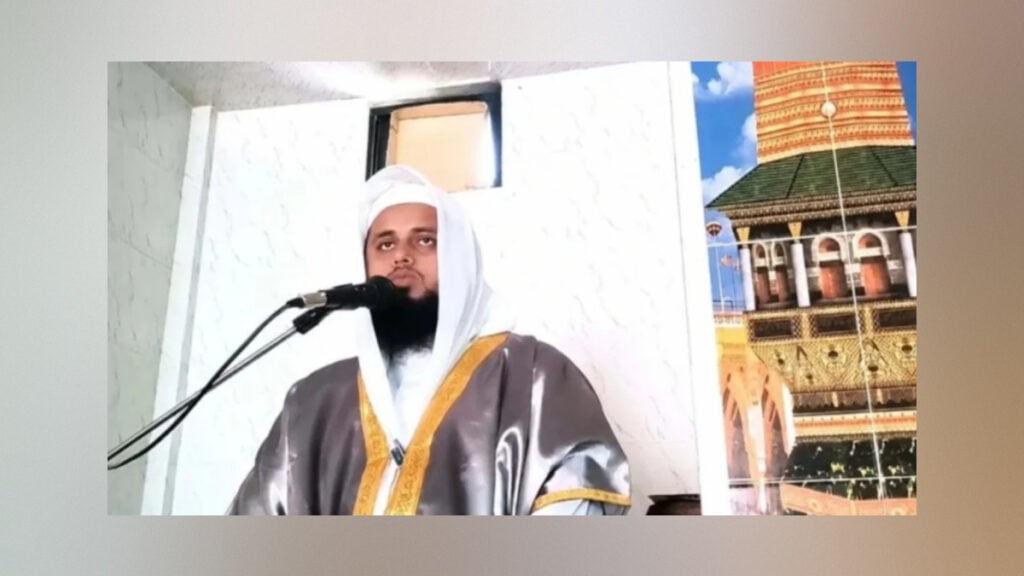
A mosque committee in Nandail, Mymensingh, has removed its imam from his position following remarks in a Friday sermon in which he described former Prime Minister Sheikh Hasina as an ‘autocrat’. The decision has prompted mixed reactions among local residents and worshippers, with some questioning the committee’s action and others raising concerns about political comments during religious sermons.
The imam, Maulana Mojahidul Islam, served at Baitul Mahfuz Purabaria Mor Jame Mosque in Nandail municipality. According to local sources, the incident took place during the Friday sermon on 23 October, when he was discussing the history and heritage of idols and sculptures and how Muslims should respond to them.
During his discussion, Mojahidul referred to a sculpture of Sheikh Mujibur Rahman and made a remark describing his daughter, former Prime Minister Sheikh Hasina, as an ‘autocrat’. His comments subsequently drew objections and criticism. Following the controversy, the mosque committee decided to relieve him of his responsibilities.
The matter gained wider attention after details of the incident circulated on social media, triggering debate within the local community.
Local resident Abdus Salam criticised the committee’s decision, arguing that an imam’s responsibilities extend beyond leading prayers and include speaking about matters he considers important. He said that anyone who disagreed with Mojahidul’s remarks could have raised their concerns through discussion rather than seeking his immediate removal.
Kamal Hossain, a regular worshipper at the mosque, also expressed reservations about the decision. He said relations between the Awami League government and sections of the country’s religious scholars had been strained, contributing to resentment towards the party and Sheikh Hasina among some members of the religious community. Against that background, he suggested, the imam might have made the remarks. However, he did not believe the controversy justified removing him from his position.
Mojahidul confirmed that he had been relieved of his duties but denied having any formal association with a political party. He maintained that his reference to Sheikh Hasina was an example used while discussing the subject of his sermon, rather than an attempt to promote a particular political position.
He also accused mosque committee president Ferdous Bhuiyan of acting out of political hostility. According to Mojahidul, the president was associated with Awami League politics and had used the controversy as a reason to remove him. The allegation, however, has been firmly rejected by the committee president.
Ferdous Bhuiyan offered a different account of the circumstances surrounding the decision. He alleged that Mojahidul was associated with Jamaat-e-Islami and said the imam’s remarks about Sheikh Hasina had caused dissatisfaction among some worshippers. The comments prompted criticism within the congregation, he said, leading the committee to convene a meeting to discuss the matter.
According to Ferdous, the committee members unanimously agreed to remove Mojahidul from his responsibilities. He rejected the suggestion that he had taken the decision independently, describing the allegation as entirely false.
The controversy has also drawn comments from Advocate AHM Khalequzzaman, president of the Mymensingh District Human Rights Commission. He said tensions between the Awami League government and sections of the country’s religious scholars had developed over various issues during the party’s 17 years in power, beginning with the Shapla Chattar incident.
Such tensions, he suggested, may have contributed to resentment towards the Awami League and Sheikh Hasina among some religious scholars. He said Mojahidul’s remarks could be understood against that broader political background.
However, Khalequzzaman questioned the decision to remove the imam solely over his comments. In his view, the mosque committee could have addressed the matter through discussion with Mojahidul rather than taking immediate disciplinary action.
The incident has brought renewed attention to the relationship between religious institutions, political expression and the responsibilities of mosque committees. Friday sermons are primarily intended for religious guidance, but they can also become platforms for discussing social and political issues. Disagreements over such remarks can create tensions within congregations, particularly when political affiliations and differing interpretations of public events come into play.
In Nandail, the conflicting accounts offered by the imam and the mosque committee have added another dimension to the dispute. While the committee maintains that its decision followed a unanimous discussion among members, Mojahidul alleges that political motives were behind his removal. The differing positions have left the local community divided over whether the committee’s action was justified or whether the matter should have been resolved through dialogue.