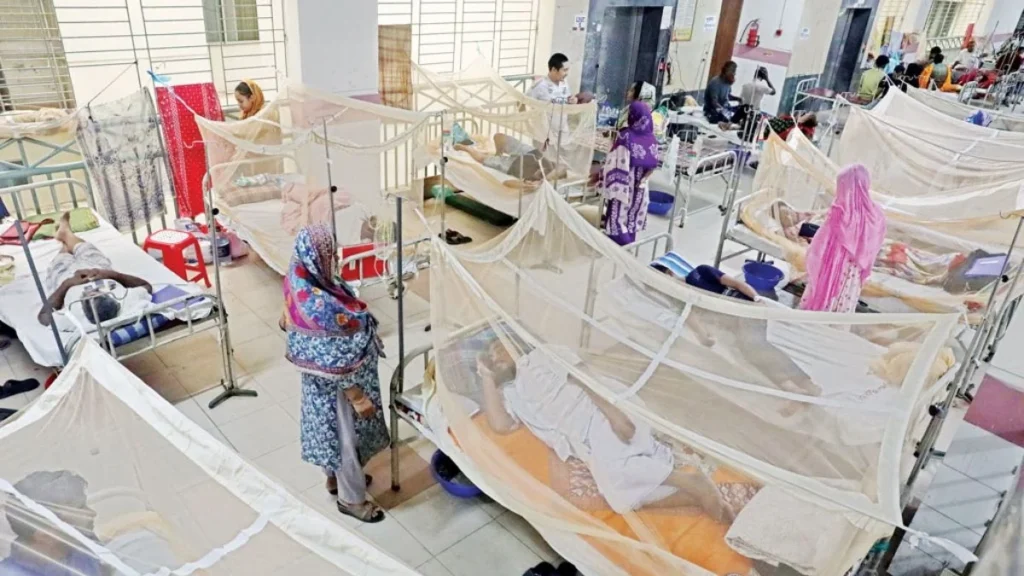
Bangladesh faces a growing public health challenge as vector-borne infection rates continue to climb across the country. According to the latest figures released by the Directorate General of Health Services (DGHS) on Monday, 2 November, six more patients succumbed to dengue fever in the preceding 24 hours. Over the same timeframe, healthcare facilities admitted 1,970 newly infected individuals, bringing the cumulative hospital admissions for the current year to 138,899.
Data compiled by the Health Emergency Operation Centre and Control Room under the DGHS indicates that transmission remains widespread across all eight administrative divisions. Metropolitan areas and urban hubs bear the primary burden of the current wave.
Dhaka Division reported the highest concentration of new cases, recording 900 admissions in 24 hours. Khulna Division registered 294 new patients, followed by Chittagong with 252 and Barisal with 183. Elsewhere, hospitals in Rajshahi received 153 patients, Mymensingh admitted 95, Rangpur logged 71, and Sylhet recorded 22.
The nationwide death toll for 2026 has reached 433 following the latest fatalities. Despite the heavy clinical load, recovery rates offer a measure of relief: 132,499 patients have been successfully treated and discharged from care this year. Nevertheless, 6,017 individuals remain hospitalised nationwide, placing sustained pressure on medical infrastructure, bed availability, and hospital supplies.
A longitudinal comparison highlights the severity of the ongoing outbreak. By early November 2026, total hospital admissions have already surpassed the full-year totals recorded in both 2025 (102,861 cases) and 2024 (101,214 cases). Annual fatalities have similarly exceeded the 413 deaths recorded throughout 2025, though they remain below the 575 deaths logged in 2024 and the record 1,705 fatalities registered during the crisis of 2023.
Public health experts stress that clinical management alone cannot halt the surge. The primary vector, the Aedes mosquito, breeds in small accumulations of clear, stagnant water commonly found on construction sites, rooftops, balconies, flower pots, and discarded domestic containers. Controlling transmission requires persistent civic action alongside municipal vector-control measures, such as targeted larviciding and public awareness campaigns.
Medical authorities advise prompt clinical evaluation upon the onset of fever. Healthcare providers caution that the critical phase of dengue often occurs as the fever subsides, requiring vigilant monitoring for warning signs such as severe abdominal pain, persistent vomiting, mucosal bleeding, extreme fatigue, or respiratory distress.