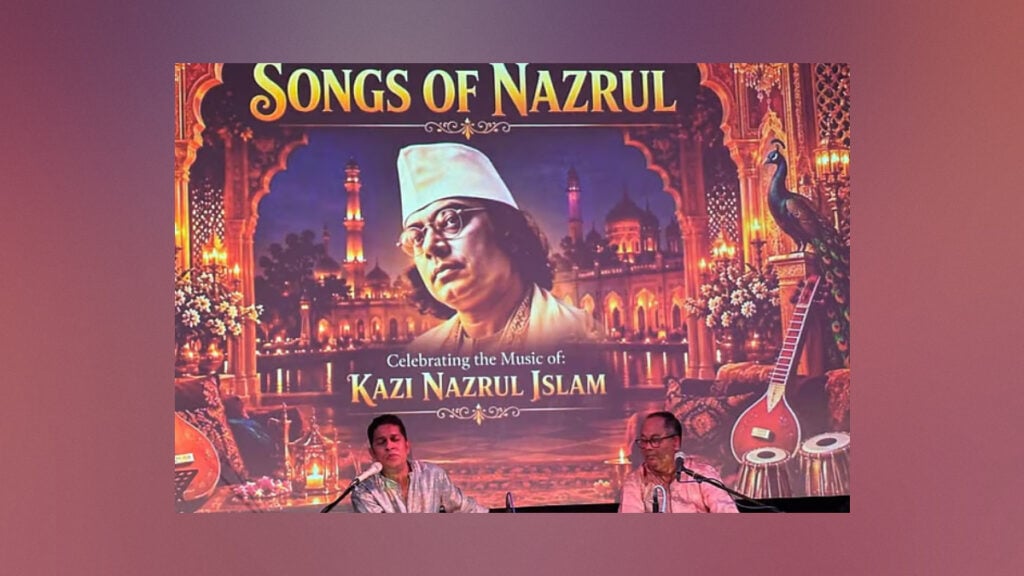
An evening celebrating the musical legacy of Bangladesh’s National Poet, Kazi Nazrul Islam, brought together Bengali music enthusiasts in Sydney, Australia, where audiences were captivated by performances of his timeless compositions. The programme, titled Songs of Nazrul, took place on 24 October 2026 at Hurstville Civic Centre, offering expatriate Bengalis an opportunity to reconnect with one of the richest traditions of Bengali music.
Organised jointly by Sydney Music Club and Canberra-based Jolsha, the event attracted a large gathering of music lovers. The strong audience turnout reflected the enduring popularity of Nazrul Sangeet among Bengali communities overseas, demonstrating that geographical distance has done little to weaken their attachment to the country’s cultural heritage.
The Saturday evening programme featured performances by singers Nizam Uddin Ujjal and Dominic Robin Guda. They presented several well-known compositions by Nazrul, including Arun Kanti Ke Go, Piya Piya Papiya, Bulbuli Nirab Nargis Bone and Amar Kon Kule Aaj. Their interpretations brought the distinctive melodies and emotional character of the poet’s songs to the stage, holding the audience’s attention throughout the performances.
Nazrul’s musical repertoire occupies a distinctive place in Bengali cultural history. His compositions encompass a wide range of themes, including love, longing, nature, spirituality and human emotions. Drawing on diverse musical influences, he created a body of work distinguished by its lyrical depth, melodic variety and expressive power. His songs have continued to appeal to successive generations, making Nazrul Sangeet an enduring part of Bengali musical identity.
The instrumental accompaniment added another dimension to the evening. Flute, tabla and guitar were used to complement the vocal performances, creating a harmonious musical arrangement. The musicians’ careful accompaniment enhanced the atmosphere without overshadowing the singers, allowing the audience to appreciate the melodies and lyrical qualities of Nazrul’s compositions.
The programme also received encouraging responses from those attending. One audience member described the decision to organise an entire concert around a classical musical tradition such as Nazrul Sangeet in a foreign country as a courageous initiative. Such events, the attendee suggested, require a committed group of organisers, dedicated performers and an audience with a genuine appreciation of the music.
Another spectator praised the efforts of Ujjal and Robin, highlighting their dedication to the art form and the contribution of the accompanying musicians. The attendee remarked that the artists’ commitment had helped strengthen the presence of Bengali cultural heritage in Sydney.
For expatriate communities, cultural programmes serve a purpose beyond entertainment. They provide opportunities to preserve linguistic and artistic traditions, maintain connections with their homeland and introduce younger generations to their cultural roots. Music has a particularly important role in this process, as familiar melodies can evoke shared memories and create a sense of belonging among people living far from home.
Nazrul’s compositions remain especially significant in this regard. Their emotional range and musical diversity have allowed them to transcend generations and geographical boundaries. Concerts dedicated to his work help keep that legacy alive while giving established and emerging audiences opportunities to experience his creations in a shared setting.
The Sydney programme was a reflection of this continuing cultural connection. Through the performances of Nizam Uddin Ujjal and Dominic Robin Guda, supported by the instrumentalists, Songs of Nazrul offered an evening devoted to the musical heritage of Bengal. The enthusiastic response from the audience demonstrated that Nazrul’s melodies continue to resonate strongly with Bengali music lovers, even thousands of miles away from Bangladesh.