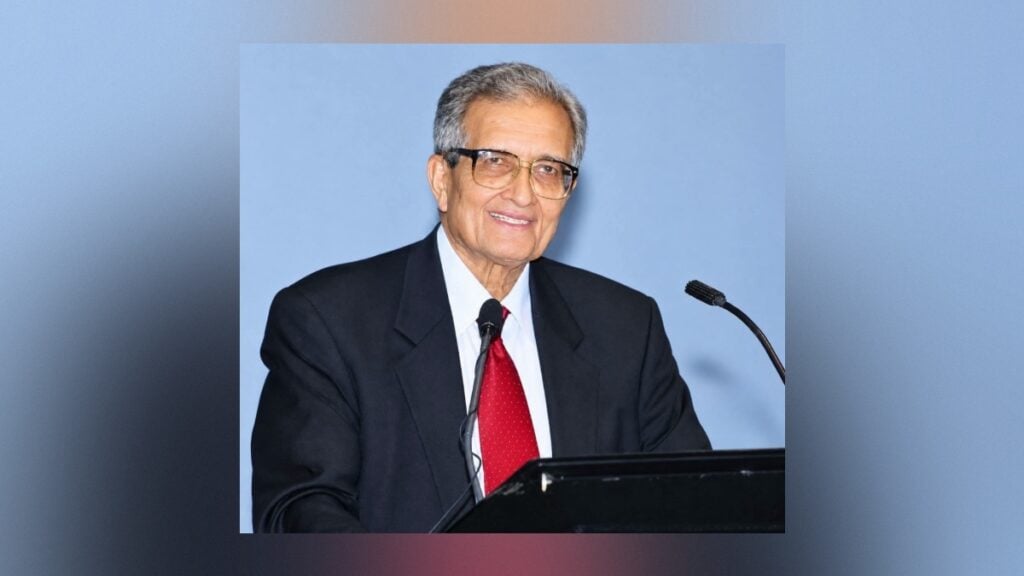
Recognised as one of the most influential intellectual figures of the modern era, Sen has made outstanding contributions to welfare economics, poverty research, famine analysis, social choice theory and the study of justice. His work has challenged conventional economic thinking and encouraged policymakers to measure progress through improvements in people’s lives.
Born on 3 November 1933, the distinguished scholar is being remembered on his birthday with admiration and respect for his lifelong contributions to economics, philosophy and humanity.
Early Life and Family Background
Amartya Kumar Sen was born on 3 November 1933 in Santiniketan, West Bengal, India. His father, Ashutosh Sen, was a professor of chemistry at the University of Dhaka, while his mother was Amita Sen. His maternal grandfather, Kshitimohan Sen, was a distinguished scholar and educator who worked closely with Nobel laureate Rabindranath Tagore at Santiniketan.
Sen’s family has deep ancestral roots in Bangladesh. Their ancestral home was in Wari, in Old Dhaka, which was then part of East Bengal. Because of his father’s professional commitments, Sen spent a significant part of his childhood in Dhaka.
His formal education began at St Gregory’s School in the capital. He later continued his studies in Santiniketan, where the intellectual environment and educational philosophy associated with Rabindranath Tagore had a lasting influence on his outlook.
Tagore’s emphasis on humanism, secularism, independent thinking and intellectual freedom helped shape Sen’s understanding of society. These values subsequently became central to his academic work, particularly his research into human development, social equality and individual freedom.
His early exposure to different social environments also contributed to his interest in understanding poverty, inequality and the circumstances that shape people’s lives.
Education and Academic Career
Sen received his higher education at Presidency College in Kolkata before moving to the United Kingdom to study at Trinity College, University of Cambridge. He completed his PhD in economics in 1959.
His academic career began remarkably early. At just 23, he was appointed professor and head of the Department of Economics at Jadavpur University in Kolkata.
The appointment marked the beginning of an extraordinary career that would take him to several of the world’s most prestigious academic institutions.
Over the following decades, he taught and conducted research at the Delhi School of Economics, the London School of Economics, the University of Oxford, the University of Cambridge and Harvard University in the United States.
Between 1998 and 2004, Sen served as Master of Trinity College, Cambridge. He was the first Indian to hold the prestigious position, marking an important milestone in the institution’s history.
He subsequently continued his academic career at Harvard University, where he has held the position of Thomas W Lamont University Professor and Professor of Economics and Philosophy. He has also served as a Senior Fellow of the Harvard Society of Fellows.
Throughout his career, Sen has combined economic analysis with philosophical reasoning to address some of the most pressing questions facing society.
Transforming the Understanding of Economics
Amartya Sen’s research has covered several important areas, including welfare economics, poverty, famine, social choice theory, human development, economic inequality, justice and public welfare.
One of his most influential contributions came through his research into the causes of famine.
His landmark book, Poverty and Famines: An Essay on Entitlement and Deprivation, published in 1981, introduced a fundamentally different perspective on food shortages and hunger.
In the book, Sen challenged the conventional assumption that famine occurs primarily because of an overall shortage of food. He demonstrated that severe hunger can occur even when sufficient food is available within a country.
His analysis focused on people’s ability to obtain food through employment, income, ownership and access to resources. A decline in purchasing power, unemployment, falling wages and unequal distribution can leave vulnerable communities without adequate food, even when supplies remain available.
This approach highlighted the importance of understanding not only how much food a country produces but also who has the economic means to obtain it.
His research significantly changed the academic discussion surrounding famine and food security. It also encouraged greater attention to distribution systems, social protection and the economic circumstances of vulnerable populations.
The Capability Approach and Human Development
Another major contribution of Sen is his Capability Approach, which has become an influential framework for understanding human development.
He argued that a country’s progress cannot be measured adequately through national income, gross domestic product or average earnings alone.
Economic growth may increase a country’s wealth, but it does not automatically guarantee that people enjoy better health, receive quality education or have greater freedom to make decisions about their lives.
According to Sen, genuine development depends on the opportunities available to individuals and their ability to pursue lives they have reason to value.
These opportunities include access to healthcare, education, adequate nutrition, employment, personal security and participation in society.
The approach also recognises that people with similar financial resources may experience very different living conditions because of differences in health, social circumstances and access to public services.
Sen’s central argument is that development should be judged by what people are actually able to do and become, rather than simply by the resources or income they possess.
This perspective has had a lasting influence on development economics, poverty research and public policy.
His Contribution to the Human Development Index
Sen’s intellectual contributions played an important role in the development of the Human Development Index (HDI), one of the world’s most widely recognised measures of human progress.
His intellectual collaboration with Pakistani economist Mahbub ul Haq helped establish a broader approach to assessing development beyond conventional financial indicators.
In 1990, the United Nations Development Programme (UNDP) published its first Human Development Report, introducing the HDI as an important measure of national development.
The index focuses on three principal dimensions:
-
Health: Measured through life expectancy.
-
Education: Assessed through indicators of educational attainment and access to learning.
-
Standard of living: Measured through income per person.
The introduction of the index represented an important shift in international development thinking.
Previously, economic growth and national income had often dominated assessments of a country’s progress. The HDI helped establish that people’s health, education and living conditions must also be considered when evaluating development.
The underlying philosophy reflects one of Sen’s most important arguments: economic growth should serve human welfare rather than become an end in itself.
Nobel Prize and International Recognition
Sen received the Nobel Memorial Prize in Economic Sciences in 1998 in recognition of his contributions to welfare economics.
The award recognised his influential research into social choice theory, economic inequality, poverty and the conditions that determine individual and collective well-being.
His work demonstrated how economic analysis could be used to address broader questions of justice, fairness and the distribution of resources.
In 1999, the Government of India honoured him with the Bharat Ratna, the country’s highest civilian award.
His other international distinctions include the United States National Humanities Medal, France’s Legion of Honour and the United Kingdom’s Order of the Companions of Honour.
He received the National Humanities Medal in 2011 in recognition of his contributions to intellectual life and the humanities.
Sen has also held leadership positions in several prominent professional organisations, including the Econometric Society, the Indian Economic Association, the American Economic Association and the International Economic Association.
These honours reflect the international recognition of his contributions not only to economics but also to philosophy, social justice and human welfare.
A Prolific Author and Influential Thinker
Amartya Sen is not only an accomplished economist and academic but also an influential author whose writings have reached readers across the world.
His books have been translated into more than 30 languages, making his ideas accessible to a diverse international audience.
Some of his most notable publications include:
-
Poverty and Famines
-
Development as Freedom
-
The Idea of Justice
-
The Argumentative Indian
-
Identity and Violence
-
Collective Choice and Social Welfare
His writings bring together economics, philosophy, ethics, democracy, freedom and social justice.
Among his most influential works is Development as Freedom, in which he explains development as a process of expanding human freedom and removing the barriers that prevent individuals from leading fulfilling lives.
He argues that poverty, illiteracy, preventable illness, discrimination and social exclusion restrict people’s ability to exercise their freedom and fulfil their potential.
For Sen, development must create conditions in which individuals can make meaningful choices and participate fully in society.
In The Idea of Justice, he examines how justice can be understood through practical efforts to reduce inequality and address existing social injustices.
His writing is distinguished by its ability to connect complex theoretical questions with the everyday experiences of ordinary people.
A Philosophy Rooted in Humanity
One of the defining features of Sen’s intellectual outlook is his refusal to separate economics from human life.
For him, development is not simply about building bridges, expanding industries, increasing national income or achieving higher growth rates.
It is equally about ensuring that poor families have access to food, children receive education, women enjoy dignity and equal opportunities, and every individual can lead a secure and meaningful life.
He believes poverty should not be understood merely as a shortage of money. It also represents a deprivation of opportunities, capabilities and freedom.
People living in poverty often face multiple disadvantages, including limited access to education, healthcare, employment and essential public services. These conditions can restrict their ability to improve their circumstances.
Sen’s approach therefore places considerable importance on democratic institutions, public accountability, education, healthcare and equal opportunities.
He has also emphasised the importance of freedom of expression and public debate. In his analysis of famine, he has highlighted how democratic accountability and a free press can help expose humanitarian crises and encourage governments to take action.
His broader philosophy suggests that economic policies should ultimately be assessed by their impact on people’s lives, particularly those who are most vulnerable.
A Special Connection with Bangladesh
Amartya Sen’s family background and childhood experiences give him a special connection with Bangladesh.
His family’s ancestral home in Wari, Old Dhaka, and his early education at St Gregory’s School are important parts of his personal history.
Although his academic achievements have brought him international recognition, his background remains closely connected with the intellectual and cultural traditions of Bengal.
His association with Santiniketan and the humanist philosophy of Rabindranath Tagore also reflects the shared intellectual heritage of the Bengali-speaking world.
For Bangladesh, his achievements represent a source of pride that extends beyond national boundaries. His research into poverty, food security, inequality and human development remains particularly relevant to developing countries facing challenges related to economic disparities and access to essential services.
His work on famine and food entitlements, in particular, offers important lessons about the need to ensure that food security is supported by purchasing power, employment opportunities and effective distribution systems.
His human development philosophy also provides a valuable framework for examining the relationship between economic progress and improvements in people’s everyday lives.
An Enduring Legacy of Knowledge and Compassion
Many distinguished economists have devoted their careers to analysing economic growth, productivity and financial indicators. Amartya Sen, however, has consistently placed people at the centre of these discussions.
His work has demonstrated that a country’s greatest wealth lies not simply in its natural resources, industrial capacity or financial strength, but in the health, education, freedom, creativity and dignity of its people.
He has helped establish the principle that economic progress must go hand in hand with social justice and the expansion of human opportunities.
His research has also shown that economics can become a powerful instrument for improving society when it is guided by ethical considerations and an understanding of human needs.
For generations of students, researchers, policymakers and intellectuals, his ideas continue to offer important insights into poverty, equality, freedom and justice.
On his birthday, heartfelt respect and warm wishes go to Professor Amartya Sen, whose lifelong dedication to knowledge, humanity and social welfare has left an enduring mark on the world.
May he enjoy good health and longevity. May his wisdom, scholarship and humanist philosophy continue to inspire future generations.
Happy Birthday, Professor Amartya Sen.