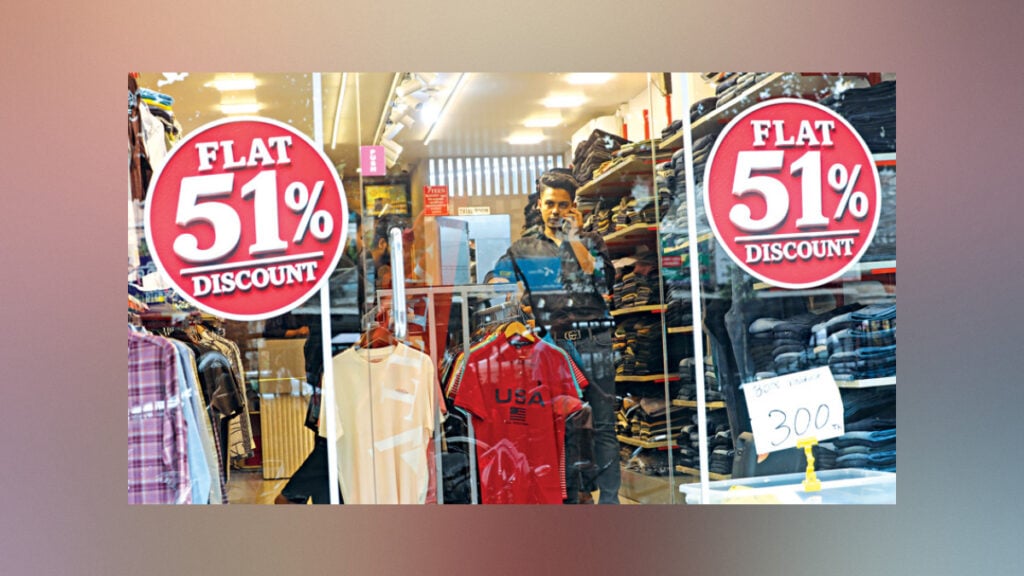
Fashion retailers in Bangladesh are finding it increasingly difficult to attract customers, despite offering discounts of up to 50 per cent on branded clothing. Prolonged high inflation, declining purchasing power and growing economic uncertainty have weakened consumer demand, leaving shops with substantial stocks but fewer buyers than expected.
Retailers say sales have fallen by at least 20 per cent compared with the same period last year. The slowdown comes at a time when businesses would normally expect seasonal discounts to attract shoppers looking for bargains and encourage them to purchase new clothes ahead of winter.
The recent conclusion of Durga Puja shopping has also affected demand. Meanwhile, an ongoing fuel crisis has led to restrictions on shop opening hours as part of efforts to conserve electricity. Markets, shopping centres and retail outlets are now allowed to remain open from 11am to 8pm, compared with the previous closing time of 10pm.
The shortened trading hours have particularly affected evening sales. Many office workers and other professionals traditionally visit shopping centres after finishing work, making the evening an important period for clothing retailers. With shops now required to close earlier, businesses are losing a significant portion of their usual trading window.
Mohammad Safin, manager of Saima Fashion’s outlet in Banani, Dhaka, told The Daily Star that the difference between this year and last year was striking.
The retailer sells women’s clothing, including salwar kameez, sarees and lehengas, and operates several outlets across the capital.
Safin said the shelves, which remain filled with clothing this year, would have been almost empty at the same stage last year after the discount campaign began. He recalled that customer demand had been so strong previously that he barely had time to speak to visitors.
This year, however, the situation has changed considerably. According to his estimate, sales have declined by around 30 per cent compared with the previous year.
He attributed the downturn to the country’s political uncertainty, the global energy crisis arising from international conflicts, and sudden increases in fuel and electricity prices. These developments have created uncertainty among consumers while making the business environment increasingly difficult for retailers.
Inflation continues to undermine purchasing power
Saumik Das, chief executive of Rong Bangladesh, one of the country’s leading fashion and lifestyle brands, said prolonged inflation had significantly altered consumer spending habits.
Bangladesh has been experiencing elevated inflation since around the middle of 2022. Average annual inflation has remained above 9 per cent since the 2022–23 financial year, while wage growth has failed to keep pace.
The gap between rising prices and relatively slower income growth has steadily reduced the purchasing power of households. Consumers are increasingly prioritising essential expenditure, leaving less room in their budgets for discretionary purchases such as branded clothing.
The International Monetary Fund (IMF) has forecast average inflation of 10.9 per cent in Bangladesh in the 2026–27 financial year. It has also projected that real gross domestic product (GDP) growth will slow to 3.2 per cent.
Such economic conditions are creating additional pressure on households and businesses. Higher living costs, weaker economic growth and uncertainty over employment and income prospects are encouraging consumers to postpone non-essential purchases.
Das said Rong Bangladesh had not received the response to its seasonal discount campaign that it experienced last year. Customer visits have fallen by approximately 15 to 20 per cent compared with the same period in 2025.
He also observed a change in the way people shop. Customers who visit stores during promotional campaigns are now purchasing only what they genuinely need rather than taking advantage of discounts to buy additional items.
In previous years, attractive price reductions often encouraged shoppers to purchase more clothing than they had originally planned. That pattern has largely disappeared as households become more cautious about spending.
Uncertain weather complicates seasonal planning
Economic pressures are not the only challenge facing fashion retailers. Unusual weather conditions have also complicated decisions about seasonal stock and consumer demand.
In a typical year, temperatures begin to fall around the beginning of November, signalling the approaching winter season. This usually encourages retailers to introduce winter collections and consumers to start looking for warmer clothing.
This year, however, temperatures have not followed the expected pattern. The prevailing conditions have made it difficult for retailers to determine whether customers are more likely to purchase summer or winter clothing.
As a result, businesses are facing uncertainty over which products to display and when to introduce new seasonal collections. Retailers must also consider the risk of holding unsold stock if consumer demand does not develop as expected.
Officials at fashion brand Embrar have reported weak demand for summer clothing, including T-shirts and polo shirts, despite offering discounts.
Kazi Maktum Shovon, head of sales and marketing at the company, said sales had fallen short of expectations.
He also identified the restriction on shop opening hours as a contributing factor. With outlets required to close at 8pm, retailers have fewer opportunities to attract customers after working hours.
Shovon said the recent conclusion of Durga Puja and the approaching Eid celebrations had also influenced shopping patterns. He expects sales to remain somewhat below target over the coming months.
Discount campaigns fail to deliver expected returns
Mohammad Mukhtar Hossain, assistant manager of fashion brand Rise, described a similar experience during the pre-winter discount season.
He said the company’s sales had declined despite offering promotional prices. In October last year, Rise sold clothing worth approximately Tk 2 million through its discount campaign. This year, sales during the same month fell to around Tk 1.5 million.
The figures represent a decline of approximately 25 per cent.
Hossain attributed the fall primarily to the deteriorating economic situation, particularly the rising cost of living. He said customer footfall had dropped by almost half during the current season, while only a small proportion of visitors were making purchases.
The experience reflects a wider problem across the retail sector. Although discounts provide an opportunity to purchase clothing at lower prices, many consumers are reluctant to spend unless a purchase is necessary.
Sajjad Hossain, an online sales executive at another lifestyle and fashion retailer, Cats Eye, said the company’s sales had fallen by approximately 50 per cent compared with last year.
He said uncertainty surrounding the overall economic situation was making consumers cautious. Many were waiting to see how conditions developed before committing to additional spending, resulting in weaker demand for clothing.
New winter collections delayed at New Market
The slowdown is also visible among smaller, non-branded clothing retailers.
At Dhaka’s New Market, several shops had yet to introduce new winter collections as of last week. Some traders were instead attempting to clear existing stocks by offering discounts on older products.
For smaller retailers, holding unsold inventory can create additional financial pressure. Businesses need to recover money tied up in existing stock before purchasing new collections. When sales slow, this process becomes more difficult and can affect their ability to prepare for the next season.
Sanaul Haque Babul, finance director of the Fashion Entrepreneurs Association of Bangladesh, said offering discounts towards the end of a season was a long-established practice in the local fashion industry.
Such promotions traditionally help retailers increase sales, clear older collections and make room for new products. They also give consumers an opportunity to purchase clothing at reduced prices.
However, he said the country’s political and economic conditions were weighing heavily on consumer demand this year. According to his assessment, sales across the sector had declined by approximately 20 per cent compared with the same period last year.
The latest figures and comments from retailers point to a broader slowdown in Bangladesh’s fashion market. High inflation is squeezing household budgets, while restricted trading hours are reducing opportunities for businesses to generate sales. Uncertain weather conditions are adding another layer of difficulty to seasonal planning.
For retailers, the challenge is no longer simply offering attractive discounts. They must contend with consumers who have become more selective, more cautious and less willing to spend on non-essential items.
Unless purchasing power improves and consumer confidence strengthens, fashion businesses may continue to face weak demand despite promotional campaigns and substantial reductions in prices.