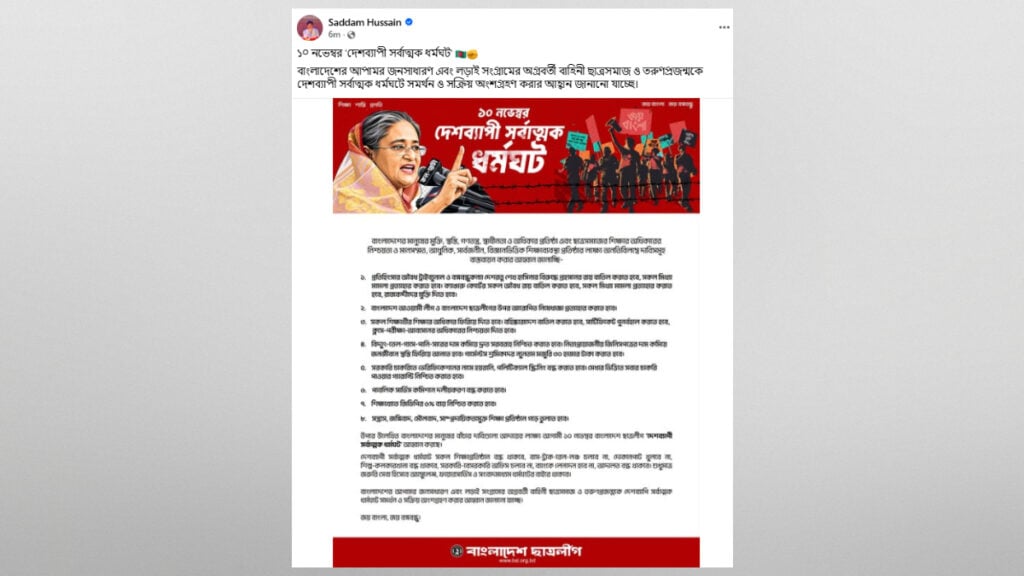
The Bangladesh Chhatra League has called a nationwide general strike for 10 November, urging the implementation of eight demands covering political, educational, economic and labour-related issues. The organisation has announced that educational institutions, public transport, shops, industrial establishments, government and private offices, banks and courts should remain closed on the day.
However, emergency services, including ambulances, fire services and the media, will be exempt from the proposed action, according to a statement issued by the organisation.
The announcement was made in a notice published on 6 November 2026 by the central executive committee of the Bangladesh Chhatra League. The statement bears the signatures of its president, Saddam Hussain, and general secretary, Sheikh Wali Asif Inan.
According to the notice, the eight-point programme is intended to promote what the organisation describes as the freedom, democracy, independence and rights of the people of Bangladesh, while restoring educational rights for students. Its demands include the cancellation of verdicts in cases against Sheikh Hasina, the withdrawal of the cases and the release of political prisoners. It has also called for the annulment of verdicts delivered by what it describes as an illegal tribunal and a ‘kangaroo court’.
The second demand calls for the withdrawal of restrictions imposed on the Bangladesh Awami League and the Bangladesh Chhatra League. The third focuses on students’ educational rights. It calls for the cancellation of expulsion orders, reinstatement of academic certificates and the restoration of students’ rights to attend classes, sit examinations and access residential facilities.
Several of the demands address the cost of living and economic conditions. The organisation has called for reductions in the prices of electricity, fuel, gas, water and fertiliser, alongside uninterrupted supplies of these essential services. It has also demanded lower prices for everyday necessities to ease financial pressure on ordinary households.
Workers’ rights feature prominently in the programme. The Chhatra League has called for a minimum monthly wage of Tk 30,000 for garment workers, a demand linked to concerns over workers’ earnings and the rising cost of living.
The organisation has also raised concerns about recruitment procedures in the public sector. It wants harassment in the name of background verification to end and political screening of job applicants to be stopped. Recruitment, it says, should be based on merit, with equal opportunities for all eligible candidates.
Reform of public administration and the education sector forms another part of the eight-point agenda. The demands include ending political influence within the Public Service Commission (PSC) and allocating 6 per cent of the country’s gross domestic product (GDP) to education.
The organisation has also called for educational institutions to become more transparent and accountable, while remaining free from fundamentalism and communalism. Its position is that students should have access to an educational environment that protects their academic rights and provides equal opportunities.
The notice outlines an extensive programme for 10 November. All educational institutions across the country are expected to remain closed. The proposed strike also covers buses, trucks, trains and launches, with shops and factories instructed to suspend operations.
Government and private offices are also included in the announced programme. Banks are expected to suspend all transactions, while court proceedings are also expected to remain closed for the day.
Emergency services will be exempt to ensure that essential public assistance remains available. Ambulances and fire services will be allowed to operate, while media organisations will also remain outside the scope of the proposed shutdown.
The Chhatra League has appealed to students, young people and members of the public to support the programme and participate actively in the nationwide strike. The statement concludes with the slogan ‘Joy Bangla, Joy Bangabandhu’ and a call to make the 10 November action successful.
The announcement outlines the organisation’s position on a range of political and socioeconomic issues. Its proposed shutdown, if carried out as described, would affect several major areas of public life, including education, transport, banking, industry and government services across Bangladesh.