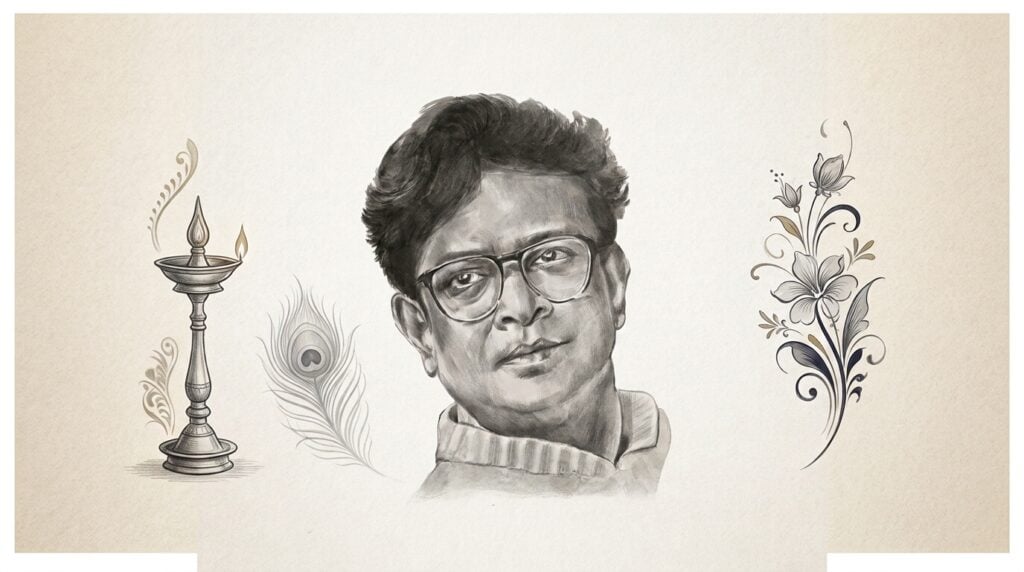
A tribute to the legendary writer on his birth anniversary
True storytellers never disappear. They continue to live through the pages of their books, the characters they create and the emotions woven into their stories. They remain alive in the hearts and imaginations of readers, long after they are gone. Humayun Ahmed was one such extraordinary literary figure. Though he passed away, his stories continue to captivate millions of readers, keeping his presence alive across generations.
Humayun Ahmed was born on 13 November 1948 at his maternal grandfather’s home in Mohanganj, Netrokona district. His father was Shaheed Foyzur Rahman Ahmed and his mother was Ayesha Foyez. His father was killed during Bangladesh’s Liberation War in 1971. His patriotism, the spirit of the independence struggle and the experiences of his family life later left a profound impression on Humayun Ahmed’s literary works.
Humayun Ahmed was far more than a novelist. He was a prolific fiction writer, short-story writer, playwright, lyricist, screenwriter and film director. Although he began his professional career as a professor in the Department of Chemistry at the University of Dhaka, he eventually devoted himself primarily to writing and creative work.
His first novel, Nondito Noroke, published in 1972, established him as a distinctive voice in Bangla literature. The book received considerable attention for its fresh narrative style and portrayal of human relationships. It marked the beginning of a remarkable literary journey that would transform the reading habits of generations.
He went on to write numerous acclaimed works, including Shankhanil Karagar, Jochona O Jononir Golpo, Kobi, Krishnopokkho, Daruchini Dwip, Aguner Poroshmoni, Shrabon Megher Din, Megh Bolechhe Jabo Jabo and Kothao Keu Nei. These works remain an important part of Bangladesh’s literary heritage.
One of the defining strengths of his writing was his ability to communicate profound observations about life through remarkably simple language. He explored the joys and sorrows of ordinary people, the struggles of middle-class families, love, heartbreak, loneliness, humour, mystery and the complexities of human relationships. His storytelling was so natural and engaging that readers often discovered their own experiences reflected in the lives of his fictional characters.
His characters became literary icons in their own right. Himu, Misir Ali, Shubhra, Baker Bhai and Rupa each possessed distinctive personalities, philosophies and psychological depth.
Himu, with his unconventional outlook and carefree wanderings, became a symbol of youthful rebellion and philosophical curiosity. Misir Ali, a rational thinker who approached unusual events through logic and psychological analysis, appealed to readers fascinated by mystery and human behaviour. Shubhra represented innocence and simplicity, while Baker Bhai became memorable for his defiant personality and sense of justice. Rupa, too, occupied a special place in the emotional world created by the author.
His novels and television dramas often reflected the realities of everyday life. Productions such as Ei Shob Din Ratri, Bohubrihi, Kothao Keu Nei, Ayomoy and Aj Robibar became household favourites, bringing entertainment, laughter and emotional engagement to television audiences across Bangladesh.
Among these productions, Kothao Keu Nei holds a particularly significant place in the history of Bangladeshi television drama. The fate of its central character, Baker Bhai, generated an extraordinary emotional response among viewers. Audiences became deeply attached to the character, and his eventual predicament sparked widespread discussion. The reaction demonstrated Humayun Ahmed’s unusual ability to make fictional personalities feel like real people.
His literary world also included works such as Tomader Ei Nagore, Chole Jay Bosonter Din, Priyotomeshu, Rong Pencil, Anondo Bedonar Kabbo, Shrabon Megher Din and Jochona O Jononir Golpo. His writing frequently combined everyday conversations with subtle humour, emotional depth and unexpected observations. Even apparently ordinary moments acquired a special significance in his hands.
Humayun Ahmed also made a lasting contribution to Bangladeshi cinema. As a filmmaker, he directed several notable films, including Aguner Poroshmoni, Shrabon Megher Din, Dui Duari, Chandrokotha and Shyamol Chhaya. His films reflected the same human sensitivity and distinctive storytelling that characterised his novels and television dramas.
His Liberation War-themed films, particularly Aguner Poroshmoni and Shyamol Chhaya, demonstrated his ability to portray the personal tragedies, sacrifices and emotional realities associated with Bangladesh’s struggle for independence. Through these productions, he brought historical experiences closer to audiences by presenting them through the lives of ordinary people.
His extraordinary contribution to Bangla literature received formal recognition throughout his career. He was awarded the Bangla Academy Literary Award in 1981 and the Ekushey Padak in 1994. His achievements in filmmaking were also recognised, including through National Film Awards and other honours.
Perhaps the secret of Humayun Ahmed’s enduring popularity lay in his ability to make readers feel that they were not merely observing a story but becoming part of it. His fictional characters were often mysterious, eccentric, lively, humorous or deeply melancholic, much like the complicated individuals people encounter in real life.
Readers laughed with his characters, cried over their misfortunes and found themselves reflecting on questions that had long remained unanswered in their own lives. His books became companions during quiet afternoons, rainy evenings and lonely nights.
Even today, young people walking barefoot along the streets may find themselves identifying with Himu. Readers fascinated by mysteries may approach life’s unanswered questions with the curiosity of Misir Ali. On moonlit nights, others may look towards the sky and remember the magical atmosphere that runs through so many of his stories.
A steaming cup of tea, a rain-soaked afternoon or a silent night can still provide the perfect setting for revisiting his books. His writing has become closely associated with these simple yet deeply evocative moments of everyday life.
On 19 July 2012, Humayun Ahmed passed away in New York, United States, following a prolonged battle with cancer. His death marked the end of an extraordinary creative journey, but not the influence of his work. He was laid to rest at Nuhash Palli, his beloved retreat in Gazipur, Bangladesh.
His legacy extends far beyond the number of books he wrote or films he directed. He helped make reading an enjoyable habit for countless people, particularly younger generations, and brought Bangla literature into the everyday conversations of ordinary households. His accessible language and engaging storytelling introduced many readers to the pleasure of books, while his memorable characters became part of the country’s popular culture.
His influence can still be felt in the way readers discuss fictional characters as though they were old acquaintances. His stories continue to find new audiences, while those who grew up reading his books return to them with the affection of meeting familiar friends.
A person’s lifetime eventually comes to an end, but great creative works can transcend the boundaries of time. Humayun Ahmed remains alive through the countless readers who continue to discover, revisit and cherish his writing.
His characters are still with us. His unforgettable dialogues continue to echo in readers’ minds, and the people who inhabit his fictional world seem to walk alongside us in our everyday lives.
True storytellers never disappear. They live on, word by word, generation after generation.
Happy birthday, Humayun Ahmed.
On the birth anniversary of this remarkable storyteller, Bangladesh remembers him with profound respect, admiration and affection. His contribution to Bangla literature and culture will remain cherished for generations to come.