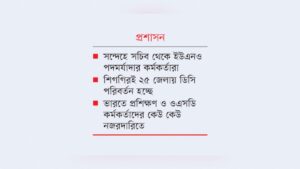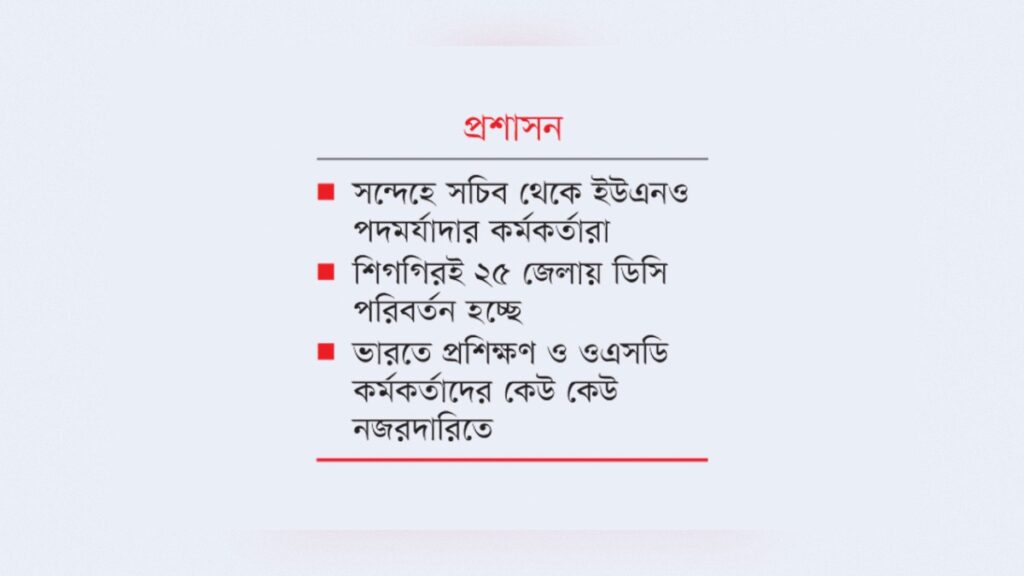
The government has placed more than 300 civil servants under intelligence surveillance amid growing concerns that some officials appointed, promoted or favourably posted during the Awami League’s 15-year rule may still be maintaining political connections and undermining the administration from within.
The officials, who hold positions ranging from senior secretaries to deputy commissioners (DCs) and upazila nirbahi officers (UNOs), are suspected of maintaining contact with Awami League leaders and activists, sharing sensitive government information and using political influence to retain favourable positions under the current administration.
The government is also preparing for a major reshuffle in the field administration, with changes expected in at least 25 districts. The move reflects growing concern among policymakers over the political neutrality of the civil service and the possible influence of officials with close links to the previous administration.
Officials in the administration and law enforcement agencies have come under renewed scrutiny following several recent incidents. The government fears that sections of the administration may still be politically aligned with the Awami League, potentially affecting intelligence gathering, law enforcement and the implementation of government decisions.
Recent incidents intensify concerns
The concerns gained prominence on 12 November when allegations emerged against Mohammad Jahangir Alam, Superintendent of Police (SP) of the Chattogram Range Reserve Force. He was accused of supplying internal and sensitive police information to the Awami League. The allegations prompted discussions about an investigation and possible administrative action.
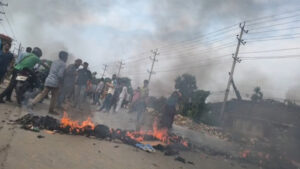
Another incident in Gopalganj further intensified the government’s concerns. Last Sunday, leaders and activists of the Awami League and its affiliated organisations reportedly staged public rallies, processions and demonstrations in the district.
Some participants allegedly carried traditional implements, including logs and oars, as well as locally made weapons. The demonstrations were accompanied by reports of vandalism and arson at several establishments. Although a substantial number of law enforcement personnel were deployed to bring the situation under control, questions were raised about their response and effectiveness.
Following the incidents, Gopalganj Deputy Commissioner Mohammad Arif-uz-Zaman was withdrawn from his post, while Superintendent of Police Mohammad Habibullah was transferred. In a separate development, Chuadanga Deputy Commissioner Lutfun Nahar was attached to the Public Administration Ministry.
Some policymakers believe that failure to identify politically influenced officials within the administration could undermine the government’s ability to maintain law and order, collect reliable intelligence and implement policy decisions. The Gopalganj incident has brought these concerns into sharper focus.
State Minister for Public Administration Mohammad Abdul Bari said the government was receiving daily intelligence reports on the activities of officials and employees across the administration, which comprises around 800,000 personnel.
“Two deputy commissioners have already been withdrawn, and investigations into their conduct are under way. Social media activities are also being examined. Action will be taken if allegations of this nature are substantiated against any official. The present government is becoming increasingly strict on these matters,” he said.
Who is under surveillance?
According to sources in the Public Administration Ministry, more than 300 officials who have served in the administration during the three terms of the Awami League government are being monitored.
The list reportedly includes secretaries, additional secretaries, joint secretaries, deputy secretaries, deputy commissioners and upazila nirbahi officers. The activities of officials currently serving as officers on special duty (OSDs), as well as those who have previously held senior administrative positions, are also being examined.
Investigators are reportedly assessing whether any of these officials have been involved in activities that could undermine the government’s work, maintain improper political contacts or compromise confidential state information.
Of the approximately 6,500 officials currently serving in the administration cadre, around 2,500 have reportedly received training in India. They are employed in various positions, including additional divisional commissioners, additional deputy commissioners, upazila nirbahi officers, senior assistant secretaries, senior assistant commissioners and assistant commissioners (land).
Some officials from this group have also been placed under surveillance. However, overseas training alone does not establish wrongdoing; the scrutiny is reportedly focused on allegations concerning individual conduct and political connections.
The government is also examining allegations that some officials abandoned professional standards during the previous administration and became closely associated with politicians. They are accused of using their positions to secure personal benefits, engage in corruption and accumulate wealth.
Other allegations concern attempts to restore the influence of contractors associated with the Awami League by helping them secure government projects. Investigators are reportedly examining whether such assistance has been used to channel financial support towards political activities, including alleged acts of sabotage.
Some officials are also suspected of attempting to obstruct development projects or influence their implementation for political purposes. These allegations remain subject to investigation.
Previous political appointments under scrutiny
Sources in the Public Administration Ministry say intelligence agencies have prepared lists of officials who served in important government offices during the past 17 years.
Particular attention is being paid to officials who worked as private secretaries (PSs) to ministers during the Awami League government’s three terms. Their previous responsibilities, professional records and relationships with political figures are being reviewed.
The government is also examining the records of serving deputy commissioners who were involved in administering the controversial national elections held in 2014, 2018 and 2024.
Those elections faced widespread political criticism and allegations of irregularities. Officials who held important responsibilities during the electoral processes are therefore among those whose past roles are being reassessed.
The scrutiny comes amid allegations that some civil servants used political connections to secure promotions, favourable postings and influential positions. Some reportedly maintained close relationships with ministers and members of parliament, while others served in key institutions such as the Prime Minister’s Office, Cabinet Division and Public Administration Ministry.
Despite the change of government, many of these officials remain in influential positions.
There are also allegations that some officials have adapted their political relationships according to changing circumstances, maintaining connections with influential figures from both the previous and current administrations. This has raised questions about whether all officials are implementing government decisions impartially or whether some are pursuing political interests behind the scenes.
Meanwhile, 22 officials at the ranks of secretary, additional secretary, joint secretary and deputy secretary have already been sent into compulsory retirement after completing 25 years of service.
Recruitment and political affiliations under examination
The recruitment history of several batches of civil servants appointed during the Awami League’s 15 years in power is also receiving attention.
Officials from the 28th to 43rd Bangladesh Civil Service (BCS) batches joined the administration and other government cadres after 2009. Allegations have circulated for years that some individuals among them had links with Chhatra League politics.
Questions have also been raised at different times over political considerations in BCS recruitment, alleged question-paper leaks and irregularities in appointments.
Sources say concerns about political favouritism extend to senior levels of the administration. Some officials reportedly served as private secretaries to ministers and MPs, while others were known for their close relationships with influential members of the former government.
Several were also assigned to important ministries and government offices, allowing them to build influence within the administrative structure.
The government is now examining whether such connections affected recruitment, promotions and postings, as well as whether any officials continue to use political networks to maintain their positions.
However, administrative experience under a previous government does not, by itself, establish political misconduct. The allegations against individual officials will require proper verification and evidence.
Deputy commissioners set for reshuffle in 25 districts
Alongside the surveillance operation, the government is preparing for a substantial reshuffle of the field administration.
Deputy commissioners hold a crucial position in district-level governance, working under divisional commissioners. Their responsibilities include coordinating government activities, maintaining administrative order, overseeing land administration and supporting the implementation of development programmes.
The current government has already replaced some deputy commissioners appointed during the interim administration. A further round of changes is now being considered.
According to Public Administration Ministry sources, officials from the 24th BCS batch are currently serving as deputy commissioners in 21 districts. They were promoted from deputy secretary to joint secretary in March this year, although the DC post carries the rank of deputy secretary.
The government has reportedly taken a policy decision to withdraw these officials from field administration. Alongside replacements in those districts, changes are also being considered in several others, bringing the possible total to at least 25.
The districts where changes are being considered include:
Habiganj, Mymensingh, Cox’s Bazar, Jhenaidah, Panchagarh, Magura, Satkhira, Jhalakathi, Noakhali, Chandpur, Pirojpur, Chuadanga, Manikganj, Gopalganj, Chapainawabganj, Bogura, Dhaka, Madaripur, Gaibandha, Kishoreganj and Joypurhat.
The final list will depend on the government’s administrative decisions and the issuance of official transfer orders.
28th and 29th BCS batches likely to receive priority
Officials from the 28th and 29th BCS batches are expected to receive priority in the next round of deputy commissioner appointments.
However, seniority will not be the sole consideration. Field-level experience, administrative competence, previous performance and annual confidential reports (ACRs) are also expected to influence the selection process.
According to the Public Administration Ministry, officials from the 25th and 27th BCS batches have previously been appointed as deputy commissioners. At present, 27 officials from the 25th batch and 16 from the 27th batch are serving in the positions.
For the upcoming appointments, greater consideration is being given to candidates from the 28th and 29th batches.
The ministry has already interviewed 160 officials from the 28th BCS batch for deputy commissioner positions. Of them, 20 were shortlisted for appointment. Interviews were subsequently conducted with officials from the 29th batch as well.
The selection process is expected to consider candidates’ professional records and suitability for district-level responsibilities before final appointments are made.
Administrative neutrality remains a major challenge
The surveillance of more than 300 officials and the planned reshuffle across at least 25 districts signal a significant effort by the government to reassess the administration’s internal structure.
The challenge, however, extends beyond transferring officials or reviewing their previous political associations. Ensuring a professional, impartial and accountable civil service will require consistent standards in recruitment, promotion and disciplinary action.
Civil servants are expected to serve the state and its citizens, regardless of which political party holds power. Their responsibilities include implementing lawful government decisions, maintaining public services and protecting institutional integrity.
For that reason, allegations of political interference, corruption or the leaking of confidential information must be investigated thoroughly. At the same time, officials should not face punitive action simply because they served under a previous government or received training abroad.
Transparent investigations, credible evidence and opportunities for officials to defend themselves will be essential to maintaining confidence in the process.
The government now faces the difficult task of removing political influence from the administration while preserving its institutional continuity and professional capacity. Whether the current surveillance drive and planned reshuffle achieve those objectives will depend largely on how fairly and consistently the decisions are implemented.