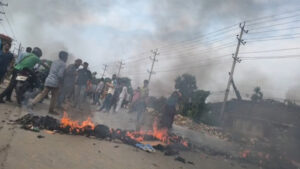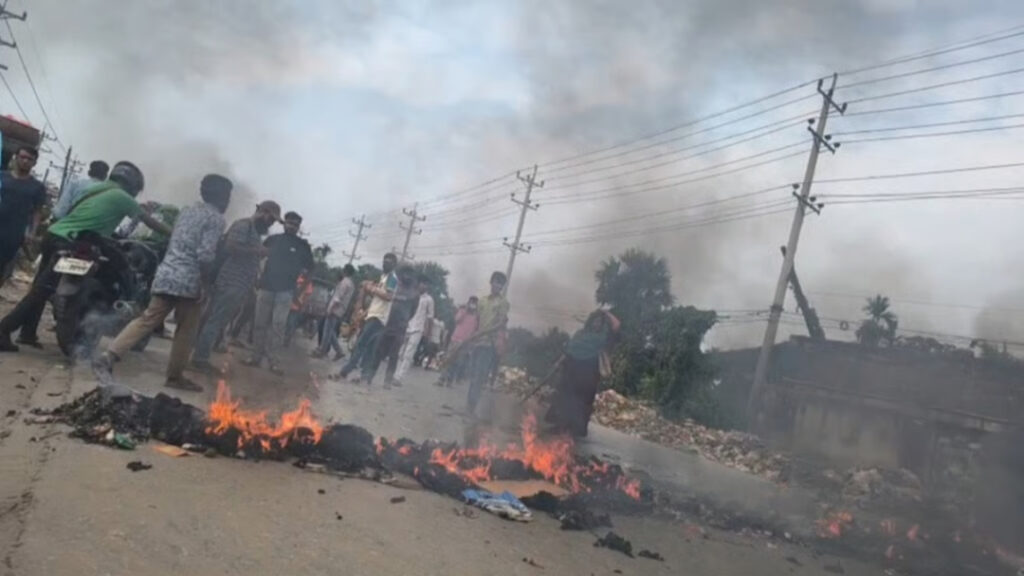
Garment workers staged demonstrations across several areas of Gazipur on Tuesday, blocking major highways and demanding that the minimum monthly wage be raised to Tk 30,000. The protests, which began in the morning, disrupted traffic in Joydebpur, Chandana Chowrasta, Bhogra, Signboard and Naojor. Clashes broke out between workers and police, prompting law enforcement agencies to fire tear gas and sound grenades in an attempt to disperse the crowds. At one stage, protesters set fire to a police barricade. At least 20 people, including journalists, were injured in the incidents.
According to police and local sources, workers from several garment factories in Joydebpur and Chandana Chowrasta in Gazipur city began demonstrating at around 9am after refusing to report for work. Hundreds subsequently gathered on the streets, blocking sections of the Dhaka-Mymensingh Highway, Joydebpur Road and the Bhogra Bypass.
The blockades brought traffic to a standstill in several locations, causing lengthy tailbacks and considerable disruption to commuters. Public transport and other vehicles were unable to move freely, leaving passengers stranded and affecting people travelling through the industrial areas.
Police and members of the Border Guard Bangladesh (BGB) were deployed after receiving reports of the demonstrations. At Bhogra and Signboard, officers attempted to persuade the workers to leave the highways and restore normal traffic. However, the protesters refused to withdraw from the roads.
As tensions escalated, police and BGB personnel fired tear gas and sound grenades to disperse the demonstrators. The operation led to several rounds of chasing and counter-chasing between the workers and law enforcement personnel. During the confrontation, a police barricade was set on fire, further intensifying the situation.
The protests also spread to Naojor, where workers attempted to block the Dhaka-Tangail Highway over the same demand for a monthly minimum wage of Tk 30,000. Security personnel subsequently removed the demonstrators from the highway.
However, the movement continued in several other locations. Workers who were dispersed from one area reportedly regrouped elsewhere and occupied nearby regional roads. This pattern made it difficult for the authorities to restore normal traffic across the affected parts of the industrial zone.
At least 20 people, including journalists, were injured during the clashes and subsequent police action. Details about the identities of all those injured, the nature of their injuries and their medical conditions were not immediately available.
Mohammad Amjad Hossain, Superintendent of Police for Gazipur Industrial Zone-2, said workers had taken to the streets from the morning demanding that the minimum monthly wage be increased to Tk 30,000.
He said the authorities were attempting to bring the situation under control through discussions with the protesters. Additional police and BGB personnel had also been deployed to maintain order and prevent further escalation.
Gazipur is one of Bangladesh’s largest garment manufacturing centres, hosting a substantial concentration of export-oriented factories and employing a large workforce. Industrial unrest in the area can have consequences beyond individual factories, particularly when demonstrations spread to major highways used for the movement of workers, commuters and commercial vehicles.
Wage disputes in the garment sector are closely linked to workers’ concerns about the rising cost of living, including expenditure on food, housing, transport and other essential goods. For many employees, maintaining a reasonable balance between monthly earnings and household expenses remains a persistent challenge.
The demand for a Tk 30,000 minimum wage reflects the continuing debate over workers’ living standards and the affordability of employment in one of Bangladesh’s most important export industries. Any revision to wages, however, involves negotiations between workers, factory owners and the relevant authorities.
With demonstrations continuing at several locations and additional security personnel deployed, restoring normal traffic and preventing further confrontations remained the immediate priorities for the authorities. The situation also highlighted the need for constructive dialogue between workers and factory management to address wage-related grievances without further disruption to industrial operations.