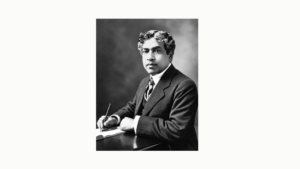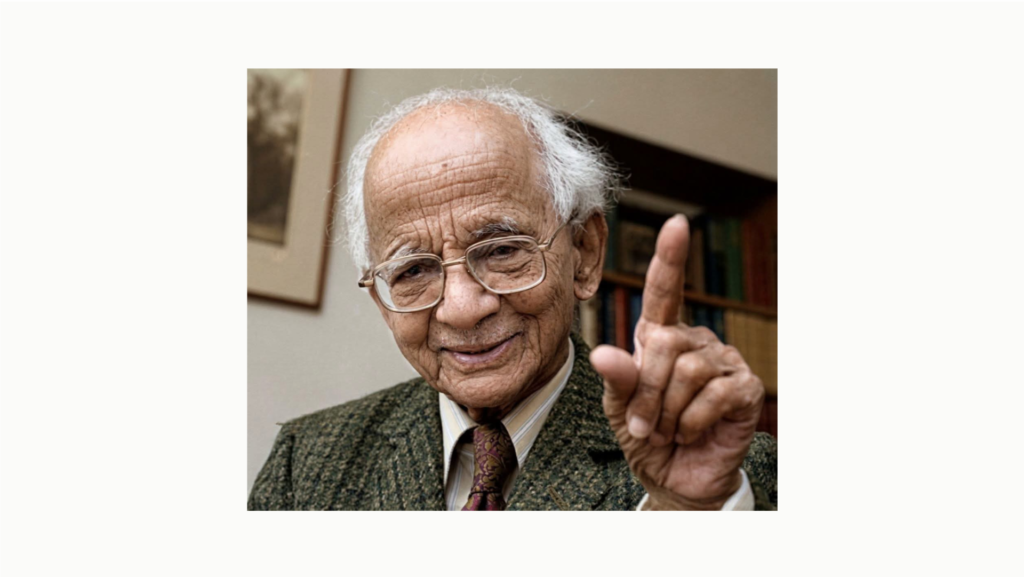
Nirad Chandra Chaudhuri, widely known internationally as Nirad C. Chaudhuri, remains one of the most distinctive, intellectually gifted and controversial figures in Bengali literature and cultural thought. A prolific essayist, author, historian, biographer and cultural commentator, he possessed an exceptional command of both Bengali and English. Renowned for his unconventional perspectives, sharp observations and fearless criticism, Chaudhuri made a lasting contribution to discussions on history, society, civilisation and the complexities of the Bengali identity. He also wrote under the pseudonym ‘Balahak Nandi’.
Born on 23 November 1897 in Kishoreganj, then part of the Mymensingh district of eastern Bengal under British India, Chaudhuri grew up in an educated and culturally conscious family. His father, Upendra Narayan Chaudhuri, was a lawyer, while his mother was Sushila Sundari Chaudhurani. He was the second of eight siblings. His early surroundings encouraged an interest in books, history, literature, philosophy and Western civilisation, interests that would eventually shape his intellectual outlook and literary career.
Chaudhuri began his education in Kishoreganj before moving to Calcutta for higher studies. He enrolled at Ripon College, where one of his contemporaries was the celebrated Bengali novelist Bibhutibhushan Bandyopadhyay. He subsequently studied history at Scottish Church College and obtained his bachelor’s degree. Although he later enrolled for postgraduate studies at the University of Calcutta, he did not complete the programme, as he failed to sit the final examinations.
His professional life began with a position in the military accounts department. However, his growing interest in public affairs and intellectual pursuits gradually drew him towards journalism, editing and writing. He worked with several publications, including the influential literary and political periodical The Modern Review. For a period, he also served as private secretary to Sarat Chandra Bose, the elder brother of Indian nationalist leader Subhas Chandra Bose.
During the 1940s, Chaudhuri joined All India Radio as a political commentator. His experience in broadcasting provided him with an opportunity to engage with contemporary political developments and communicate his views to a wider audience. Yet, it was his first major book that would establish his reputation far beyond the Indian subcontinent.
Published in 1951, The Autobiography of an Unknown Indian became his most celebrated and internationally recognised work. The book offered a deeply personal account of his upbringing, intellectual development and observations of Indian society under British colonial rule. It also examined the influence of British institutions, education and culture on the Indian subcontinent.
The book generated considerable controversy, particularly because of its dedication, in which Chaudhuri expressed an unusually favourable assessment of the British Empire. His position provoked strong reactions among sections of the Indian intellectual community, many of whom regarded his views as deeply problematic in the context of the country’s colonial experience and struggle for independence. The controversy also had professional consequences, and he lost his position at All India Radio.
In 1955, Chaudhuri travelled to England for the first time at the invitation of the British Council and the BBC. His experiences during the visit inspired another notable work, A Passage to England, in which he explored British society, customs, institutions and cultural traditions through the perspective of an Indian intellectual. The book further demonstrated his ability to examine cultural differences with a combination of curiosity, historical awareness and critical insight.
In 1970, he settled permanently in Oxford, England, where he spent the remaining years of his life. His relocation did not diminish his connection with Bengali and Indian intellectual traditions. Instead, he continued to write about the history, culture and social characteristics of the subcontinent, often from a perspective shaped by his experiences of both Eastern and Western societies.
His major English-language works include The Autobiography of an Unknown Indian, A Passage to England, The Continent of Circe, Scholar Extraordinary, Thy Hand, Great Anarch! and Three Horsemen of the New Apocalypse. His important Bengali publications include Bangali Jibane Ramani, Atmaghati Bangali, Amar Debottor Sampatti and Bangali-r Swarup.
Among his Bengali writings, Atmaghati Bangali (The Self-Destructive Bengali) remains particularly influential and controversial. In this work, he examined what he perceived as the weaknesses, self-deception, historical amnesia and social decline within Bengali society. His criticism extended to the community’s collective mentality, cultural attitudes and responses to changing circumstances.
One of the defining characteristics of Chaudhuri’s writing was his willingness to challenge established assumptions. He frequently approached history and civilisation from unconventional angles, refusing to accept popular interpretations without questioning their foundations. His observations about Bengali identity and society often provoked intense debate. While admirers regarded him as an exceptionally perceptive thinker with remarkable intellectual courage, critics sometimes interpreted his comments as evidence of an anti-Bengali outlook.
His international reputation was reinforced by several prestigious awards and honours. In the 1960s, he received the Duff Cooper Memorial Prize for The Continent of Circe. In 1975, India’s Sahitya Akademi recognised his biographical work Scholar Extraordinary, which explored the life and achievements of the distinguished German-born scholar Max Müller.
In 1990, the University of Oxford awarded him an honorary Doctor of Letters degree in recognition of his intellectual contributions. Two years later, the British Government appointed him a Commander of the Order of the British Empire (CBE). In 1997, he received the Vidyasagar Award as well as the Desikottama honour from Visva-Bharati University.
Beyond his literary achievements, Chaudhuri was known for his confidence, outspoken nature and uncompromising personality. He rarely hesitated to express opinions that challenged prevailing sentiments, even when doing so exposed him to criticism. His intellectual positions were not always welcomed, but his scholarship, historical knowledge and command of language established him as a significant figure in twentieth-century literary and cultural discourse.
Nirad C. Chaudhuri died on 1 August 1999 in Oxford, England, at the age of 101. Remarkably, he remained intellectually active and continued writing well into his later years. His long life spanned an extraordinary period of historical transformation, encompassing colonial India, the independence movement, the emergence of modern nation-states and major changes in global intellectual thought.
There is an important aspect of his legacy that deserves particular attention in Bengal. Kishoreganj, the place where he was born and spent his early years, remains an essential part of his personal history. Yet, his international recognition and literary reputation have arguably received greater attention abroad than his birthplace has given to his life and contributions. Even in Oxford, where he spent the final decades of his life, his intellectual legacy continues to be remembered.
Chaudhuri was not a writer whose views could easily be accepted or dismissed. His arguments frequently challenged readers, forcing them to reconsider familiar ideas about history, culture and identity. Agreement with his opinions is not a prerequisite for recognising the significance of his intellectual contributions. Rather, his ability to question established beliefs, examine complex historical developments and articulate unconventional arguments remains central to his importance as a writer and thinker.
On the anniversary of his birth, the celebrated literary figure and intellectual who emerged from the soil of Bengal deserves to be remembered with deep respect. His ideas may continue to invite disagreement, but his extraordinary literary legacy and place in the history of Bengali and international intellectual thought remain undeniable.