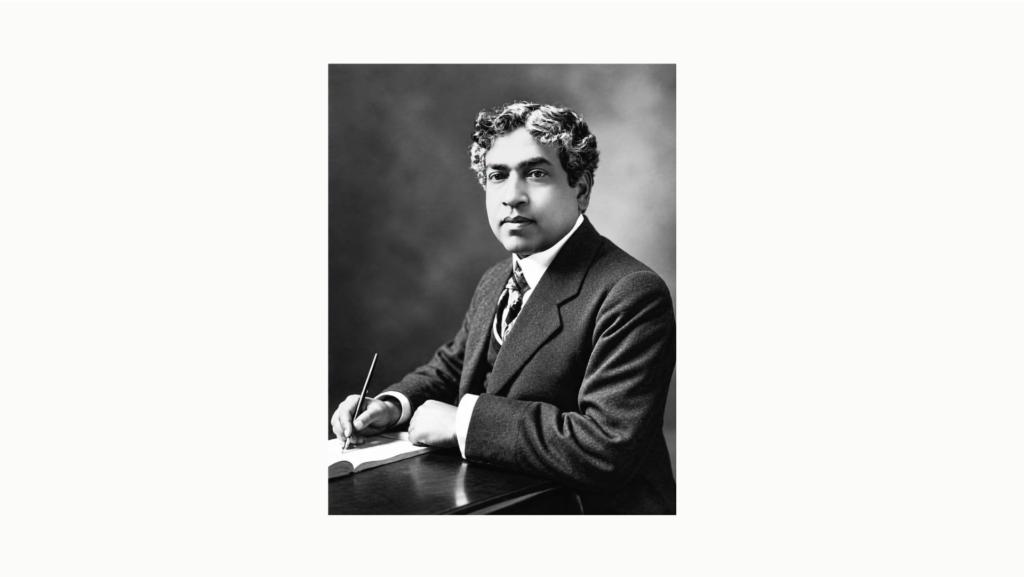
Bose was among the earliest scientists in the Indian subcontinent to conduct advanced experimental research under colonial rule. His work on electromagnetic and microwave waves demonstrated the possibilities of transmitting signals without physical connections, while his later experiments revealed that plants respond to external stimuli. His achievements continue to hold an important place in the history of modern science.
Born on 30 November 1858 in Mymensingh, in what was then British India and is now Bangladesh, Bose grew up in a family that valued education, intellectual curiosity and social responsibility. His father, Bhagawan Chandra Bose, served as a deputy magistrate and was also involved in social reform. His mother was Bama Sundari Devi. The family’s ancestral home was in Rarikhal village in Bikrampur, now part of Sreenagar Upazila in Munshiganj district.
His early education began at a Bengali-medium school in Faridpur. His father believed that children should first become familiar with their own language, culture and society before pursuing education in foreign languages. This approach helped shape Bose’s outlook and strengthened his connection with his cultural roots.
He later studied at Hare School and St Xavier’s School in Calcutta. After passing the entrance examination in 1875, he enrolled at St Xavier’s College, where he developed a growing interest in science. In 1879, he graduated in science under the University of Calcutta.
A major influence during his college years was Father Eugene Lafont, a renowned teacher of science and physics. Lafont’s teaching and experimental demonstrations helped deepen Bose’s fascination with the physical sciences and encouraged him to pursue scientific research.
In 1880, Bose travelled to England for higher education. He initially enrolled to study medicine in London but was forced to abandon the course because of health problems. He subsequently joined Christ’s College at the University of Cambridge, where he studied natural sciences. In 1884, he completed the Natural Sciences Tripos at Cambridge and obtained a Bachelor of Science degree from the University of London in the same year.
Returning to India, Bose joined Presidency College in Calcutta as a professor of physics in 1885. His early academic career, however, was marked by racial discrimination under British colonial administration. Indian lecturers were treated unequally and received lower salaries than their European counterparts, despite performing comparable duties.
Bose protested against this discriminatory arrangement by refusing to accept his salary for an extended period while continuing to fulfil his teaching responsibilities. His decision reflected his determination to defend professional dignity and equality. Eventually, the college authorities recognised his position and agreed to grant him the same salary as European professors, including retrospective payment for the period during which he had refused to accept his wages.
Groundbreaking research into wireless communication
In 1894, Bose began conducting experiments on electromagnetic waves, a field that was attracting considerable scientific interest following the theoretical work of James Clerk Maxwell and the experimental demonstrations of Heinrich Hertz.
His research focused particularly on extremely short electromagnetic waves, now commonly associated with the microwave region. He developed equipment capable of generating, transmitting and detecting these waves, making significant contributions to the experimental study of wireless technology.
In 1895, he demonstrated the transmission of electromagnetic signals through walls at Calcutta’s Town Hall. The experiment showed that signals could travel across physical barriers without requiring a connecting wire. It attracted considerable attention and established his reputation as an innovative experimental physicist.
One of his important contributions was the development of a highly sensitive detector, based on the coherer principle, capable of receiving electromagnetic signals. His work also involved improvements in microwave-generating and receiving apparatus, which helped advance understanding of high-frequency electromagnetic radiation.
Bose’s experiments took place before Guglielmo Marconi became widely recognised for developing practical long-distance wireless telegraphy. Although their research had different objectives and applications, Bose’s pioneering demonstrations formed an important part of the early history of radio science.
Unlike many inventors of his time, Bose was reluctant to place commercial ownership above scientific advancement. He believed that scientific knowledge should be shared for the benefit of humanity rather than restricted for personal financial gain. His approach contributed to the relatively limited commercial recognition of some of his inventions during his lifetime, despite their scientific significance.
In recognition of his academic achievements, the University of London awarded him a Doctor of Science degree in 1896.
From physics to the mysteries of plant life
Bose’s scientific interests gradually expanded beyond physics. From the late 1890s, he increasingly concentrated on investigating the responses of living organisms, particularly plants, to external stimuli.
At the time, the mechanisms through which plants responded to their surroundings were not fully understood. Bose sought to investigate whether plants exhibited measurable physiological reactions to environmental changes and whether these responses shared certain characteristics with those observed in other living organisms.
Through carefully designed experiments, he demonstrated that plants respond to a variety of external influences, including light, heat, cold, physical injury and chemical substances. He also investigated electrical responses within plant tissues, providing important experimental evidence of signalling processes in plants.
One of his most remarkable inventions in this field was the Crescograph, an extremely sensitive instrument designed to measure minute plant growth. The device magnified the movement associated with growth, allowing researchers to observe changes that would otherwise be almost impossible to detect with the naked eye.
Using this instrument, Bose investigated how plants reacted to different environmental conditions. His experiments demonstrated that even small changes in temperature, light and chemical exposure could influence plant activity and growth.
His findings encouraged scientists to reconsider the traditional view of plants as relatively passive organisms. Although some of his broader interpretations concerning similarities between living and non-living systems remain subjects of historical scientific discussion, his experimental approach represented an important contribution to plant physiology and biophysics.
Scientific publications and the establishment of Bose Institute
Bose presented his findings through several influential scientific publications. His book Response in the Living and Non-Living, published in 1902, explored the similarities and differences in the responses of living organisms and inorganic materials.
Other significant works included Plant Response as a Means of Physiological Investigation, The Nervous Mechanism of Plants and Motor Mechanisms of Plants. Through these publications, he introduced his experimental observations and theories to the international scientific community.
His commitment to institutionalising scientific research in India culminated in the establishment of the Bose Institute, known as Basu Bigyan Mandir, in Calcutta in 1917.
The institution reflected his vision of creating an independent centre where scientific research could flourish in an atmosphere of intellectual freedom and dedication to humanity. He wanted research to serve society rather than narrow commercial interests.
At its inauguration, Bose emphasised the importance of science as a shared achievement of humankind. The institute was intended to encourage original research and provide future generations of scientists with opportunities to pursue scientific inquiry. He remained its director until his death in 1937.
Today, the Bose Institute continues to be associated with his legacy and his vision of advancing scientific knowledge through independent research.
International recognition and lasting honours
Bose’s contributions earned him recognition from leading scientific institutions in Britain, Europe and elsewhere. In 1917, the British government conferred a knighthood upon him, formally recognising his services to science.
On 13 May 1920, he was elected a Fellow of the Royal Society of London, one of the most prestigious scientific honours of the time. His election reflected the international standing he had achieved through decades of research.
In 1927, he was elected president of the Indian Science Congress, further demonstrating his influence within the scientific community of the subcontinent. Two years later, he received membership recognition from the Vienna Academy of Sciences. Several scientific organisations in Europe and the United States also acknowledged his contributions through honorary memberships and other distinctions.
These honours established Bose as one of the most internationally respected scientists to emerge from colonial India.
A scientist who brought science closer to Bengali readers
Bose’s intellectual interests extended beyond laboratory research. He also believed that scientific knowledge should reach ordinary people and that the Bengali language could serve as an effective medium for communicating complex scientific ideas.
He wrote scientific essays in Bengali and made efforts to encourage scientific curiosity among readers who had limited access to formal scientific education. His literary contributions included Niruddesher Kahini, regarded as one of the early examples of Bengali science fiction.
His interest in literature and language reflected a broader belief that scientific progress should not remain confined to universities and research institutions. He wanted people to develop a rational outlook and appreciate the importance of observation, experimentation and evidence.
By writing about science in his mother tongue, Bose helped demonstrate that scientific thinking was not dependent on any particular language or cultural background.
The end of an extraordinary scientific journey
Sir Acharya Jagadish Chandra Bose died on 23 November 1937 in Giridih, in present-day Jharkhand, India, at the age of 78.
His death marked the end of a remarkable life devoted to scientific investigation, education and the advancement of human knowledge. Yet his intellectual contributions continued to influence researchers long after his passing.
His journey was particularly significant because of the circumstances in which he worked. Scientific research in colonial India faced numerous institutional limitations, and Indian scholars frequently encountered racial prejudice and unequal treatment. Bose overcame these obstacles through exceptional intellectual ability, persistence and an unwavering commitment to his principles.
His achievements also demonstrated the importance of interdisciplinary research. Moving from electromagnetic waves to the physiological responses of plants, he showed how curiosity and experimental investigation could open new avenues of scientific understanding.
The technologies and scientific disciplines associated with wireless communication, microwave research and plant physiology have developed enormously since his time. Modern science has advanced far beyond the equipment and methods available to Bose, but his early experiments remain an important part of their historical foundations.
For Bangladesh and the wider Bengali-speaking world, his legacy carries particular significance. Born in Mymensingh and connected through his ancestral roots to Rarikhal in Bikrampur, he brought international recognition to a region that had limited opportunities for advanced scientific research during his lifetime.
His life stands as a powerful example of how intellectual courage, perseverance and dedication to knowledge can overcome social and institutional barriers. He believed that scientific discovery should ultimately contribute to the welfare of humanity, an ideal that remains relevant to researchers and educators today.
Jagadish Chandra Bose was not merely a distinguished physicist or an innovative botanist. He was a visionary who crossed disciplinary boundaries, challenged conventional thinking and helped establish a culture of experimental science in the Indian subcontinent.
His scientific achievements, personal integrity and commitment to making knowledge accessible will continue to inspire generations. As one of Bengal’s greatest scientific minds and a pioneer of modern scientific research in the subcontinent, Sir Acharya Jagadish Chandra Bose deserves to be remembered with profound respect and gratitude.