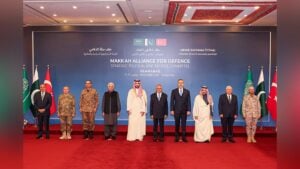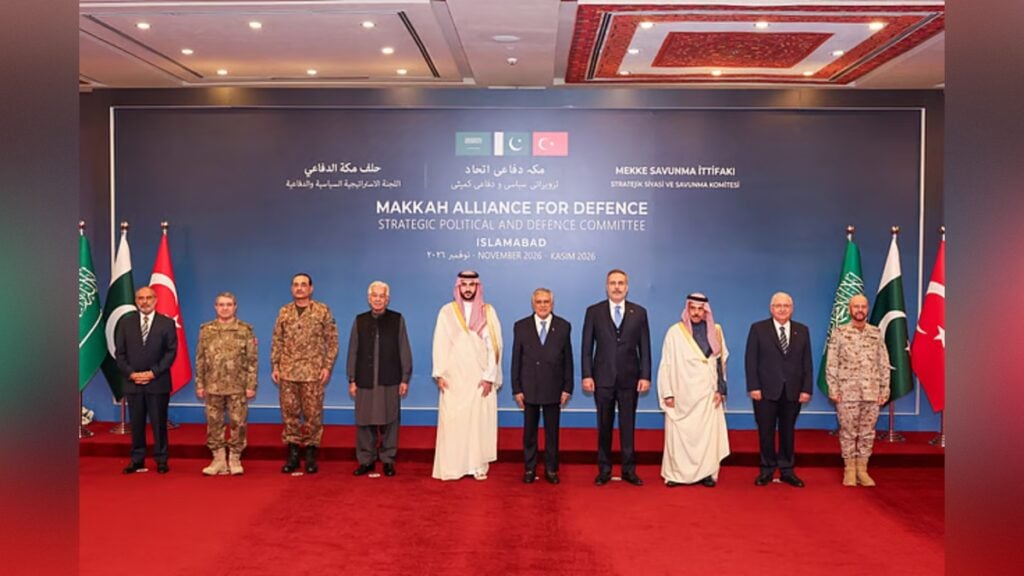
Officials from Saudi Arabia, Pakistan and Türkiye began discussions in Islamabad on Friday, with the final day of talks scheduled for Saturday. The meeting comes amid continuing regional hostilities linked to the Iran war and growing concerns over security threats facing Saudi Arabia.
The three countries signed the Mecca defence agreement on 7 August against the backdrop of the conflict, which began in February. Under the pact, an armed attack against any one of the three members is to be treated as an attack against the other two, establishing a framework for collective security and defence cooperation.
This is the third meeting between the countries since the agreement was signed. The discussions involve defence ministers from all three countries, alongside Pakistan’s Foreign Minister Ishaq Dar, Türkiye’s Foreign Minister Hakan Fidan and Saudi Foreign Minister Faisal bin Farhan.
Pakistan’s Defence Minister Khawaja Asif recently told AFP that any threat to Saudi Arabia would also constitute a threat to Pakistan and Türkiye under the agreement. He described the commitment as clear.
However, the extent to which the pact translates into direct military intervention remains uncertain, particularly as Saudi Arabia faces attacks from the Houthis.
Questions over military commitments
Despite the collective defence commitment, neither Pakistan nor Türkiye has directly intervened militarily against the Houthis following attacks on Saudi Arabia.
On 9 October, Pakistan’s Foreign Ministry clarified its position. Spokesman Sajjad Haider Khan said Pakistani troops stationed in Saudi Arabia would not enter Yemen to conduct operations against the Houthis.
The statement underscored Islamabad’s reluctance to become directly involved in the Yemeni conflict, even as it maintains military cooperation with Riyadh.
Pakistan already has a military presence in Saudi Arabia under earlier bilateral arrangements. In April, Saudi Arabia’s Defence Ministry announced that a Pakistani military contingent, accompanied by fighter aircraft and support aircraft, had arrived in the kingdom.
The deployment was made under a bilateral defence agreement signed between Islamabad and Riyadh in 2025. The Pakistani contingent was stationed at King Abdulaziz Air Base in Saudi Arabia’s eastern province.
Sydney-based security analyst Muhammad Faisal said a significant proportion of Pakistani troops currently stationed in Saudi Arabia were deployed under earlier agreements. He added that Riyadh had not pressured Islamabad to launch a direct military operation in Yemen.
Nevertheless, Umer Karim, a researcher at the King Faisal Centre for Research and Islamic Studies in Riyadh, believes Pakistan’s current position may not fully satisfy Saudi expectations.
The issue has created a delicate situation between the two allies. Greater Pakistani military involvement against the Houthis could undermine Islamabad’s diplomatic role in efforts to facilitate talks between the United States and Iran, as well as its attempts to ease tensions between Tehran and Riyadh.
Iran is regarded as the Houthis’ principal supporter, making direct Pakistani involvement against the group particularly sensitive for Islamabad.
Saudi Arabia faces mounting security concerns
The security situation in Saudi Arabia has become increasingly concerning following a series of suspected Houthi drone and missile attacks.
On 24 November, Saudi Arabia’s civil defence authorities reported that a high-rise building in Riyadh had been damaged in an attack, leaving 11 people injured.
According to Saudi government figures, at least 26 people have been killed in suspected Houthi drone and missile attacks since 23 September. Of those fatalities, 23 reportedly occurred during an attack on an airport.
The attacks have heightened concerns over the protection of civilian infrastructure, transport facilities and other strategically important sites across the kingdom.
At an emergency meeting in Riyadh on 5 October, representatives of the three countries agreed to strengthen military cooperation, including the exchange of troops and military capabilities and arrangements for their rapid deployment to Saudi Arabia when required.
However, the agreement has not resulted in a decision to deploy troops to Yemen.
On 21 November, Türkiye’s Foreign Minister Hakan Fidan said no decision had been taken on deploying troops to Yemen, while confirming that Riyadh was receiving defensive assistance.
Defence alliance likely to remain defensive
Omer Ozkizilcik, an Ankara-based analyst and Atlantic Council researcher, believes the Mecca pact is likely to remain focused on defensive measures for the time being.
He said Saudi Arabia had so far sought defensive assistance, rather than an offensive military campaign against Houthi fighters in Yemen. Consequently, he does not expect the alliance to participate in direct offensive operations against the group.
The alliance also faces limitations in its military capabilities. Ozkizilcik pointed out that none of its members is a major global power, meaning its capacity to project military force remains constrained.
The pact brings together three influential regional and middle powers, but it does not possess the military resources of a major-power alliance. Its effectiveness may therefore depend more on coordination, deterrence, military support and diplomatic cooperation than on large-scale intervention.
Pakistan caught between Riyadh and Tehran
The most difficult question for Islamabad is how it would respond if Iran directly attacked Saudi Arabia.
Khawaja Asif declined to outline Pakistan’s response to such a scenario. He did, however, identify Israel as a potential source of regional aggression, arguing that countries in the Middle East needed to strengthen unity and cooperation in the face of possible threats.
Pakistan has longstanding strategic and defence ties with Saudi Arabia, while maintaining important diplomatic and regional interests in its relationship with Iran. Any military decision involving one country could therefore have consequences for its relationship with the other.
Umer Karim said Pakistan could face increased pressure if diplomatic engagement between Iran and Saudi Arabia failed. Riyadh might then expect Islamabad to become more actively involved in countering the Houthis, potentially putting Pakistan’s relationship with Tehran at risk.
Such a scenario would complicate Pakistan’s efforts to maintain its diplomatic standing and preserve its ability to engage with both sides.
Karim said balancing the interests of the two countries was becoming increasingly difficult for Pakistan. Tehran has shown little willingness to accommodate Saudi and Pakistani concerns over Yemen, while Islamabad remains cautious about taking steps that could damage its relationship with Iran.
Despite the growing strain, he said relations had not reached a point where a complete breakdown was imminent.
The Mecca defence pact is therefore emerging as more than a military arrangement. It represents a test of Pakistan’s ability to honour its security commitments while protecting its diplomatic interests in a region marked by shifting alliances and competing strategic priorities.
For now, Islamabad appears inclined towards defensive assistance and diplomatic engagement rather than direct military intervention in Yemen. But as regional hostilities continue, maintaining that balance could become increasingly difficult.