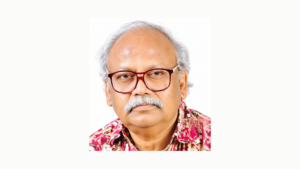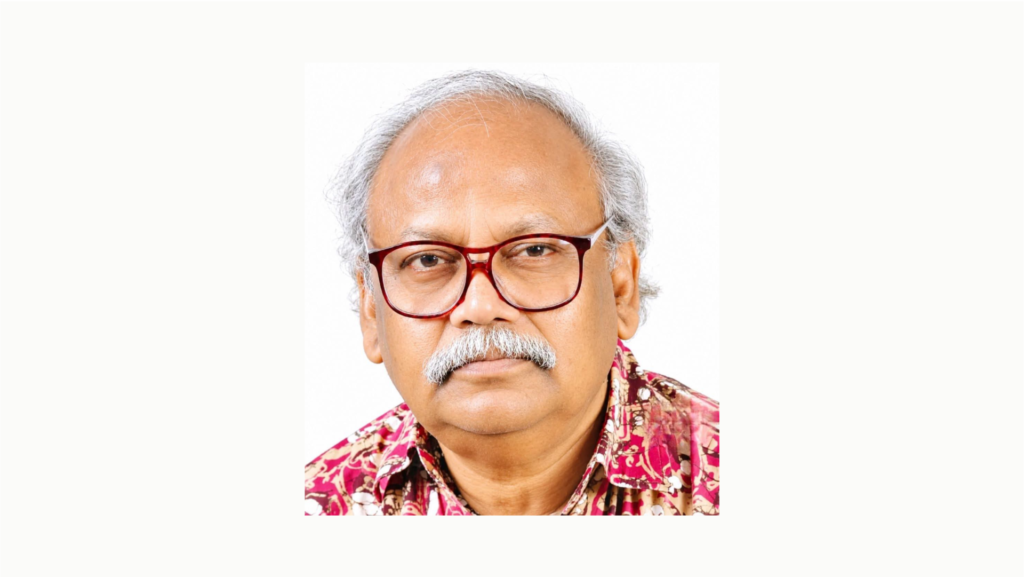
Born on 28 November 1943 in Chapainawabganj, Rafiqun Nabi is one of the most influential figures in Bangladesh’s visual arts. His father, Rashidun Nabi, was a police officer, while his mother was Anwara Begum. He is married to Nazma Begum. Although his father’s profession meant that he spent parts of his childhood in different locations across the country, much of his formative life was spent in Old Dhaka, where his interest in drawing and painting began to flourish.
His passion for art emerged at an early age, encouraged in part by his father. In 1959, he enrolled at the East Pakistan College of Art, now the Faculty of Fine Arts at the University of Dhaka. During his studies, he came under the influence of some of the country’s most prominent artists, including Shilpacharya Zainul Abedin, Safiuddin Ahmed and Quamrul Hassan. Their guidance and artistic philosophies helped shape his creative outlook. He graduated in 1964, laying the foundation for a career that would span painting, illustration, cartooning and teaching.
Following his graduation, Nabi began working in newspapers, producing illustrations and cartoons alongside his writing. His drawings for poet Abdul Gani Hazari’s popular column ‘Kal Pechar Diary’ in the weekly Purbodesh attracted considerable attention. His distinctive visual language and sharp sense of observation quickly established him as a prominent newspaper cartoonist.
On 3 August 1964, he joined Dhaka Art College as a teacher, beginning a professional journey that would become one of the defining chapters of his life. What started with teaching first-year students developed into a distinguished academic career, during which he played an important role in nurturing generations of artists.
During the Liberation War of 1971, Nabi remained in Dhaka but actively supported the freedom fighters. Alongside fellow artists, he took part in collecting money, clothing and food for those engaged in the struggle. His contribution during the war reflected not only his commitment to art but also his sense of responsibility towards the country and its people.
In 1973, he received a scholarship from the Greek government to pursue higher studies at the Athens School of Fine Arts. He specialised in printmaking, expanding his artistic knowledge and technical skills. After returning to Bangladesh in 1976, he resumed teaching and creative work, eventually progressing through the academic ranks of lecturer, assistant professor, associate professor and professor.
He served as head of the Drawing and Painting Department at the Institute of Fine Arts, University of Dhaka, from 1988 to 1991. Between 1994 and 1997, he was the institute’s director. He subsequently became the first elected dean of the Faculty of Fine Arts at the University of Dhaka. After a long and distinguished career, he retired in 2010. In recognition of his contributions to education and the arts, the university honoured him with the title of Professor Emeritus in 2023.
Tokai: A cartoon character that became a social voice
Among Nabi’s many creations, Tokai remains his most celebrated and enduring contribution to Bangladeshi cartooning. The character first appeared in the inaugural issue of the weekly Bichitra on 17 May 1978 and soon became a defining symbol of the country’s cartoon culture.
Tokai is much more than a cartoon character. Representing street children and marginalised people, he offers a perspective on society from the fringes, often exposing the realities that remain overlooked by the privileged and powerful.
Through Tokai’s seemingly simple observations and questions, Nabi has addressed hypocrisy among the wealthy, political dishonesty, administrative failures, class inequality and the everyday struggles of ordinary people. His cartoons can provoke laughter, but they frequently leave readers reflecting on uncomfortable truths.
The character’s appeal lies in the contrast between his innocent appearance and the depth of his commentary. Tokai’s words often carry powerful social and political messages, making the character relevant to readers of different ages and backgrounds. Over the decades, he has become an integral part of Bangladesh’s popular culture and a lasting example of how cartooning can serve as a vehicle for social criticism.
Nabi’s artistic achievements, however, extend well beyond cartooning. He has made significant contributions to painting, printmaking, drawing, illustration, cover design, literature and art criticism. Nature, landscapes, rural life and the emotional experiences of ordinary people have remained recurring themes in his work. His paintings reflect a distinctive aesthetic sensibility, combining an appreciation of beauty with a profound awareness of human experiences and social realities.
His artistic vision is rooted in observation, imagination and an understanding of the world around him. Whether depicting a landscape, portraying a human figure or drawing a satirical cartoon, he has consistently demonstrated an ability to transform everyday experiences into compelling artistic expressions.
Recognition and a lasting artistic legacy
In recognition of his outstanding contribution to the arts, Nabi received the Ekushey Padak, one of Bangladesh’s highest civilian honours, in 1993. He has also received numerous awards and recognitions at home and abroad for his contributions to visual arts, literature and children’s literature.
His legacy is defined not merely by the beauty or technical excellence of his creations, but by their ability to connect with people, provoke thought and preserve the spirit of their time. Through his work, he has documented social realities, reflected the aspirations and struggles of ordinary people, and encouraged audiences to look at their surroundings with greater awareness.
Rafiqun Nabi is an artist who has done more than create pictures. He has given society a mirror through which it can examine itself. His work has bridged generations, making art accessible to a wider audience while maintaining its intellectual depth and artistic integrity.
On his birthday, admiration and heartfelt greetings are extended to this distinguished artist. His creativity, wisdom and dedication to art continue to inspire younger generations of artists and admirers.
May Professor Rafiqun Nabi enjoy good health, longevity and a fulfilling life. May the light of his artistic vision continue to enrich Bangladesh’s cultural landscape, and may his creations remain alive in the memories of people and in the history of the nation’s art.
Happy birthday to the beloved artist Ronabi.