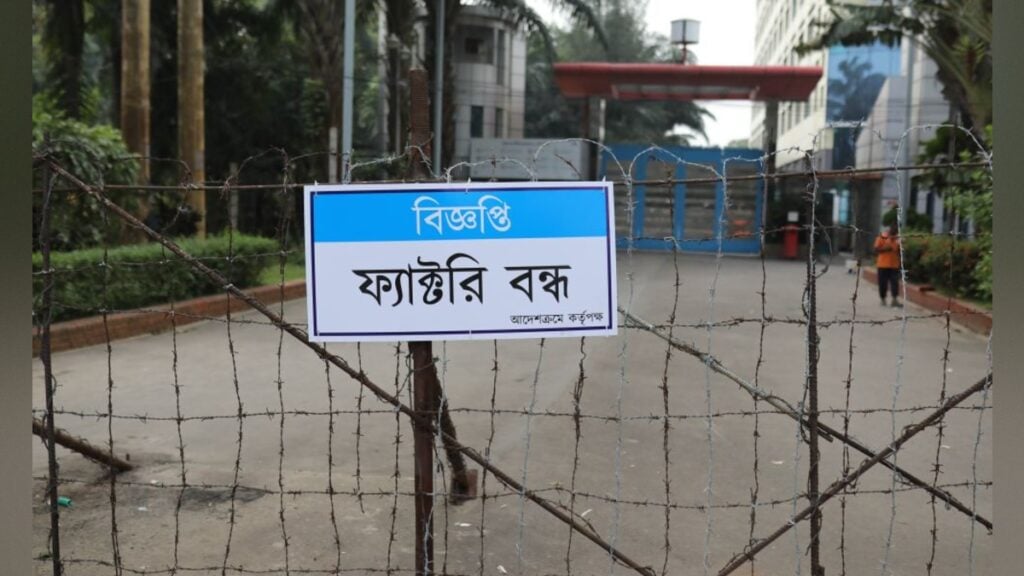
The proposed shutdown has raised fresh concerns about the stability of Bangladesh’s ready-made garment (RMG) sector, particularly its ability to meet international export commitments. A prolonged closure could affect workers’ livelihoods, disrupt existing supply chains and undermine the confidence of overseas buyers.
According to industry sources, production was suspended at 143 garment factories in Ashulia, Jamgora and Hemayetpur on Wednesday amid continuing labour unrest. Although workers entered factory premises, many refused to participate in production. Some reportedly marked their attendance before leaving the premises, while incidents of vandalism were also reported at several factories.
The disruption has become particularly serious at establishments where production has remained suspended for up to 11 consecutive days. Such prolonged interruptions are placing considerable pressure on manufacturers, who must meet operational expenses while struggling to fulfil existing orders.
Shovon Islam, managing director of Sparrow Group, said factory owners had reached an initial decision, following recommendations from industry leaders attending Wednesday’s meeting, to close 210 factories in Ashulia and other areas affected by labour unrest indefinitely.
He said the final decision would be announced following consultations with all members at Saturday’s meeting.
Mohammad Rashed, vice-president of the Bangladesh Knitwear Manufacturers and Exporters Association (BKMEA), said the situation had become increasingly difficult for factory owners.
Workers were refusing to work at some establishments, while vandalism had been reported at others. At the same time, discussions over wages were continuing, making it increasingly challenging to maintain normal operations.
Rashed also expressed concern about how factory owners would pay workers’ salaries if production remained suspended for an extended period. With some factories already facing 11 days without production, the financial burden on manufacturers is growing.
Around 300,000 workers could face uncertainty
Ashulia and Savar are among Bangladesh’s major garment manufacturing centres, hosting several prominent industrial groups, including Ha-Meem, New Age, Ananta Garments, Sterling, Envoy, Islam and Dekko.
According to information from the Bangladesh Garment Manufacturers and Exporters Association (BGMEA), approximately 300,000 workers are employed in factories across these areas.
The potential closure of 210 factories could therefore have serious consequences for employment and household incomes. Many workers depend on regular factory wages to support their families, leaving them particularly vulnerable to prolonged industrial shutdowns.
The impact could also extend beyond factory workers and owners. Businesses involved in transporting goods, supplying raw materials, packaging and other supporting services may experience disruptions if manufacturing activity remains suspended.
Several factory owners have already issued closure notices under Section 13(1) of the Bangladesh Labour Act. The provision allows employers to close an establishment, either partially or entirely, in circumstances involving an illegal strike.
However, workers’ entitlement to wages during such closures is subject to specific legal conditions and limitations. The implications for employees will therefore depend on the circumstances of each closure and the applicable provisions of labour law.
Export orders face delivery risks
The possibility of an indefinite shutdown has also raised concerns about Bangladesh’s export commitments.
Factories in Ashulia and Savar handle orders for international buyers, many of which operate according to strict production schedules and delivery deadlines. If manufacturing remains suspended, exporters may struggle to complete existing orders and dispatch finished garments on time.
Transferring production to other factories is not an easy solution. Many establishments are already operating under pressure to fulfil their own orders and may lack the capacity to absorb additional production.
International buyers also impose specific requirements concerning designated factories, manufacturing processes and quality-control procedures. These conditions can make subcontracting production to alternative facilities difficult without the necessary approval.
Shovon Islam said manufacturers could not simply shift production to another factory through subcontracting whenever disruptions occurred.
He warned that exporters might have to arrange air freight at additional expense to meet delivery deadlines. Even then, failure to supply products on time could result in order cancellations.
Such developments could create financial losses for manufacturers and potentially affect their business relationships with overseas buyers. In an industry where delivery reliability is an important consideration, repeated production delays may also influence future sourcing decisions.
Previous closure initiative failed to resolve unrest
This is not the first time garment manufacturers have considered shutting down factories because of labour unrest.
The BGMEA had previously taken an initiative to close garment factories amid worker dissatisfaction. However, following a request from the government, factory owners agreed to keep their establishments operational.
Meanwhile, a meeting of the new wage board announced that revised wages for garment workers would take effect from December.
Following the announcement, workers returned to their workplaces in several industrial areas, including Gazipur, Mirpur in Dhaka and Narayanganj. However, unrest has continued in parts of Ashulia and Savar, where production remains disrupted.
The situation highlights the challenges of restoring industrial stability even after wage-related decisions have been announced. Differences between workers and employers, concerns over workplace conditions and disagreements surrounding labour issues can all complicate efforts to resume normal operations.
Urgent intervention needed to restore production
Industry representatives believe that a prolonged shutdown would hurt both factory owners and workers. Manufacturers could face mounting financial losses, while employees would risk losing their regular income.
The wider consequences could also be significant for Bangladesh’s export earnings and its reputation as a dependable garment supplier. The RMG sector is a major source of the country’s foreign currency earnings and provides employment to millions of people.
For international buyers, consistency in production, quality and delivery schedules remains essential. Disruptions in major manufacturing hubs such as Ashulia and Savar could therefore create difficulties extending beyond the immediate industrial areas.
Factory owners believe that resolving the unrest and restoring normal production should be treated as an urgent priority. Constructive discussions involving manufacturers, workers’ representatives and the government will be necessary to address outstanding concerns and prevent further disruption.
All eyes are now on Saturday’s meeting, where factory owners are expected to decide whether the proposed indefinite closure of 210 factories will go ahead. The outcome could have significant implications for workers, manufacturers and Bangladesh’s garment export industry.