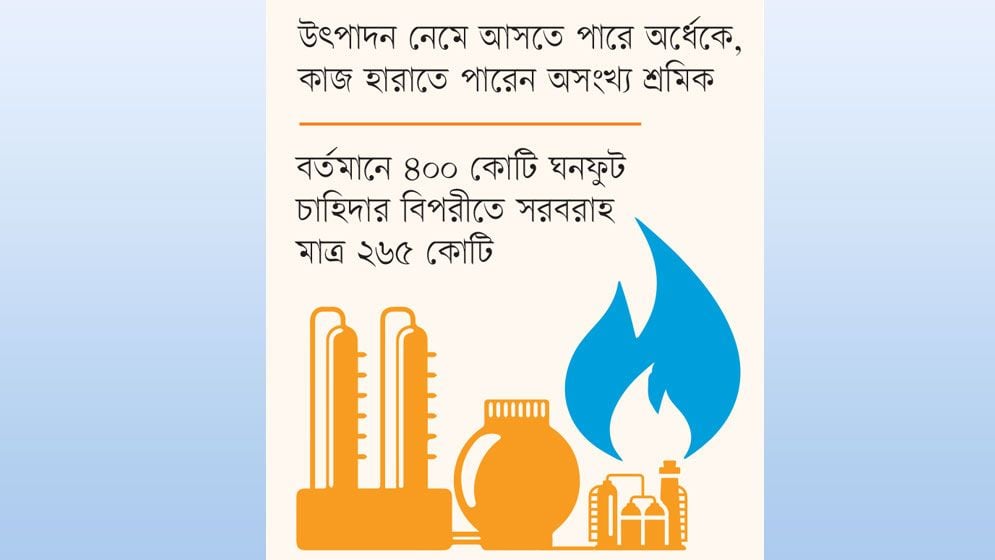
Bangladesh is heading towards a severe natural gas shortage as production from its domestic gas fields continues to decline, raising fears that hundreds of industrial factories could either shut down or drastically reduce operations between next year and 2028. Industry experts warn that unless urgent measures are taken to strengthen gas supply, the crisis could trigger widespread job losses, weaken industrial output and place significant pressure on the country’s broader economy.
The effects of the shortage are already becoming evident. Industrial zones across Gazipur, Tangail, Ashulia, Chandra, Dhanua, Rajendrapur and Konabari have experienced prolonged disruptions due to inadequate gas pressure. Residential consumers in parts of the capital have also reported that gas stoves frequently fail to function because of insufficient supply.
Shahnewaz Parvez, Managing Director of Titas Gas Transmission and Distribution Company, said that gas pressure has been falling steadily and warned that industries as well as other categories of consumers would face increasingly serious difficulties if the trend continues. According to him, the issue has already been raised with the government’s highest policy-making levels through various official forums.
The latest supply figures illustrate the scale of the challenge. Bangladesh’s daily gas demand currently stands at around 4 billion cubic feet (bcf), while only 2.656 billion cubic feet were supplied nationwide on Saturday. Of that amount, approximately 1.032 billion cubic feet came from imported liquefied natural gas (LNG), highlighting the country’s growing dependence on overseas energy sources.
The situation became particularly difficult after gas supply to the power generation sector was increased by an additional 70 million cubic feet per day. The redistribution of available gas resulted in reduced pressure across numerous industrial areas, leaving hundreds of factories struggling to maintain normal production.
According to official records, the Titas distribution network alone serves more than 4,500 industrial and captive power connections. Industry officials say that several hundred of these factories are already approaching operational shutdown because of persistent gas shortages.
The government also faces mounting pressure from investors waiting for new gas connections. A recent report from the Energy Division revealed that around 550 industrial establishments have completed required payments and have been waiting for gas connections for years. In addition, nearly 1,300 more industrial projects have pending applications. Supplying gas to these 1,800 prospective industrial consumers would require more than 400 million cubic feet of additional gas every day.
Officials within the energy sector acknowledge that supply is expected to deteriorate further over the coming years. Government projections indicate that total daily gas supply, including imported LNG, is expected to decline from the current 2.656 billion cubic feet to around 2.607 billion cubic feet by June next year and to approximately 2.57 billion cubic feet by 2028. During the same period, national demand is projected to exceed 5 billion cubic feet per day.
One of the most significant concerns is the rapid decline in domestic production. Output from Bangladesh’s 22 producing gas fields is expected to fall to only 850 million cubic feet per day by the end of 2028, compared with approximately 1.65 billion cubic feet at present.
Petrobangla has outlined plans to increase domestic production by drilling additional wells and bringing new supplies from Bhola and other fields into the national grid by 2029. The proposal includes transporting Bhola gas through a new pipeline via Barishal, although the project remains at the feasibility study stage and no implementation timeline has been confirmed.
The government is also seeking to install another floating LNG terminal capable of supplying an additional 600 million cubic feet of gas per day by 2029. However, officials have yet to select a contractor for the project despite several months of deliberation, raising concerns about potential delays.
Offshore exploration represents another long-term strategy. An international bidding round for offshore oil and gas exploration in the Bay of Bengal was launched in May, with bids expected in November. Even if international energy companies participate, negotiations, exploration activities and eventual production would require several years before contributing to domestic supply.
Petrobangla officials acknowledge that natural gas production from existing fields has been declining by roughly 15 million cubic feet annually, while demand continues to rise much faster. Previous efforts to reverse the trend have produced only limited results. More than 20 wells have reportedly been drilled over the past four years, yet they have added less than 50 million cubic feet of daily production.
The decline is visible across many of Bangladesh’s largest gas fields. Bibiyana, operated by Chevron, previously produced around 1.2 billion cubic feet per day but now generates about 746 million cubic feet. Titas has fallen from 542 million to 327 million cubic feet, while Habiganj has declined from 225 million to 102 million cubic feet per day. Bakhrabad, Moulvibazar, Bangura and Sylhet gas fields have also experienced substantial reductions in output as reserves mature and natural depletion accelerates.
Energy specialists warn that without significant new discoveries, faster infrastructure development and timely investment in both domestic production and LNG import facilities, Bangladesh could face prolonged energy shortages. Such a scenario would threaten industrial competitiveness, discourage new investment, disrupt manufacturing supply chains and undermine economic growth in the years ahead.