Khabowrala online Desk
Published: 23 Mar 2026, 03:28 pm

The Bangladesh Bank’s proposed amendment to the Bank Companies Act, aimed at restricting shareholding by individuals, families, and institutions across multiple banks, has met with strong opposition from bank owners and industry representatives.
Under the draft amendment, no individual, family member, or institution would be allowed to hold more than 5% of shares in multiple banks, either directly or indirectly. The central bank justifies the move as a measure to reduce conflicts of interest and curb undue influence over bank decision-making, citing recent experiences of mismanagement and financial irregularities in the sector.
A consultation meeting was held last Wednesday by the Financial Institutions Division (FID) of the Ministry of Finance, chaired by its secretary, Nazma Mobarak, to collect feedback on the proposed changes. The draft proposes adding three new subsections to Section 14(k) of the Bank Companies Act 2025, with the primary goal of preventing any individual or institution from exercising control over multiple banks simultaneously.
Key provisions of the draft include:
Currently, under the existing Bank Companies Act, there is no restriction on cross-holdings, and a shareholder may hold up to 10% of a bank’s shares, exercising full voting rights on a “one share, one vote” basis.
Representatives from the Bangladesh Association of Banks (BAB) strongly opposed the proposed limits. They argue that ordinary shareholders cannot influence bank policies directly; rather, the board of directors holds decision-making power. BAB further stated that since limits on family representation on boards have already been proposed, additional restrictions on shareholding are unnecessary.
Conversely, Bangladesh Bank officials cited cases where a large industrial group controlled majority shares in six banks, enabling them to influence policy decisions, siphon off funds, and harm depositors. Compensation for depositors of five merged private banks last year cost the government BDT 20,000 crore, highlighting the stakes involved.
Financial Institutions Division Secretary Nazma Mobarak said the draft amendment requires further deliberation, noting that differences persist between the central bank and BAB over shareholding caps. She indicated that representatives from both sides have been asked to reach a consensus at the next meeting.
BAB has proposed defining “family” strictly as spouses and dependent members and increasing the aggregate family holding limit to 25%, arguing that broader definitions could unfairly restrict legitimate entrepreneur families. The association emphasises that any legislative reform should avoid unnecessary rigidity.
| Feature | Proposed Amendment / Current Practice |
|---|---|
| Maximum shares in multiple banks | 5% per individual/family/institution (proposed) |
| Aggregate limit for families | 25% (BAB proposal) |
| Voting rights cap | 5% maximum, except for govt/non-profit/strategic investors |
| Current maximum shareholding per bank | 10% per shareholder (existing law) |
| Board influence | Ordinary shareholders: limited; Board of Directors: primary authority |
| Justification | Prevent undue influence, reduce conflicts, protect depositors |
| Recent incidents | Industrial group controlling 6 banks; BDT 20,000 crore paid to depositors |
The debate underscores the tension between regulatory efforts to safeguard the banking sector and concerns from bank owners about over-regulation. As discussions continue, the final version of the amendment will need to strike a balance between financial stability and operational flexibility for shareholders and entrepreneur families.

> Pakistan Role Alters Israeli Target List
> Imam and Family Brutally Attacked
> Shakira Doha Concert Cancelled Amid Tensions
> Woman Dies in Train Incident
> Foreign Debt Hits Record High
> Mbappé: A World Cup Without Neymar is Unthinkable
> Four Dead, 41 Missing After Bus Sinks at Daulatdia Ferry Terminal
> Road Deaths Spike During Eid Holiday: Discrepancies Highlighted
> Fuel Card Rule Enforced for Motorcyclists
> Nabin Fashion Branches Remain Open Amid Controversy
> Shepherd Secures $42M to Transform Commercial Insurance
> Flights Suspended Amid Regional Tensions


A teenage mosque imam and two members of his family were brutally attacked and seriously injured aft...

A woman, estimated to be around 30 years old and yet to be identified, was killed after being struck...

Bangladesh’s external debt has surged to an unprecedented level during the tenure of the interim gov...

Foreign trade between Bangladesh and the global market continues to expand steadily, driving a growi...

A landmark cultural celebration is set to take place in Dhaka this evening as the capital marks Bang...

Renowned Bangladeshi composer and singer Belal Khan continues to strengthen his reputation not only...

A newly reinterpreted rendition of the celebrated patriotic anthem “Prothom Bangladesh” is scheduled...

A sustained downturn in global gold prices appears increasingly likely as geopolitical tensions in t...

A tragic road accident in the early hours of Thursday claimed the life of a 50-year-old woman after...

Independence Day celebrations at the Sher-e-Bangla National Cricket Stadium in Mirpur once again tra...
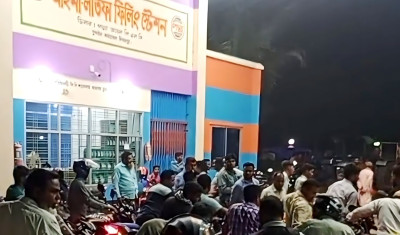
A routine visit to a petrol station turned tragic in Dinajpur’s Kaharol upazila when a 48-year-old m...
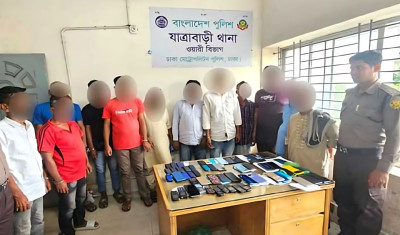
A coordinated police operation in the capital’s Jatrabari area has led to the arrest of 12 individua...


Availabe for iphone & ipads

Available in google play
 বাংলা
বাংলা