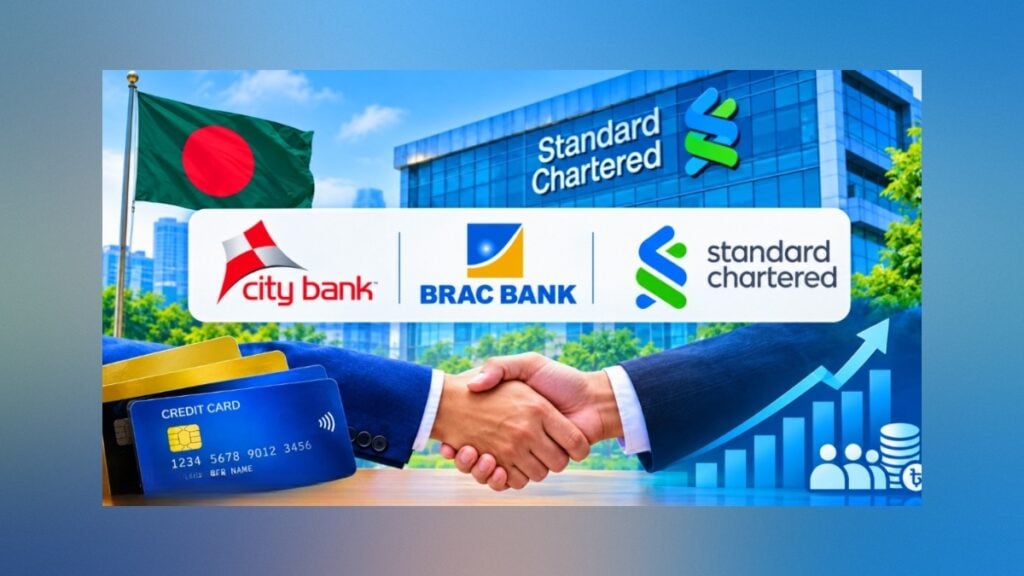
Standard Chartered Bank Bangladesh is considering an exit from its retail banking operations, with BRAC Bank and City Bank emerging as potential buyers in preliminary discussions. However, no final decision has been made and no formal agreement has been signed between the parties.
People familiar with the matter said Standard Chartered has been exploring options to wind down its retail banking business in Bangladesh or transfer the operations to another financial institution. As part of that process, initial discussions have taken place with BRAC Bank and City Bank, two established private-sector lenders with significant positions in the domestic banking market.
BRAC Bank Managing Director and Chief Executive Officer Tarek Refat Ullah Khan confirmed that preliminary discussions had taken place regarding the possible acquisition of Standard Chartered’s retail operations. He said, however, that there had been no further progress on the matter so far.
A senior City Bank official also confirmed that an informal meeting had taken place with Standard Chartered Bangladesh around one and a half months ago. According to the official, the two banks were being considered because of their established market presence and reputation.
Any potential acquisition would involve several stages before it could be completed. The parties would first need to assess the value of the business, conduct audits and due diligence, and examine its assets, liabilities, loan portfolio and other obligations. Regulatory approval would also be required before any transfer could take place.
Bangladesh Bank Executive Director and spokesperson Arif Hossain Khan said the central bank was aware of Standard Chartered’s plans, but no decision had yet been taken. He said Standard Chartered, as an international bank, could make strategic decisions based on its wider global business strategy.
At the same time, the central bank expects the bank to follow all applicable rules and regulations concerning its employees if the retail business is eventually transferred or wound down. Particular attention is being given to ensuring that any changes affecting employees are handled in accordance with labour regulations and do not result in sudden job losses or labour unrest.
The possible shift comes against the backdrop of relatively modest growth in Standard Chartered’s consumer and SME lending business compared with its corporate portfolio. According to the bank’s financial statements, consumer and SME loans stood at Tk 7,333 crore in 2020. By 2025, the figure had risen to Tk 8,087 crore, representing growth of roughly 10 per cent over the period.
Corporate lending, by contrast, expanded much more significantly. Standard Chartered’s corporate loans increased from Tk 14,290 crore in 2020 to Tk 22,337 crore in 2025, a rise of around 56 per cent. The figures indicate the increasing importance of corporate and institutional banking within the bank’s business in Bangladesh.
Despite the possible restructuring of its retail operations, Standard Chartered remains a major banking institution in the country. Its Bangladesh operations recorded post-tax net profit of Tk 3,219 crore in 2025, compared with Tk 3,300 crore in 2024.
BRAC Bank and City Bank have also maintained substantial positions in the domestic banking sector. City Bank reported a record profit of Tk 1,324 crore in 2025, while BRAC Bank’s profit exceeded Tk 2,000 crore during the same year. Their financial performance is one factor behind their potential interest in expanding their respective banking businesses.
Standard Chartered has operated in Bangladesh for more than 120 years. The bank opened its first branch in Chattogram in 1905 and now operates 18 branches across major economic centres of the country.
The potential withdrawal from retail banking should not, however, be interpreted as a complete departure from Bangladesh. The bank is expected to continue its corporate and institutional banking operations, which form a significant part of its business in the country.
Standard Chartered has been reviewing its business model across global markets as part of its broader strategy. Bitopi Das Chowdhury, country head of corporate affairs and brand and marketing at Standard Chartered Bangladesh, has said the group regularly reviews the effectiveness of its global business model and focuses resources where it can serve customers more effectively.
The possible transfer of Standard Chartered’s retail business would therefore represent a significant development for Bangladesh’s banking sector, particularly if one of the two local banks eventually takes over the portfolio. For now, however, the discussions remain preliminary. Any transaction would depend on valuation, due diligence, regulatory clearance and the outcome of negotiations between the parties.
The development also follows a similar move by another international bank. HSBC announced in July 2025 that it would gradually withdraw from retail banking in Bangladesh. That decision prompted wider discussion about the changing strategies of foreign banks operating in the country’s retail banking market.
Standard Chartered’s latest move could add further momentum to that debate, although the bank’s continued focus on corporate and institutional banking indicates that its broader presence in Bangladesh is not necessarily coming to an end.