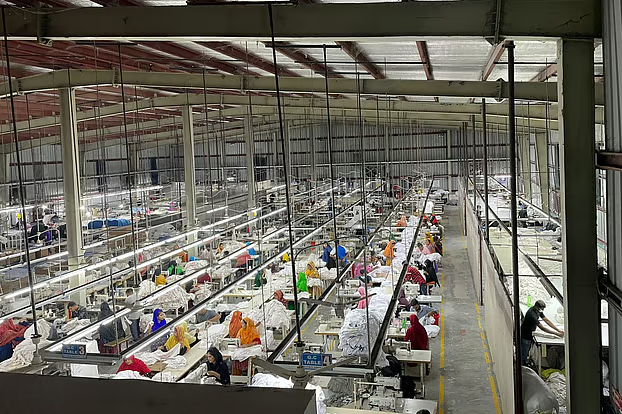
Nineteen years of relentless struggle ended in heartbreak for Mahbubul Hasan, owner of Dhaka’s Matrix Dresses. The export-oriented readymade garment factory officially shut down, leaving 177 workers and 13 staff members jobless. Persistent business slumps, international market volatility, and mounting local pressures forced the owner to permanently lock the factory gates, rendering him entirely destitute.
Mahbubul Hasan Faisal, the managing director of the firm, shared his profound failure and loss of livelihood in a message sent to a member group of the Bangladesh Knitwear Manufacturers and Exporters Association. He explained that despite exhausting every possible avenue to keep operations afloat, he could no longer sustain the enterprise. He is now actively seeking buyers for the factory machinery and assets to clear outstanding debts to creditors and suppliers.
The enterprise had humble beginnings in 2006, when Hasan launched a sub-contracting venture named Matrix Style in Mirpur alongside business partners. Disagreements with partners caused that initial initiative to collapse, prompting him to use 2.6 million taka in accumulated savings to establish Matrix Dresses in 2009. Early operations involved utilizing external licences to export garments, which unfortunately triggered financial losses. He eventually secured his own licence in 2011 and relocated the factory to a rented shed in Rupnagar, Mirpur, enabling direct exports.
Following the Rana Plaza tragedy, safety compliance mandates deemed the factory building risky, forcing a relocation to a rented shed near the Botanical Garden area in Mirpur toward the end of 2022. That transition ushered in the company’s golden era. By 2023, the factory exported garments worth approximately 4.1 million US dollars, equivalent to over 440 million taka. Regular buyers included well-known retail brands across ten to eleven European nations, including Poland, France, Germany, Spain, and Austria.
The downward spiral accelerated in December 2023, when the government raised the minimum monthly wage for garment workers from 8,000 taka to 12,500 taka. While production and operational costs multiplied rapidly, foreign buyers stubbornly refused to adjust or increase apparel purchase prices.
Without sufficient purchase orders, annual export volumes plummeted to 2.05 million dollars, before dropping further to 1.7 million dollars. Operating on sub-contracting work for the final seven to eight months failed to cover basic overheads, leaving factory rent in arrears for nine months. In a desperate bid to rescue the business, Hasan mortgaged his personal residential flat, yet that final sacrifice proved insufficient to stave off bankruptcy.
Reflecting on his journey, Hasan expressed deep anguish over how a business built brick by brick over nearly two decades left him completely ruined. His remaining objective is to find a buyer or a new owner who might revive the factory premises, allowing him to settle all liabilities and transition toward a peaceful life.