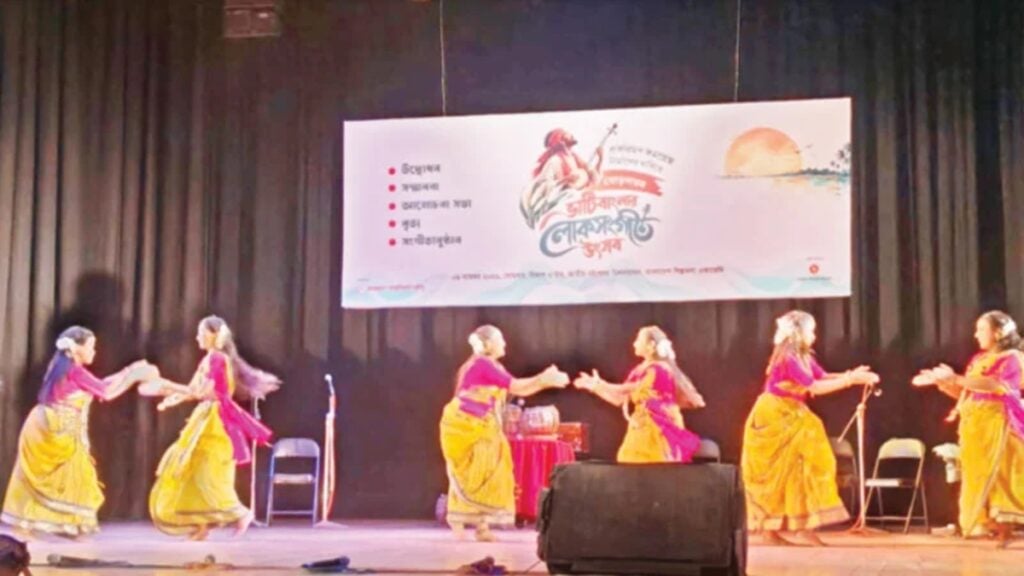
The festival celebrated the musical legacy of some of Bengal’s most influential folk composers, including Radharaman Dutta, Hason Raja, Ukil Munshi and Shah Abdul Karim. Despite persistent rain, music enthusiasts gathered on Monday evening at the National Theatre Hall of Bangladesh Shilpakala Academy in Segunbagicha to enjoy performances by folk singers from different parts of the country.
Organised by the Radharaman Sanskriticharcha Kendra, the festival has been held regularly since 2011. Over the years, it has provided a platform for preserving and promoting the traditional music of Bhati Bengal, a region whose cultural identity is closely connected with rivers, wetlands and rural life.
Previous editions were held in open-air settings. This year, however, circumstances forced the organisers to restrict the programme to a single day and move it indoors. The change in venue and schedule altered the familiar atmosphere of the festival, but the auditorium provided a setting for audiences to appreciate the region’s distinctive musical traditions.
The programme opened with a special award being presented to Baul singer Md Harun Mia, who also formally inaugurated the festival. Raised in a remote village in Sunamganj, Harun has a longstanding association with traditional folk music. Expressing his gratitude for the recognition, he paid tribute to the organisers and audience, describing the honour as a source of great happiness.
Festival chief guest Fazlur Rahman, a Member of Parliament and freedom fighter, spoke about his personal connection with the music of the haor region. He stressed that Baul music should not be viewed simply as a form of entertainment, but as an important means of nurturing humanity and keeping people’s moral consciousness alive.
“Just as human beings cannot survive without air, humanity would struggle to survive without Baul music,” he said.
He also observed that music and melody were essential to the development of civilisation. Recalling his childhood and adolescence in the Bhati region, he mentioned the compositions of Ukil Munshi, Hason Raja and Radharaman Dutta, whose songs had shaped his early understanding of the region’s cultural heritage.
Renowned music director and composer Sheikh Sadi Khan raised concerns about the declining practice of cultural activities in society. He argued that the weakening of cultural engagement was holding society back and that there could be no meaningful social progress without sustained cultural practice.
Referring to the power of music to counter destructive influences, he praised the Radharaman Sanskriticharcha Kendra for its efforts to keep traditional folk music alive. His remarks also drew attention to the importance of encouraging younger generations to engage with the country’s cultural heritage.
Music formed the heart of the evening’s programme. Performers presented a succession of compositions by celebrated mystic poets and folk musicians, including Syed Shahnoor, Radharaman Dutta, Hason Raja, Jalal Khan, Ukil Munshi, Deen Sharot, Manmohan Dutta, Shah Abdul Karim and Durbin Shah.
The performances reflected the emotional and philosophical depth of Bhati Bengal’s musical tradition. Themes of love, separation, spirituality, human relationships and the search for meaning in life featured prominently. The songs also captured the experiences of rural communities, whose lives have long been shaped by the natural environment, particularly the rivers, wetlands and seasonal changes of the haor region.
One of the defining characteristics of this music is its ability to communicate profound ideas through simple language and evocative melodies. While some compositions explore human emotions and relationships, others reflect spiritual devotion, philosophical questions and the relationship between humanity and the divine.
These songs are more than musical expressions. They preserve the memories, beliefs and collective experiences of generations, making them an important part of Bengal’s intangible cultural heritage.
The participation of artists from several districts added diversity to the festival. Alongside performers from the capital, folk musicians travelled from Sunamganj, Netrokona and Brahmanbaria to take part in the event.
A nine-member group from Sunamganj, including Ranesh Thakur and Baul Siraj Uddin, joined the programme. Five artists came from Netrokona, while three Baul singers, including Sagar Dewan, represented Brahmanbaria.
Their performances brought different regional styles and interpretations of traditional folk music to the same stage. The gathering also offered an opportunity for established practitioners from different parts of the country to exchange experiences and introduce audiences to the diversity of the Bhati musical tradition.
Alongside the performances, the proposed establishment of a Radharaman Complex emerged as a significant issue during the festival.
The Radharaman Sanskriticharcha Kendra has long been campaigning for a dedicated complex to preserve and promote the life, compositions and philosophy of Radharaman Dutta, the celebrated Vaishnava poet and mystic songwriter.
The proposed complex is expected to provide a dedicated space for preserving his works, conducting research and encouraging cultural activities centred on his musical legacy. It could also help introduce younger generations to his compositions and the philosophical traditions reflected in them.
Radharaman Dutta holds an important place in Bengali folk literature and music. His compositions, influenced by Vaishnava philosophy, explore devotion, love, separation and spiritual reflection. His songs have remained popular well beyond Sunamganj and the haor region, forming an important part of the wider Bengali cultural tradition.
In his welcome address, Biswajit Roy, general secretary of the organising organisation, explained why this year’s festival had been arranged on a smaller scale.
He said the prevailing circumstances had made it impossible to hold the event on an open-air stage, requiring changes to both the venue and schedule. Following an application from the organisation, Bangladesh Shilpakala Academy had allocated its auditorium for a single day.
Rajat Dutta delivered the opening remarks, while the programme was chaired by artist Akramul Islam. Abul Khayer also addressed the gathering. Recitation artists Rafiqul Islam and Naila Tarannum Kakoli jointly conducted the event.
Although this year’s festival was smaller than previous editions, it offered an important platform for celebrating a musical tradition closely connected with the history and identity of Bhati Bengal. The participation of artists from different districts demonstrated the continuing vitality of folk music and the commitment of its practitioners to preserving their cultural inheritance.
The festival also highlighted the need for greater institutional support for traditional artists, the preservation of important musical works and the creation of opportunities for younger generations to learn about the country’s folk heritage.
As the melodies of the mystic poets filled the auditorium, the evening became more than a celebration of music. It offered Dhaka audiences an opportunity to reconnect with the cultural roots of a region whose songs continue to express the emotions, beliefs and philosophy of generations of Bengali people.