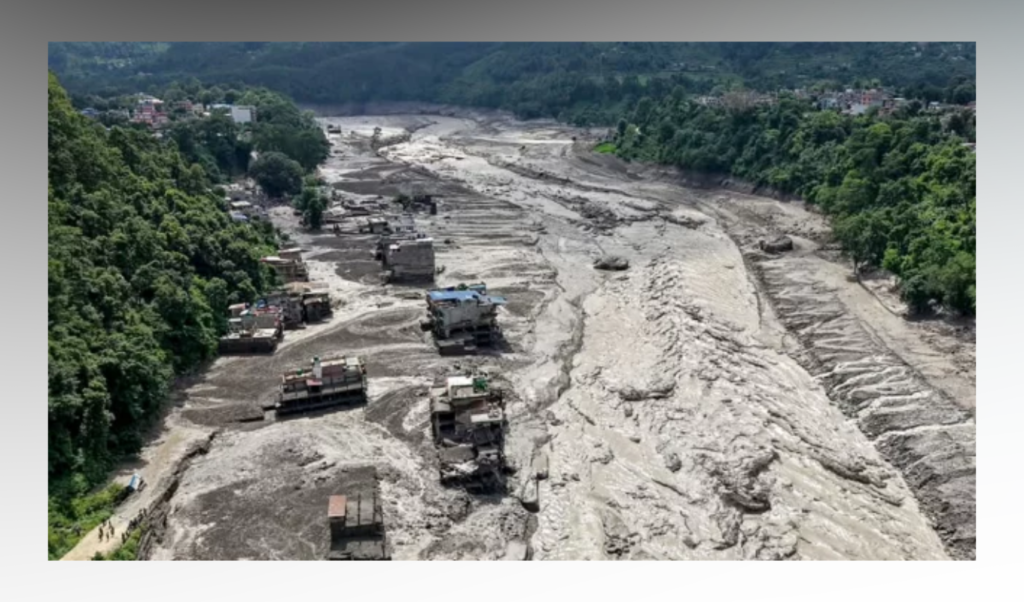
A catastrophic flash flood triggered by landslips and potential glacial disruptions along the Nepal-Tibet border has killed at least 95 people, leaving hundreds more missing across damaged Himalayan valleys. The disaster struck on Wednesday, 26 August, sending torrential surges of water, mud, and debris through mountain settlements, wiping out infrastructure and stranding scores of international travellers.
Emerging video footages and eyewitness reports paint a grim picture of the destruction. Swollen rivers breached their banks within minutes, obliterating homes, crucial arterial roads, and key hydroelectric installations. Among the missing are at least 384 tourists and trekkers who were exploring the high-altitude terrain when the torrent unleashed. According to preliminary figures from Nepalese tourism authorities, the missing foreign nationals include 105 Indians, 12 Britons, three Americans, and eight South Koreans, alongside 93 Nepalese citizens.
The disaster unfolded rapidly around 9:00 am local time along the Bhote Koshi River, which originates in Tibet before flowing south through Nepal. Official accounts suggest that the cataclysm may have been triggered by a 4.4-magnitude earthquake recorded by the German Research Centre for Geosciences (GFZ) roughly seven minutes prior to the outburst. Foreign Minister Shisheer Khanal informed parliament that seismic activity likely triggered a massive ice-and-rock avalanche into the Lende River, creating a natural dam that subsequently burst with violent force. Qianggong Zhang, representing the International Centre for Integrated Mountain Development (ICIMOD), warned that substantial debris continues to block river channels, raising acute fears of secondary upstream flooding.
The human toll has been particularly severe in Nepal’s mountainous Rasuwa District. In settlements such as Syabru Besi and Timure, rising waters completely submerged entire hamlets. Local healthcare worker Tula Bahadur BK recounted that several riverside communities were entirely wiped out, confirming that five of his own relatives remain unaccounted for. Rasuwa Chief District Officer Narendra Pariyar has ordered the immediate evacuation of all low-lying areas. However, thick cloud cover and turbulent river surges have hindered rescue operations, preventing relief helicopters from landing in affected zones.
across the border in China’s Tibet Autonomous Region, CCTV footage captured pedestrians fleeing as torrents of mud and boulders swept through the Gyirong Port crossing in Shigatse prefecture. Chinese state news agency Xinhua reported that landslips severed telecommunications, power grids, and road networks. President Xi Jinping ordered an all-out emergency response, dispatching 574 rescue personnel. Progress remains agonizingly slow, with emergency teams battling mud deposits up to five feet deep.
The disaster has dealt a heavy blow to Nepal’s national energy grid. The Ministry of Energy confirmed that damage to multiple hydroelectric plants along the river basin shut down roughly 430 megawatts of capacity—representing 12 per cent of the country’s total electricity supply.
Prime Minister Balendra Shah announced that the Nepalese Army and Armed Police Force have been deployed to lead search-and-rescue efforts. Concurrently, government spokesman Sasmita Pokharel indicated that formal requests for international assistance were extended to neighbouring powers. Indian Prime Minister Narendra Modi offered complete humanitarian support, coordinating joint relief efforts. The crisis also prompted flood warnings across downstream Indian states, particularly Uttar Pradesh and Bihar, as water flows heavy into the Gandak River system.
The Himalayan region remains exceptionally vulnerable to such outburst floods. Just last year, a glacial lake outburst in Tibet breached the very same river basin, killing nine people and leaving 24 missing. As search operations continue under treacherous conditions, authorities warn that the casualty figure may rise further as access is restored to isolated mountain enclaves.