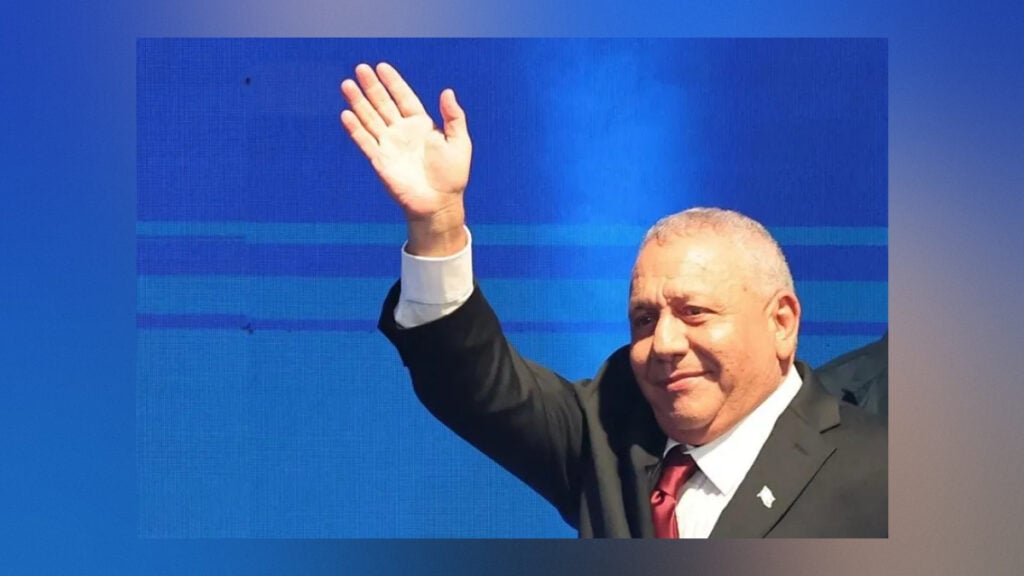
Israel’s political landscape has entered a new phase after former military chief and Yashar Party leader Gadi Eisenkot was tasked with forming the country’s next government. President Isaac Herzog has chosen the opposition figure over incumbent Prime Minister Benjamin Netanyahu, raising the prospect of a major political shift after years of Netanyahu’s dominance.
The decision was announced on Saturday evening, 8 November, with the president’s spokesperson confirming that Eisenkot would formally receive the mandate at a ceremony on Sunday, according to Al Jazeera.
The appointment followed consultations between Herzog and political parties after the general election held on 27 October failed to produce a clear parliamentary majority. During those discussions, 67 lawmakers expressed support for Eisenkot, including members of Arab-led parties. Netanyahu, by comparison, received the backing of just 46 lawmakers.
Eisenkot now has 28 days to assemble a governing coalition, with the possibility of a 14-day extension if necessary. To secure power, he must obtain the support of at least 61 members of Israel’s 120-seat parliament, the Knesset.
The election produced a fragmented political landscape. The four-party alliance led by Eisenkot secured 48 seats, while Netanyahu’s right-wing and religious bloc won 53. Neither side reached the 61-seat threshold required to govern independently.
Arab-led parties, which represent Palestinian citizens of Israel, achieved a record result by winning 19 seats. Their parliamentary strength could prove decisive in determining the country’s next government.
Despite the potential importance of their support, Eisenkot has ruled out forming a formal coalition with the Arab-led parties. Their backing, however, could raise his bloc’s effective support to 67 seats. Alternatively, support from the ultra-Orthodox parties United Torah Judaism and Shas could provide the 61 seats needed for a parliamentary majority.
Another possibility is the formation of a minority government. Under this arrangement, Eisenkot could govern without a formal majority coalition, provided he secured sufficient support to win a parliamentary confidence vote.
Reporting from Ramallah in the occupied West Bank, Al Jazeera correspondent Nour Odeh said Herzog’s decision had been widely anticipated because Eisenkot had secured support from the largest number of lawmakers. However, the challenge now lies in assembling a government that reflects campaign commitments while withstanding pressure from the right-wing opposition led by Netanyahu.
Opposition Parties United to Remove Netanyahu
Eisenkot brings considerable military and political experience to the task. He served as chief of staff of the Israeli military from 2015 to 2019. Following the outbreak of Israel’s war on Gaza in October 2023, he also served as an observer in Netanyahu’s wartime cabinet for the first eight months of the conflict.
Speaking to Al Jazeera on Saturday, Ahmed Tibi, a senior figure in the Joint List alliance of Arab-led parties, said Herzog’s decision had been expected. However, he acknowledged that there had been concerns about the possibility of a national unity government based on a power-sharing arrangement between Eisenkot and Netanyahu.
Tibi said the decision to give Eisenkot the mandate had brought relief to his political camp, creating a significant opportunity for the opposition to establish a new government.
He suggested that Eisenkot might form a minority government with support from Arab-led parties without formally including them in the governing coalition. Although such an arrangement would not fully meet the expectations of those parties, Tibi said their immediate priority was to remove the government associated with Netanyahu, Itamar Ben-Gvir and Bezalel Smotrich from power.
The political tensions intensified shortly before Herzog announced his decision. Netanyahu warned that an opposition government relying on support from Arab-led parties would place Israel’s existence at risk.
In a video address, Netanyahu claimed that a government dependent on Islamist parties would undermine the Israeli state from within. He also suggested that the situation in Israel could become worse than developments in parts of Europe, where far-right groups have repeatedly raised concerns about the influence of Islamic law.
Tibi strongly rejected Netanyahu’s characterisation of the Arab-led parties. He said Netanyahu had portrayed them as supporters of terrorism and terrorists. In response, Tibi accused the Israeli prime minister of being the region’s greatest terrorist and of acting as a principal supporter of Jewish terrorism, particularly in the occupied West Bank and other Palestinian territories.
Al Jazeera correspondent Nour Odeh observed that, although Eisenkot had publicly expressed reluctance to form a government with Arab-led parties, both sides shared an important political objective: ending Netanyahu’s tenure as prime minister.
That common interest could become a decisive factor in the negotiations, particularly if the Arab-led parties agree to provide parliamentary support without joining the coalition.
What Happens if Eisenkot Fails?
Israel’s parliamentary system provides several stages for government formation if the initial candidate cannot secure sufficient support.
If Eisenkot fails to form a government within the allotted period, including any approved extension, the president can assign the task to another candidate. Should the second candidate also fail, a majority of Knesset members may nominate a third person, who will receive a final 14-day period to put together a government.
If the third attempt is unsuccessful, another general election must be held within 90 days. Netanyahu would remain as caretaker prime minister until a new government takes office.
The coming weeks will therefore be crucial for Israel’s political future. Eisenkot must navigate competing interests among opposition parties, religious factions and Arab-led lawmakers while maintaining the support that secured him the presidential mandate.
His ability to turn that support into a functioning parliamentary majority will determine whether Israel enters a new political era or returns to the ballot box, with Netanyahu potentially remaining in office in a caretaker capacity.