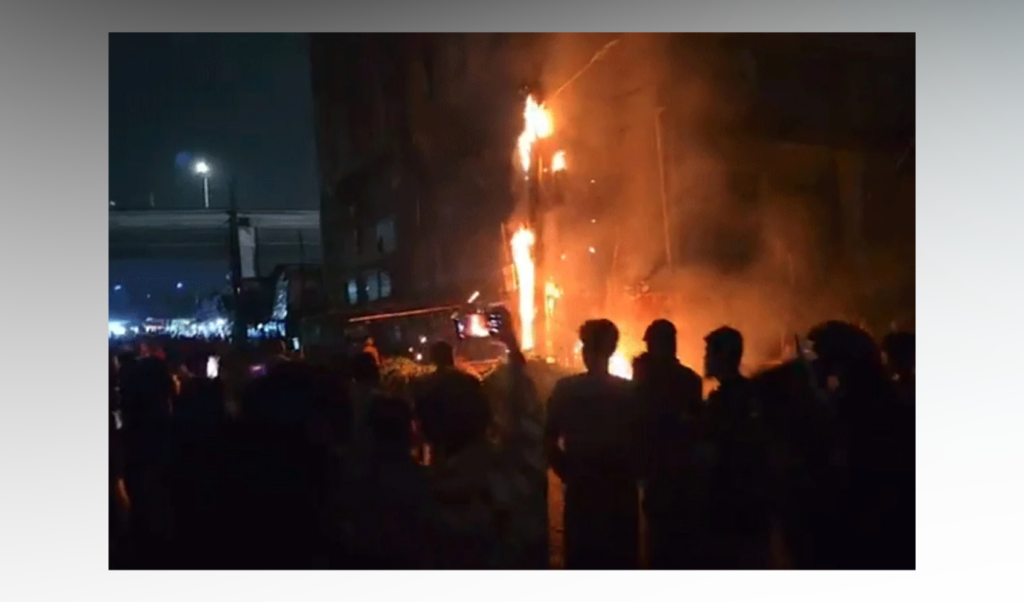
A fire broke out on a utility pole adjacent to the high-rise Janata Tower in Dhaka’s bustling Kawran Bazar area late Friday night. Fortunately, the incident resulted in no casualties, though it briefly sparked panic among local traders and late-night commuters navigating the busy commercial district. The blaze, primarily suspected to have been triggered by an electrical malfunction, illuminated the street before emergency responders arrived to swiftly bring the situation under control.
The Fire Service and Civil Defence control room received the distress call at exactly 11:35 pm. Duty officer Rafi Al Faruq confirmed that two firefighting units were immediately dispatched from the nearby Tejgaon Fire Station. Benefiting from their close proximity to the site, the crews reached the scene rapidly despite the typical nocturnal traffic of the wholesale district. Firefighters executed a targeted operation, safely navigating the live electrical hazards, and successfully extinguished the flames within twenty minutes. Their prompt intervention prevented the fire from travelling along the wires to adjacent buildings or igniting the dense web of telecommunication lines overhead.
Kawran Bazar operates as one of the most vital commercial arteries in Bangladesh. The area is essentially a round-the-clock hub, housing major corporate headquarters, software technology parks like Janata Tower, and numerous national media offices alongside the capital’s largest wholesale produce market. An outbreak of fire in such a densely populated and infrastructure-heavy zone inherently triggers high alert, as the potential for rapid escalation is immense. The quick containment of Friday’s utility fire averted what could have easily developed into a significant urban emergency.
This incident casts a renewed spotlight on the persistent hazards posed by Dhaka’s tangled overhead utility cables. For decades, the capital’s streets have been heavily draped with chaotic clusters of electrical wires, internet cables, and satellite television lines. These precarious installations remain highly susceptible to short circuits, particularly during sudden fluctuations in the power supply or changing weather conditions. While municipal authorities and utility providers have initiated long-term campaigns to move these cables underground to enhance urban safety, progress in highly congested commercial epicentres remains challenging. Consequently, minor electrical faults frequently escalate into open flames, routinely threatening pedestrians, vehicles, and adjacent properties.
Following the successful firefighting operation, utility engineers were deployed to the site to assess the compromised infrastructure and safely restore power to the affected grid. Although preliminary assessments point towards a sudden short circuit within the main power lines, a thorough inspection will be required to pinpoint the exact technical failure. Authorities have not yet released an official estimate regarding the extent of the financial damage caused to the electrical hardware. Meanwhile, regular commercial activities in the area resumed shortly after the area was declared safe by the fire brigade.