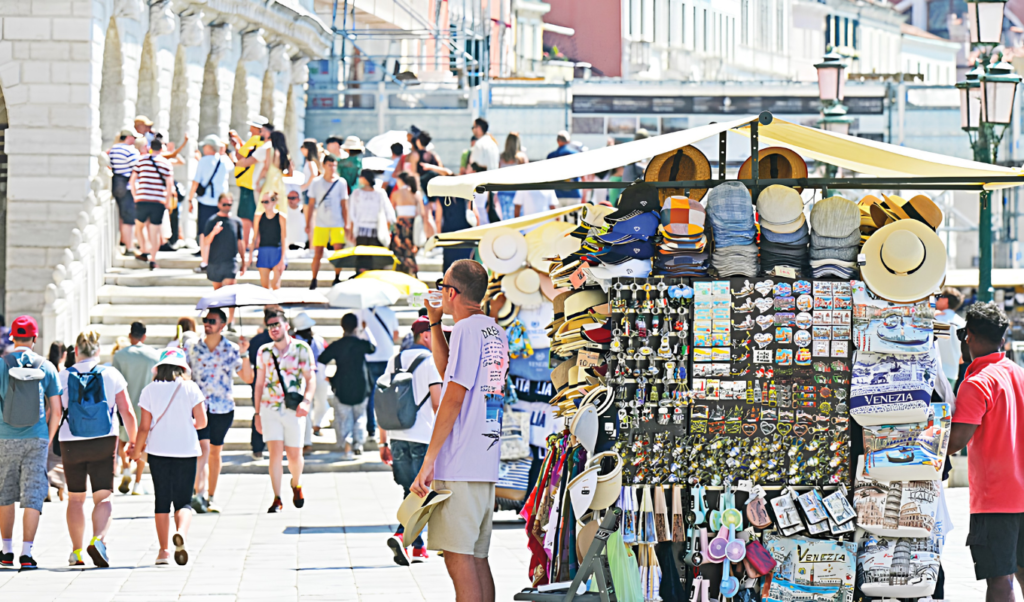
For over a century, local cafes in the Italian city of Padua have welcomed patrons for an early evening aperitivo, encouraging outdoor dining and socialising before dinner. Today, as Europe bakes under its fifth heatwave of the summer, that traditional 6 p.m. to 7 p.m. ritual has practically vanished. Pedestrians actively seek air-conditioned indoor spaces instead, causing revenues across hospitality businesses to plunge.
Compounding these operational pressures, extreme thermal conditions typically fall outside traditional business interruption policies. This exposes a expanding protection gap for commercial enterprises across the continent. Estimates published by Moody’s reveal that European heatwaves last summer cost an estimated €43 billion ($50 billion) in lost economic output. In stark contrast, insurers paid out a mere €500 million in covered claims.
In Padua, aperitivo hour now shifts much later into the evening. Federica Luni, president of the regional hospitality trade association APPE Padova, noted that outdoor seating areas, terraces, and open-air plazas remain empty during peak hours. A recent survey covering roughly 600 hospitality firms across Padua and its surrounding province revealed that over 80 percent experienced turnover drops of around 20 percent during the peak of the heatwave. Luni pointed out that a 20 percent decline in revenue effectively eliminates a small business’s entire profit margin.
Across the continent, rising temperatures are dampening productivity, curtailing consumer spending, and inflating overheads. Covering these financial hits poses a structural challenge for underwriters because the damage stems from indirect operational disruption rather than physical destruction. Swenja Surminski, managing director for climate and sustainability at Marsh, explained that heat itself is not a traditionally insured risk. Unlike severe floods or windstorms, extreme heat rarely causes catastrophic property damage, yet the financial fallout from operational disruption can prove just as devastating.
A 2023 survey conducted for Europe’s insurance regulator involving 9,000 small and medium-sized enterprises revealed that only 28 percent held business interruption coverage tied to property policies. Just 17 percent possessed non-damage business interruption protection covering events like industrial action.
As temperatures soar, economic friction multiplies. Railway lines buckle and delay transit schedules, agricultural crop yields drop, factory cooling costs skyrocket, and outdoor workforces struggle to maintain output. High-profile companies flagging quarterly earnings hits or issuing warnings tied to severe weather include Swedish shop-fitting firm ITAB Group, Italian cement manufacturer Buzzi, and French payments provider Worldline.
Part of the underwriting difficulty lies in how heat operates as a compound risk. Thermal stress routinely interacts with drought, forest fires, and water scarcity rather than triggering a single, isolated loss event, complicating risk modelling for underwriters.
The crisis is particularly pronounced in Europe, currently identified as the world’s fastest-warming continent. Data from the Reuters Climate Monitor showed that average temperatures across Western Europe reached nearly 10 degrees Celsius above the 1961–1990 baseline in mid-August. Figures compiled by environmental disclosure platform CDP indicate that 35 percent of monitored firms identify heatwaves as a principal driver of operational risk, led by manufacturing, infrastructure, service, and food production sectors.
While standard policies might compensate businesses for direct property damage or grid-level power failures, business owners maintain that such claims fail to reimburse uncaptured sales and abandoned footfall.
To bridge this financial gap, underwriters are accelerating the adoption of parametric insurance products. These contracts trigger automatic payouts whenever temperatures breach predefined numerical thresholds, bypassing the cumbersome loss-adjustment procedures required by traditional indemnity insurance. Research by KBV Research forecasts the European parametric insurance market to reach $7.93 billion by 2031, expanding at a compound annual growth rate of 9.5 percent.
Parametric solutions are already establishing a foothold in agriculture to cushion crop loss and livestock mortality. Industry specialists see potential to extend these covers into public transport and workforce safety schemes. Aidan Kerr, head of UK and Ireland public sector solutions at Swiss Re, affirmed that parametric models can play a pivotal role in mitigating climate exposures.
Nevertheless, risk experts emphasize that financial products alone cannot fully insulate the market. Companies must prioritize structural adaptation by investing in advanced cooling infrastructure, altering shift patterns, and stress-testing vulnerable supply chains to withstand an era of recurring extreme weather.