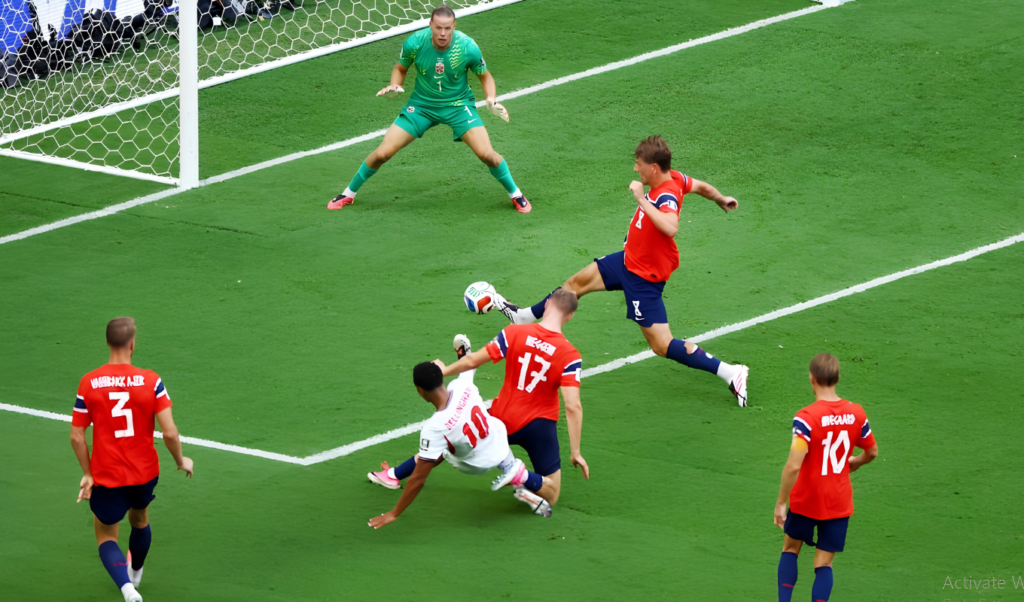
FIFA has intervened to dismiss a mounting controversy surrounding England’s equaliser during their 2-1 World Cup quarter-final victory over Norway. The governing body issued an official statement on Saturday following formal complaints that the ball had struck an overhead camera cable immediately before the goal was scored. According to FIFA’s technical experts, extensive data analysis has yielded no evidence to support the Norwegian claims.
The incident occurred at the Hard Rock Stadium during first-half stoppage time, when Jude Bellingham scored in the 47th minute (45+2′) to cancel out Norway’s opening lead. The goal sparked an immediate and furious reaction from the Norwegian players, who surrounded French referee Clément Turpin to protest.
The controversy began when Norway goalkeeper Ørjan Nyland took a standard goal-kick to launch a defensive clearance. Television replays and stadium footage showed the ball’s trajectory altering slightly mid-air before falling directly to England midfielder Elliot Anderson, who promptly initiated the attacking sequence that led to Bellingham’s equaliser. Under the official Laws of the Game established by the International Football Association Board, if a ball strikes an external fixture like an overhead spider-cam cable whilst in play, the referee must halt proceedings immediately and restart the match with a dropped ball.
Norway argued that the altered flight of the ball proved a physical deflection had occurred, which should have invalidated the subsequent phase of play. However, FIFA clarified on Saturday that the state-of-the-art “connected ball” technology used in the tournament has completely disproved this theory. The match ball contains a highly sophisticated internal chip sensor designed to track spatial movement and detect real-time impact data.
In their detailed statement, FIFA explained that the sensor tracking the “heartbeat” of the ball showed absolutely no unusual spikes or impact frequencies whilst traveling through the air during that specific passage of play. Consequently, there remains no objective proof that the ball touched any overhead cables or changed its natural trajectory due to external interference.
This high-tech ball tracking system has already played a definitive role earlier in the competition. The same connected ball system was successfully utilised to disallow a controversial goal during the knockout fixture between Croatia and Portugal. While the technological explanation clarifies the officiating decision, the incident has added another chapter of dramatic debate to this high-stakes World Cup campaign.