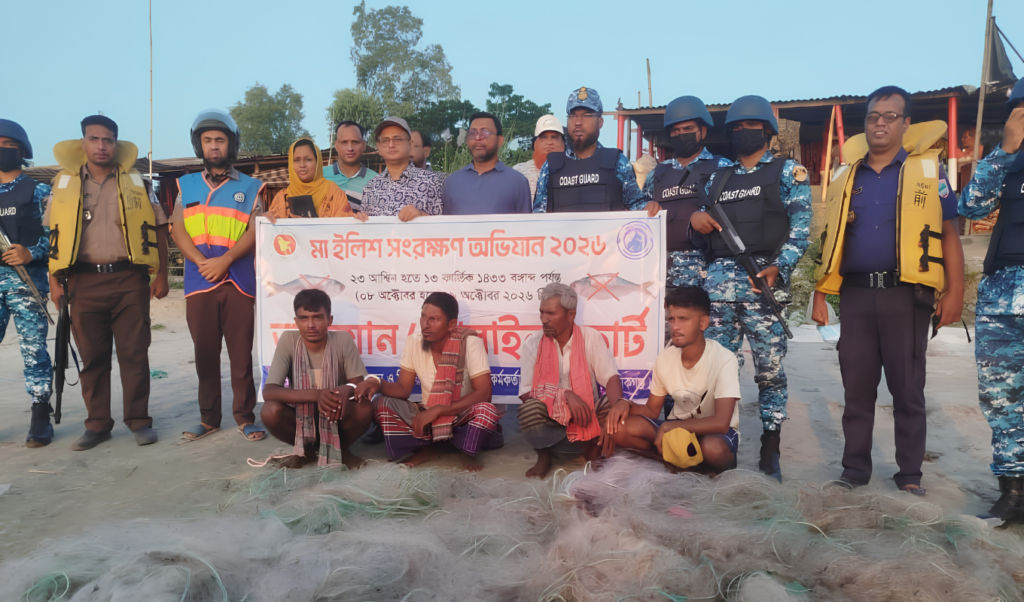
The operation was conducted on Monday, 12 October 2026, as part of the Mother Hilsa Conservation Campaign 2026. The drive covered sections of the Jamuna and Padma rivers within Shibaloy, where authorities sought to prevent illegal fishing and protect breeding fish.
The four fishermen were detained on allegations of illegal fishing. Officials subsequently brought them before a mobile court, which sentenced each to one month of imprisonment without hard labour. The seized nets, measuring approximately 30,000 metres in total, have an estimated market value of Tk 1.05 million.
The mobile court was led by Manisha Rani Karmakar, executive magistrate and upazila nirbahi officer (UNO) of Shibaloy, Manikganj.
Several senior fisheries officials attended the operation, including Mohammad Sheikh Monirul Islam Monir, district fisheries officer of Manikganj; Mohammad Delwar Hossain, senior assistant director at the District Fisheries Officer’s Office; and Sathi Rani Niyogi, senior upazila fisheries officer of Shibaloy.
Members of the Manikganj District Fisheries Office, the Shibaloy Upazila Nirbahi Officer’s Office, the Shibaloy Upazila Fisheries Office, the Bangladesh Coast Guard and the Shibaloy river police also provided operational support.
Protecting Hilsa During the Breeding Season
The protection of mother hilsa during their principal breeding season is essential to sustaining Bangladesh’s fisheries resources. Allowing mature hilsa to spawn without disturbance helps support natural reproduction and maintain fish stocks for future seasons.
Enforcement operations during this period are intended to prevent fishing in restricted waters and deter the use of prohibited equipment. Current nets, which have fine mesh, can trap fish of different sizes and species, including immature fish. Their use can therefore affect fish populations and disrupt the natural reproductive cycle.
The Jamuna and Padma are among Bangladesh’s major river systems and important sources of inland fisheries. Protecting breeding fish in these waterways is significant not only for maintaining hilsa stocks but also for supporting the livelihoods of fishing communities that depend on the rivers.
Regular patrols, the seizure of illegal fishing equipment and legal action against those who violate fishing restrictions form part of efforts to conserve the country’s aquatic resources. Public awareness among fishing communities is also important, particularly during periods when fishing bans are in force.
The latest operation in Shibaloy highlights the enforcement measures being taken by local administration and fisheries authorities during the breeding season. Continued monitoring of the rivers and compliance with conservation rules will be important to protecting mother hilsa and sustaining future fish production.