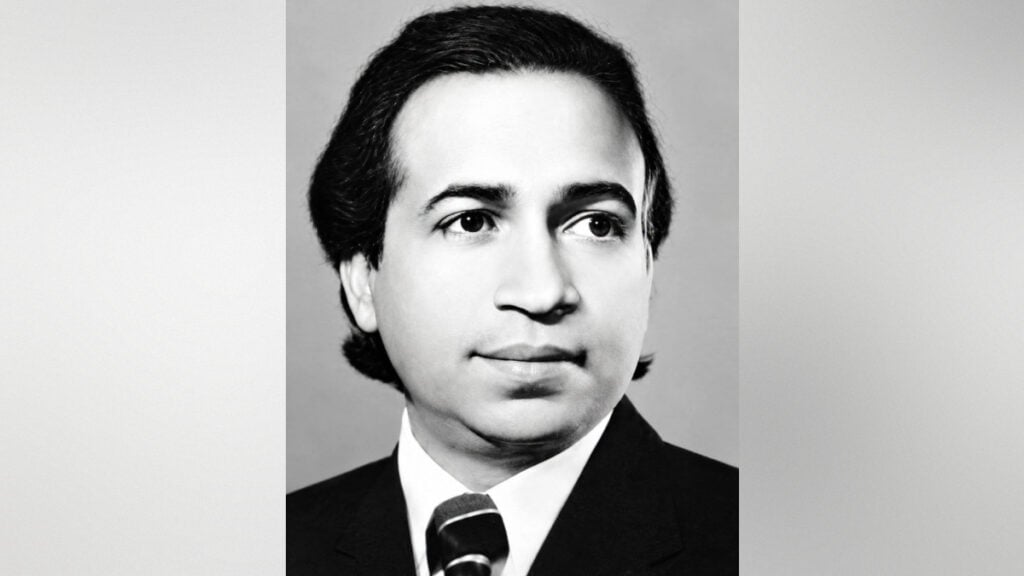
Gowhar Jamil remains a memorable figure in the history of dance in Bangladesh, particularly for his contribution to the development and wider acceptance of modern dance practice. Through years of dedicated training, choreography and teaching, he helped establish dance as an important form of artistic expression while nurturing a new generation of performers. His work drew on classical traditions as well as the folk culture and everyday life of Bengal.
Born in 1925 in Sirajdikhan village of the Bikrampur Pargana, Gowhar Jamil came from the well-known Nath family. His given family name was Ganesh Chandra Nath. His interest in dance emerged at an early age. When he was only eight, he watched renowned dancer Kelu Nayar perform the ‘Shikari Nritya’, an experience that inspired him to dream of becoming a dancer. That early fascination eventually became the central pursuit of his life.
Jamil devoted years to acquiring a broad foundation in dance. Between 1935 and 1954, he trained under several distinguished figures, including Bhaskar Dev, Pandit Ravi Shankar, Uday Shankar and Bulbul Chowdhury. In 1962, he travelled to India for further training, studying Bharatanatyam under Maruthappa Pillai and Kathak under Ramnarayan Mishra. His exposure to different traditions allowed him to develop an artistic style that brought together elements of classical dance and indigenous folk forms.
His contribution extended beyond performance. Jamil understood that the long-term development of dance required institutions where artists could learn, practise and develop their craft. In 1950, he established the cultural organisation Kala Bhavan. Nine years later, in 1959, he founded Jago Art Centre. Through these initiatives, he created spaces for dance education and artistic practice, helping aspiring performers build their skills and encouraging the growth of a wider dance community.
As a choreographer and dance-drama writer, Jamil explored the possibilities of using movement to tell stories and communicate social and human experiences. Among his notable dance dramas were ‘Samanya Kshati’, ‘Anarkali’, ‘Bichar’, ‘Kanchanmala’, ‘Itihasher Ekti Pata’ and ‘Chhiyattorer Monnontor’. His works often connected dance with history, emotion and social realities rather than treating it solely as a form of visual performance.
Folk life was another defining feature of his creative work. The experiences of ordinary people, the rhythms of rural life, nature and the emotions associated with work and community found expression in his choreography. His notable short dance pieces included ‘Jele Nritya’ or ‘Polo’, ‘Santhal’, ‘Garo’, ‘Morong’, ‘Gramya Mela’, ‘Gypsy’, ‘Dhopa’, ‘Sukhi Jora’, ‘Tea Garden’ and ‘Matrusneho’. Through such works, he sought to translate aspects of Bengal’s cultural landscape into the language of dance.
Jamil’s artistic career also reached beyond the country. He represented Bangladesh at international cultural festivals and performed in countries and regions including Russia, China, Hong Kong, the Middle East and the United Kingdom. His international engagements gave him opportunities to present dance rooted in the cultural traditions of Bengal to audiences abroad. During a visit to the United States, he also visited several music and dance institutions, gaining exposure to international approaches to artistic practice.
His talents were not confined to the stage. Jamil worked as a dance director in films and also appeared as an actor in several productions. Among the films associated with his acting career were ‘Moner Moto Bou’, ‘Pagla Raja’ and ‘Bela Shesher Gaan’. His involvement in cinema added another dimension to his contribution to Bangladesh’s cultural landscape.
Jamil’s personal life was also closely connected with the arts. After converting his religion in 1952, he married renowned dancer and film actress Rowshan Jamil. The couple became a familiar presence in the country’s cultural sphere, with both making lasting contributions through their artistic careers. They had one daughter, Kanta Jamil.
On 21 September 1980, Gowhar Jamil died in a road accident at the age of 55. His sudden death was a major loss to the country’s dance community. Yet the institutions he established, the works he created and the artists he helped nurture ensured that his influence continued beyond his lifetime.
The government of Bangladesh recognised his contribution to the arts by awarding him the Ekushey Padak posthumously in 1981. Two decades later, in 2001, Bangladesh Post issued a commemorative postage stamp in his honour.
Gowhar Jamil’s significance lies not only in the performances he created but also in the broader vision he brought to dance. He worked to connect classical technique with the cultural life of Bengal and treated dance as a means of expressing history, society and human emotion. His work as a choreographer, teacher and institution-builder helped strengthen the foundations of dance practice in Bangladesh.
More than four decades after his death, his name remains part of the country’s cultural history. His creative works and commitment to dance continue to represent an important chapter in the evolution of Bangladesh’s performing arts.
On the anniversary of his death, the contribution of dance maestro Gowhar Jamil is remembered with respect and gratitude.