The political landscape in Bangladesh has long seen competing narratives, but recent statements from senior figures within the administration have brought the energy sector into sharp focus. During a budget session in the national parliament, Member of Parliament Rumin Farhana questioned the Minister for Power, Energy and Mineral Resources, Iqbal Hasan Mahmud Tuku, regarding delays in ensuring gas supply to the Ashuganj Fertiliser Factory. The inquiry highlighted a previously given assurance that gas would be supplied by the first of May.
In response, the minister claimed that not a single exploratory gas well had been drilled in the country over the preceding seventeen years. This assertion was subsequently echoed by the Prime Minister during a commemoration event in Mohakhali, Dhaka, marking the eighty-second birth anniversary of Begum Khaleda Zia. The parallel claims from both the ministry and the highest office of government presented a unified political narrative: that the administration in power from 2009 to 2024 completely neglected hydrocarbon exploration.
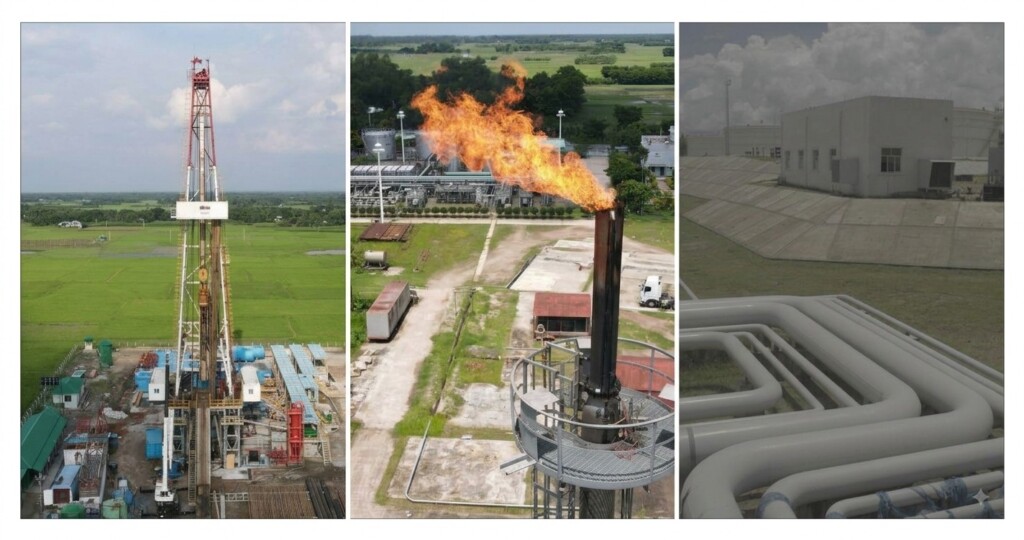
However, official records maintained by the Energy and Mineral Resources Division present a markedly different picture. According to these documented archives, the previous administration under Sheikh Hasina oversaw the drilling of one hundred and fifty-five wells between 2009 and July 2024. Furthermore, this period witnessed the discovery of six new gas fields, expanding domestic production capabilities.
To provide a comprehensive overview of the sector’s documented trajectory, the following table outlines key infrastructural and exploratory metrics recorded by the relevant government division between 2009 and 2024:
| Metric / Indicator | 2009 Baseline | 2024 Recorded Figure |
| Total Exploratory & Development Wells Drilled | Negligible / Baseline | 155 Wells |
| Active Gas Fields | 23 Fields | 29 Fields |
| Total Daily Gas Supply (Including LNG) | 1,744 MMCFD | Over 3,100 MMCFD |
| Gas Transmission Pipelines | 2,102 Kilometres | 3,657 Kilometres |
| New Pipeline Expansion | Baseline | ~1,555 Kilometres Added |
| LNG Supply Contribution | 0 MMCFD | ~1,100 MMCFD |
| Petroleum Product Supply | 3.326 Million Metric Tonnes | 6.905 Million Metric Tonnes |
| Oil Storage Capacity | 0.893 Million Metric Tonnes | 1.570 Million Metric Tonnes |
| Refined Oil Pipeline Network | 0 Kilometres | 624 Kilometres |
| Liquefied Petroleum Gas (LPG) | 0.045 Million Metric Tonnes | Over 1.4 Million Metric Tonnes |
The disparity between political declarations and departmental data extends beyond the number of wells. At the outset of 2009, daily gas production stood at 1,744 million cubic feet per day (MMCFD), eventually climbing toward 2,750 MMCFD prior to the disruptions of the global pandemic. Operational capacity was similarly augmented; whereas no functional drilling rigs were readily available in public inventories at the start of the period, older units were rehabilitated, and four new rigs were subsequently procured.
Exploration efforts also involved extensive geological surveys. Authorities conducted two-dimensional seismic surveys across thirty-one thousand, two hundred and eighty-one line kilometres, alongside three-dimensional surveys spanning approximately six thousand, nine hundred and eighty-six square kilometres. Offshore operations saw multi-client two-dimensional surveys completed across twelve thousand, six hundred and forty-two line kilometres in both deep and shallow maritime zones.
Despite these documented metrics, current explanations for ongoing supply shortages often point toward immediate technical challenges, such as temporary disruptions at floating liquefied natural gas storage and regasification units. Government officials have occasionally attributed immediate pressures to such mechanical faults rather than long-term structural neglect. This dual messaging—attributing current deficits to technical glitches while simultaneously claiming a total absence of historical exploration—has drawn scrutiny from analysts and energy experts.
Critics of the current rhetoric point out that constructive political discourse relies on verifiable data rather than sweeping generalizations. While legitimate debates can be had regarding the sufficiency of past exploration policies, maritime strategies, or the optimal balance between domestic extraction and imported liquefied natural gas, dismissing over a hundred operational wells and multiple new gas fields as non-existent runs contrary to institutional archives.
As the administration navigates contemporary energy demands, the reconciliation between official ministerial records and public statements remains an ongoing challenge. Effective policymaking requires an accurate baseline of infrastructure, and as the historical data demonstrates, the physical assets established over the past decade and a half continue to form the backbone of the national energy grid.