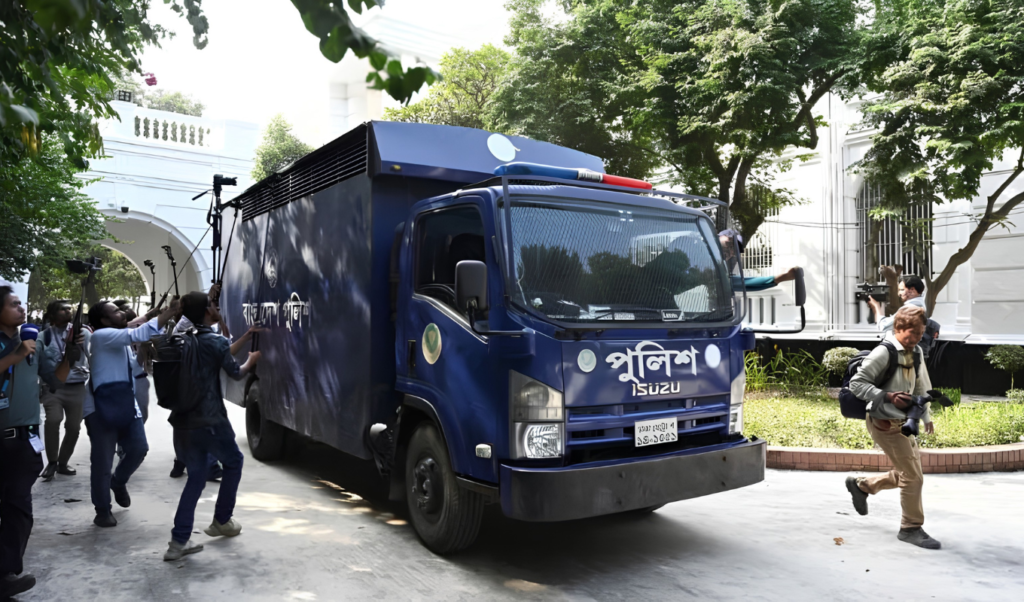
Human Rights Watch (HRW) has urged authorities in Bangladesh to immediately cease the indefinite detention without trial of individuals affiliated with the ousted Awami League administration. In a statement released on Monday, the New York-based rights organisation pressed for an urgent end to arbitrary arrests and demanded that due legal process be strictly observed.
The international rights group highlighted that following the resignation of former Prime Minister Sheikh Hasina in August 2024 amidst widespread public protests, law enforcement agencies rounded up thousands of Awami League leaders, activists, and supporters. Hundreds remain incarcerated across the country without formal charges or indictments being presented in court.
HRW acknowledged that officials implicated in serious human rights abuses under the previous administration should face justice through credible legal channels. However, the organisation stressed that numerous detentions connected to protest-related violence appear to have been made without visible or credible evidence. Family members and legal counsel representing the detainees report that many of those held are elderly or suffer from severe chronic health conditions, yet they are systematically denied fundamental rights, including bail and adequate medical care.
According to HRW, at least ten Awami League activists have died in custody over the past six months under the current interim government led by Chief Adviser Muhammad Yunus, with the majority facing no specific criminal charges prior to their deaths. Commenting on the situation, Elaine Pearson, Asia Director at Human Rights Watch, noted that detaining political opponents en masse without evidence or due process across successive administrations undermines democratic reforms. She urged the government to demonstrate its commitment to reform by ending the practice of prolonged, arbitrary detentions.
The organisation also expressed serious concern regarding the proposed National Human Rights Commission Bill, warning that without key structural reforms, the commission would remain powerless to investigate arbitrary arrests and custody abuses independently.
Those held without charge include former Awami League members of parliament, lawmakers from coalition parties, government officials, and journalists supportive of the former administration. Security personnel facing allegations of extrajudicial killings, torture, and forced disappearances also remain in custody. HRW observed a pattern where prosecution team members repeatedly oppose bail without presenting substantive evidence, leading lower courts to routinely reject applications. Even when the High Court grants bail, authorities frequently re-arrest individuals under newly filed cases to block their release.
HRW cited the case of 82-year-old former Chief Justice A.B.M. Khairul Huq to illustrate this cycle. Arrested on 24 July 2025 in connection with a murder case, he was subsequently implicated in four additional cases over the following three months. Despite obtaining bail from the High Court, police repeatedly re-arrested him under new charges—including one instance where he was accused of being at a location ten kilometres away from another scene at the exact same time—until the Appellate Division finally intervened to secure his release on 19 August 2026. No formal charge sheet was submitted throughout his detention.
The report also detailed cases before the International Crimes Tribunal (ICT), where over 150 detainees have been held without bail or the right to appeal bail rejections. Notable instances include 81-year-old Toufiq-e-Elahi Chowdhury, former energy adviser to Sheikh Hasina, who has been held for 22 months without charge, and former MP Kamal Ahmed Majumder, whose family reported that he suffered gangrene leading to toe amputations during his 22-month detention. Other cases involve 75-year-old activist Shahriar Kabir, who uses a wheelchair, and 71-year-old former minister R.A.M. Ubaidul Muktadir Chowdhury, who suffers from heart disease.
HRW reminded Bangladeshi authorities that under international human rights law, pre-trial detention must remain an exceptional measure rather than the default standard. The organisation called for independent investigations into all in-custody deaths and urged the immediate release of all individuals held arbitrarily without charge.