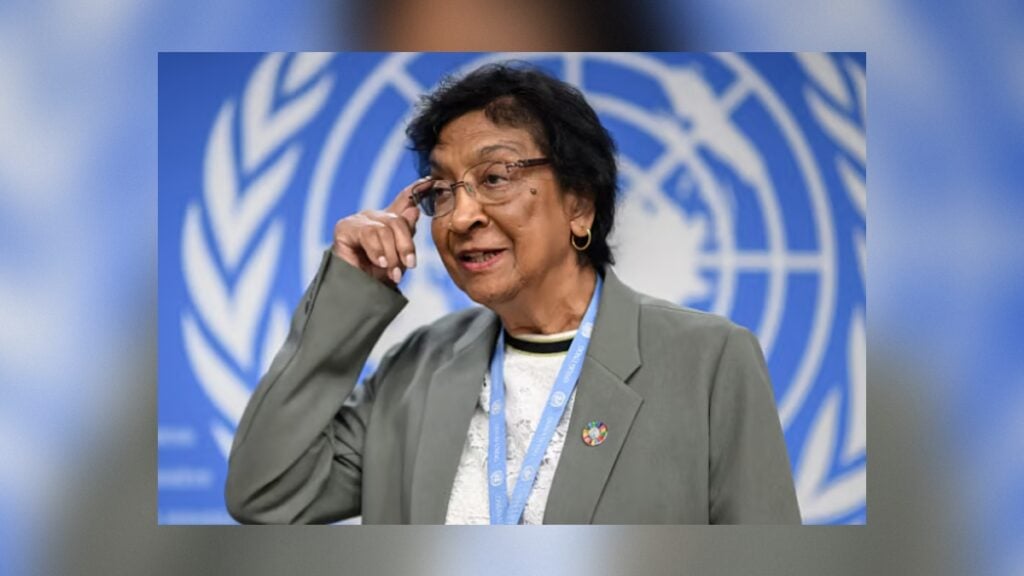
South African human rights lawyer Navi Pillay has been awarded the Nobel Peace Prize in recognition of her longstanding efforts to promote peace, uphold human rights and strengthen international law.
The Norwegian Nobel Committee announced the award on Friday in Oslo, highlighting Pillay’s contribution to bringing perpetrators of war crimes, crimes against humanity and genocide to justice. Committee chairman Jørgen Watne Frydnes said her work had played an important role in ensuring that serious international crimes were addressed through judicial processes.
The committee also recognised her determination as a judge, personal integrity and courage in helping to establish international legal standards and strengthen mechanisms of accountability.
Pillay’s career spans several decades and includes judicial positions in South Africa, international criminal tribunals and senior roles within the United Nations. Her work has focused on the principle that individuals responsible for grave human rights violations should be held accountable, regardless of the circumstances in which those crimes occur.
From South Africa’s anti-apartheid struggle to international law
Born in 1941 in Durban, South Africa, to a family of Tamil Indian descent, Pillay grew up in a country deeply divided by racial discrimination. After studying law, she began representing people involved in the struggle against apartheid, the system of institutionalised racial segregation and discrimination enforced by the South African government.
In 1967, she established her own legal practice in Durban. Her early work placed her in a position to witness the difficulties faced by those challenging racial inequality and state discrimination.
Pillay later pursued further studies at Harvard University in the United States, where she earned a doctorate in law in 1988. Her legal training and experience in South Africa helped shape her approach to human rights, equality and the rule of law.
In 1995, she was appointed a judge of South Africa’s High Court, marking a significant milestone in her legal career. Four years later, she joined the International Criminal Tribunal for Rwanda as a judge and subsequently served as its president.
A landmark role in prosecuting crimes in Rwanda
Pillay’s work at the Rwanda tribunal became one of the defining chapters of her career. Established to prosecute those responsible for the 1994 genocide and other serious violations of international humanitarian law, the tribunal played a significant role in developing international criminal jurisprudence.
During her time there, Pillay contributed to legal efforts to establish that rape and other forms of sexual violence could constitute crimes against humanity and acts of genocide, depending on the circumstances and the evidence presented.
These proceedings helped reinforce the principle that sexual violence committed during conflict should not be treated as an incidental consequence of war. Instead, such acts can form part of systematic campaigns of persecution and destruction and must be examined within the framework of international criminal law.
The tribunal’s work also addressed the role of incitement and the spread of hatred in facilitating mass violence. Its judgments helped clarify how individuals could be held criminally responsible for conduct that contributed to genocide.
The significance of these cases extended beyond the punishment of individual offenders. They also helped establish legal precedents for future investigations and prosecutions involving mass atrocities, while strengthening recognition of the experiences of victims.
Senior roles at international institutions
Following her work at the Rwanda tribunal, Pillay served as a judge at the International Criminal Court, which prosecutes individuals accused of genocide, crimes against humanity, war crimes and, under certain conditions, the crime of aggression.
From 2008 to 2014, she served as the United Nations High Commissioner for Human Rights. In that position, she was responsible for helping advance the protection and promotion of human rights worldwide, including through monitoring violations, engaging with governments and supporting international efforts to uphold fundamental freedoms.
The role placed her at the centre of international discussions on discrimination, armed conflict, civil liberties and state accountability. Her experience in national and international courts provided a strong foundation for addressing complex human rights challenges.
Pillay also served as an ad hoc judge at the International Court of Justice in 2019 in proceedings concerning allegations of genocide against Myanmar. The case brought renewed international attention to the legal obligations of states under the Genocide Convention and the mechanisms available for addressing allegations of mass atrocities.
Between 2021 and 2025, she chaired the United Nations Independent International Commission of Inquiry concerning the Occupied Palestinian Territory. The commission’s work formed part of broader international efforts to investigate alleged violations and assess compliance with international law.
Recognition of a lifelong commitment to accountability
Pillay’s career reflects the growing importance of international legal institutions in addressing crimes that extend beyond national borders. From defending people affected by apartheid to helping adjudicate cases involving genocide and sexual violence, she has worked across several areas of human rights law.
Securing justice for victims of serious international crimes remains a complex undertaking. Investigations can be hindered by political pressure, limited access to evidence and difficulties in bringing suspects before a court. International tribunals and legal institutions seek to overcome these obstacles by establishing procedures through which allegations can be examined and responsibility determined.
Pillay’s professional contributions have been closely associated with these efforts. Her work has helped advance the principle that serious crimes must be investigated and prosecuted through lawful processes, rather than left without scrutiny.
The Nobel Peace Prize recognises her contribution to the promotion of peace and international law. It also draws attention to the wider role of human rights defenders, judges and legal institutions in protecting vulnerable communities and strengthening accountability for grave violations.
Her career illustrates how legal advocacy and judicial work can contribute to the broader pursuit of justice, particularly when the rights of individuals are threatened by discrimination, conflict or mass violence.