“After Much Rain, You Arrived”
— Abu Hena Mustafa Kamal
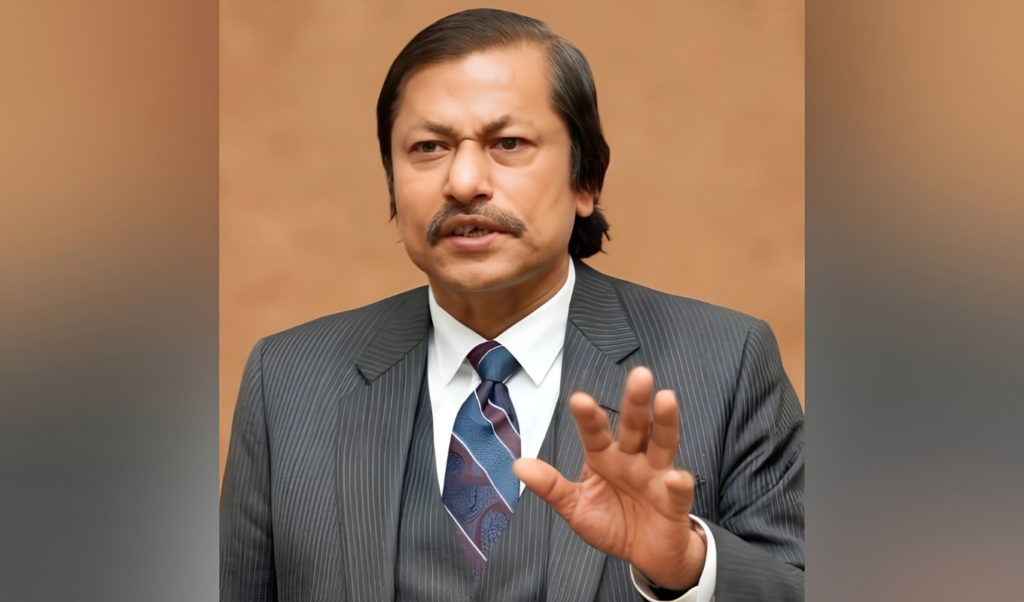
Abu Hena Mustafa Kamal stands as a luminary of multifaceted talent in the realms of Bengali literature and modern music. He was simultaneously a poet, lyricist, essayist, researcher, literary critic, professor, vocalist, orator, and a hugely popular television presenter. Within a brief lifetime of just 53 years, the indelible mark he left on Bengali literature and culture remains bright and memorable to this day.
Born on 13 March 1936 in Govinda village of Pabna district, his father, M. Shahjahan Ali, was a schoolteacher. From early childhood, he developed a profound passion for literature and culture.
He passed his Matriculation from Pabna Zilla School in 1952 and completed his Intermediate in Arts (IA) from Dhaka College in 1954. He then earned his BA (Honours) in 1958 and MA in 1959 from the Department of Bengali at the University of Dhaka.
During the 1950s, as a vibrant new literary and cultural atmosphere emerged around Dhaka, Abu Hena was one of its most active young figures. His poetic gift and musical talent manifested during his student years. In 1954, in collaboration with Mohammad Mahfuzullah, he published Purbo Banglar Kobita (Poems of East Bengal), marking a significant milestone in his early literary journey.
He gained widespread recognition as a poet and lyricist early in his youth. Alongside his friends Abu Bakar Khan, Anwaruddin Khan, and M. Asafuddowlah, he helped shape an influential cultural circle dedicated to modern song compositions. The popular song Shei Champa Nodir Tire, sung by Abu Bakar Khan, was penned by him. Simultaneously, he became a regular performing artist for Radio Dhaka.
The greatest strength of his lyrics lay in their accessible yet deeply poetic language, intimate expressions of love, natural imagery, a gentle melancholy of separation, and a profound compassion for human life. Songs such as Onek Brishti Jhore Tumi Ele, Tumi Je Amar Kobita, Oshru Diye Lekha E Gan, Nodir Majhi Bole, Ei Banglar Hijol Tomale, and Opomane Tumi Jole Uthechhile Shedin Bornomala remain etched in the memories of listeners.
His lyricism is famously reflected in the lines:
Much like these lines, his songs returned time and again to an exquisite blend of clouds, rain, light, shadow, waiting, love, and expectation.
Beyond his reputation as a lyricist, Abu Hena was a poet of a distinct and individual voice. His published poetry collections include Apon Joubon Boiri (1974), Jehetu Jonmandho (1984), and Akrantho Gojol (1988). His poetry uniquely gave form to the inner world of the individual, love, loneliness, time, and social consciousness.
He shone with equal brilliance in prose and academic research. His prominent publications include Shilpir Rupantor, Kotha O Kobita, and his doctoral thesis, The Bengali Press and Literary Writing, 1818–1831. His essays on Bengali literature, literary figures, and criticism reflected extensive reading, sharp analytical rigor, wit, and exceptional linguistic sophistication.
His professional career began in collegiate teaching. In 1962, he joined the Public Relations Directorate as an Assistant Director. He became a Lecturer in the Department of Bengali at the University of Dhaka in 1963 and subsequently joined the Department of Bengali at the University of Rajshahi in 1965. Awarded a Commonwealth Scholarship in 1966, he traveled to the University of London for advanced research, earning a PhD for his work on the history of Bengali newspapers and literary culture.
In September 1973, he joined the Department of Bengali at the University of Chittagong as an Associate Professor, later assuming a professorship in the Department of Bengali at the University of Dhaka on 1 November 1978.
Alongside academia, he played a crucial role in administering state cultural institutions. He was appointed Director General of the Bangladesh Shilpakala Academy in 1984 and Director General of the Bangla Academy in 1986, serving in the latter position until the end of his life.
In recognition of his outstanding contributions to literature and culture, he was honored with numerous awards, including the Alaol Literary Award (1975), Suhrid Literary Gold Medal (1986), Ekushey Padak (1987), and the Abdul Karim Sahityavisarad Gold Medal (1989).
Though Abu Hena Mustafa Kamal’s life was short, the breadth of his creation was vast. Just as he enriched Bengali poetry, he infused modern Bengali song lyrics with a fresh sweetness. In his music, love arrived with pure sensibility, nature appeared through vivid imagery, and human emotion found a natural, melodic voice.
Though he passed away many years ago, his songs still return unexpectedly on rainy evenings, along the corridors of old memories, or in quiet moments of unspoken love. It often feels as though his familiar voice is drifting once more across some distant, invisible radio wave:
He passed away in Dhaka on 23 September 1989. His departure left a profound void in the cultural landscape of Bengali literature and art. Yet, like a true artist, he lives on through his creations—in songs, poetry, words, memories, and the enduring cultural consciousness of the Bengali people.
On 23 September, his death anniversary, we offer our deepest respect and humble tributes to the memory of this multifaceted artist and intellectual.