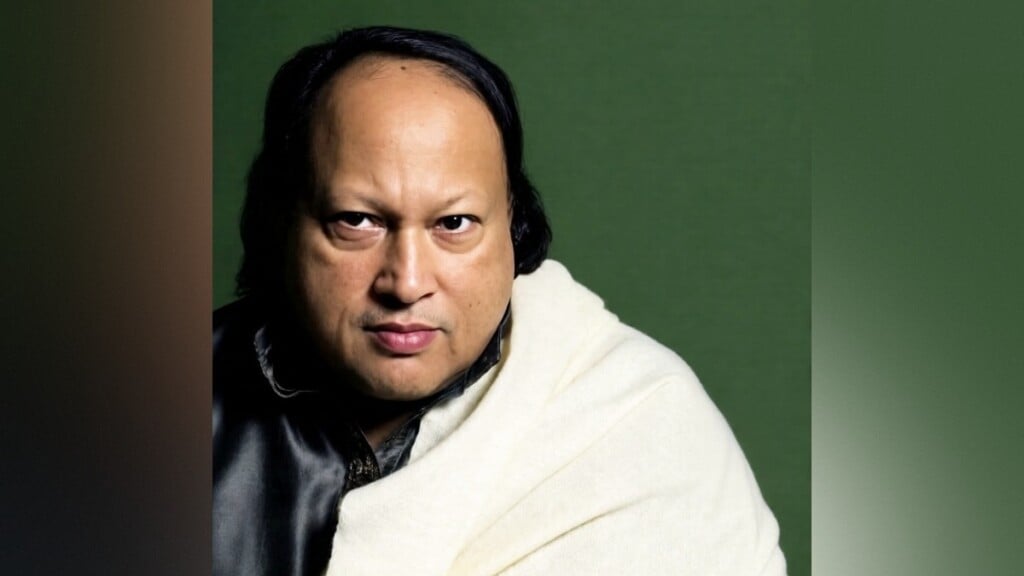
His voice carried an aura of spirituality, while his melodies echoed the deepest yearnings of the soul. Through the enchanting power of his music, he captured the hearts of millions across the world.
He was Nusrat Fateh Ali Khan—the legendary qawwali singer, global ambassador of Sufi music, and one of the most extraordinary figures in the musical heritage of the Indian subcontinent.
Nusrat Fateh Ali Khan was a legendary Pakistani musician. In particular, he took qawwali, an inseparable part of Sufi tradition, far beyond the boundaries of the subcontinent. Through his extraordinary voice, distinctive performance style and immense musical power, he brought qawwali to the world music stage.
He was born on 13 October 1948 in Lyallpur, now Faisalabad, in present-day Pakistan, into a Punjabi Muslim family. His father, Fateh Ali Khan, was a renowned musician, singer, instrumentalist and qawwal. His family had preserved a tradition of performing qawwali for more than six centuries. Nusrat not only inherited this remarkable musical legacy but also elevated it to an entirely new level.
Following his father’s death, he assumed leadership of the family qawwali ensemble at a young age. Gradually, the uniqueness of his voice and performance distinguished him from his contemporaries. His voice was extraordinarily powerful, deep and emotive. At the same time, he possessed the remarkable ability to perform qawwali continuously for extended periods. In his voice, the yearning of prayer, the anguish of love and the longing for communion between the soul and the Creator seemed to merge into one profound musical expression.
One of the defining characteristics of his qawwali was the gradual intensification of emotion through melodic improvisation, vocal ornamentation, rhythm, hand-clapping and collective singing. His performances slowly drew listeners into a deeply spiritual atmosphere. For many, listening to Nusrat was not simply a musical experience; it was an encounter of the soul.
Nusrat Fateh Ali Khan was widely known as the ‘Shahenshah-e-Qawwali’, meaning the Emperor of Qawwali. His extraordinary vocal range, spontaneity and ability to sing for prolonged periods led many to regard him as one of the greatest recorded singers in musical history.
His association with world music expanded further through collaborations with Western artists. He worked with the celebrated musician Peter Gabriel, helping introduce his distinctive musical tradition to a much wider Western audience. His voice also featured in film soundtracks. Beyond the Indian subcontinent, his qawwali inspired generations of musicians and helped establish South Asian Sufi music as an influential force in the international music scene.
Among his best-known qawwalis are ‘Tumhe Dillagi’, ‘Afreen Afreen’, ‘Allah Hoo’, ‘Mera Piya Ghar Aaya’, ‘Yeh Jo Halka Halka Suroor Hai’ and ‘Akhiyaan Udeek Diyan’, alongside countless other compositions that remain cherished by listeners. The Sufi poetry he performed in his unmistakable voice transcended linguistic boundaries and became a universal language of emotion.
In recognition of his outstanding contribution to music, the Government of Pakistan honoured him with the Pride of Performance award in 1986. He received numerous other honours and accolades both at home and abroad. His voice, musicianship and creative vision subsequently became a profound source of inspiration for countless qawwali and world music performers.
Yet the life of this legendary artist was tragically short. At just 48 years of age, Nusrat Fateh Ali Khan died on 16 August 1997 in London while receiving medical treatment, following cardiac arrest.
He is gone, but his voice has never fallen silent.
Even today, when his voice rises with the words—
‘Allah Hoo… Allah Hoo…’
—it can feel as though an unseen door is opening deep within the soul, allowing music to guide us back to ourselves.
Nusrat Fateh Ali Khan was far more than a qawwal; he was a living institution of qawwali. Carrying a six-century-old musical tradition, he took qawwali beyond the confines of mosques, shrines and intimate gatherings, bringing it to some of the world’s greatest stages.
The physical form of music may fade, but the soul of music never dies.
That is why, nearly three decades after his death, the voice of Nusrat Fateh Ali Khan continues to resonate across the world—immortal, eternal and everlasting.
On the 29th death anniversary of Nusrat Fateh Ali Khan, the Emperor of Qawwali and global ambassador of Sufi music, we pay our deepest respects and offer our heartfelt tribute.