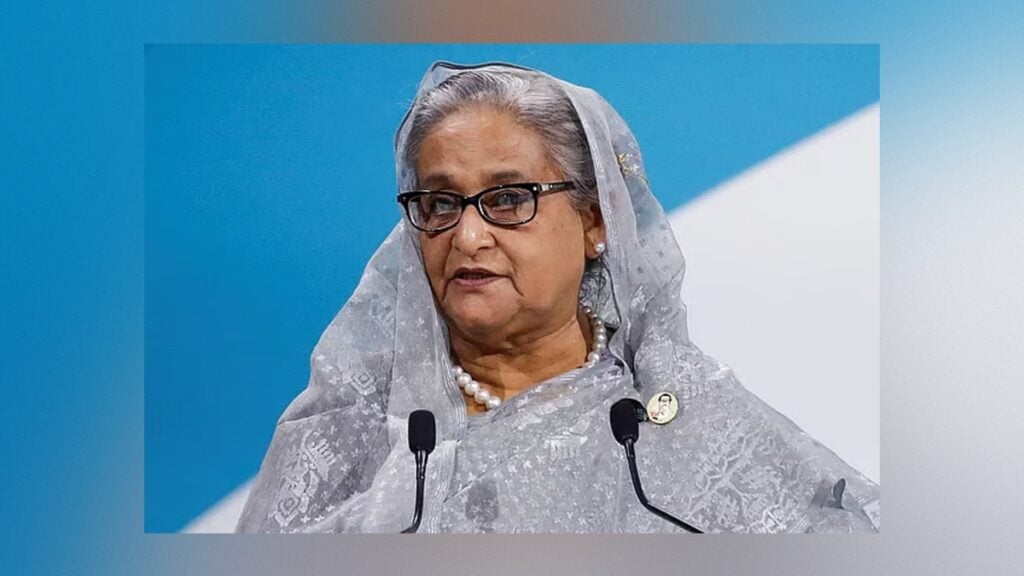
The details emerged in a recent report by BBC Bangla, which said India had outlined two key conditions to facilitate Hasina’s return.
The first is that the Bangladesh Army must take direct responsibility for the process. According to the proposal, Bangladesh should send a military aircraft to collect her, replicating the arrangement under which she left the country on 5 August 2024. Alternatively, Bangladeshi military personnel could receive her at an agreed location along the land border.
The second condition concerns her legal rights. India wants Bangladesh to guarantee that Hasina will be able to appeal against the death sentence handed down in connection with cases arising from the July 2024 uprising. New Delhi also wants assurances that she will have access to a fresh and transparent judicial process.
India faces growing diplomatic pressure
According to the BBC Bangla report, Hasina’s prolonged stay in India is becoming increasingly uncomfortable for New Delhi, both in its bilateral relationship with Bangladesh and on the international stage.
India has faced criticism from sections of the international community for continuing to host a former leader convicted over allegations of a deadly crackdown on protesters during the 2024 uprising.
Initially, Indian policymakers reportedly explored the possibility of Hasina relocating to a third country. However, repeated diplomatic contacts with several countries failed to produce a workable arrangement.
As a result, India is increasingly viewing her return to Bangladesh, followed by participation in the country’s legal proceedings, as the most practical option.
New Delhi also believes that the Awami League may struggle to regain its political footing without Hasina’s return. Her continued absence from Bangladesh has left questions about the party’s leadership and future political direction.
A senior Indian Foreign Ministry official told BBC Bangla that India could not knowingly hand her over to face execution. Instead, the official said, New Delhi wanted her to have another opportunity to receive justice.
India reportedly wants the judicial process to take place under the scrutiny of the international community and global media, with particular attention to transparency and the right to appeal.
Security guarantees remain a major concern
Legal assurances are not India’s only concern. The security of Hasina after her return is also a significant consideration.
An Indian military source told BBC Bangla that New Delhi wants the Bangladesh Army to guarantee her personal safety once she is back in the country.
India believes that the military’s direct involvement could help manage the security risks surrounding such a politically sensitive return. Hasina’s departure in August 2024 followed weeks of mass protests and a dramatic change in the country’s political landscape. Her return could therefore carry considerable political and security implications.
Extradition request remains unresolved
Bangladesh formally requested Hasina’s return in December 2024. However, India has yet to make a final decision, citing legal considerations under the extradition treaty between the two countries.
According to the BBC Bangla report, New Delhi is reluctant to place her directly on a Bangladeshi aircraft as an accused person and hand her over through a conventional extradition arrangement.
Indian officials are also concerned about the diplomatic implications of such a move. It could send an uncomfortable message to political leaders in neighbouring countries, including Nepal, Sri Lanka and the Maldives, who maintain close relations with India.
The proposed military-assisted arrangement is therefore being considered as an alternative approach to handling her return.
Backchannel discussions involving military leaders
Discussions over Hasina’s possible return have reportedly continued behind closed doors for several months.
The BBC Bangla report referred to undisclosed meetings held in the first week of October in New Delhi involving Bangladesh’s then High Commissioner, Dinesh Trivedi, Indian Prime Minister Narendra Modi and Indian Army Chief General Dhiraj Seth.
According to an Indian military source, one of the purposes of these meetings was to explore how the Bangladesh Army could play an active role in facilitating Hasina’s return.
Military-to-military communication between the two countries has also been highlighted in this context.
Former Indian Army Chief General Manoj Pande has publicly stated on several occasions that he maintained regular, weekly conversations with Bangladesh Army Chief General Waker-Uz-Zaman following the political upheaval of July 2024.
Indian military sources have suggested that New Delhi wants to make use of these established channels of communication to facilitate Hasina’s return. The idea is to involve the two armies in managing the arrangements rather than treating the matter solely as a political or diplomatic transfer.
December return plan raises questions
According to BBC Bangla, Hasina expressed her intention to return to Bangladesh by December 2026 in an interview with Reuters after reaching an understanding with Indian authorities.
Her statement has added a new dimension to the discussions surrounding her future.
However, Indian officials reportedly remain uncertain whether Bangladesh’s current government genuinely wants her to return at this stage.
The government is already facing several domestic challenges, including energy shortages and protests by garment workers. Indian policymakers reportedly believe that Hasina’s return could create fresh political instability at a time when Bangladesh is dealing with economic and social pressures.
A South Block official in New Delhi told BBC Bangla that India had agreed to Hasina’s announcement despite knowing that her return by December would be difficult because the conditions had not been met.
The official suggested that the announcement could give India a diplomatic argument in the future: Hasina had expressed her willingness to return, but Bangladesh had been unable or unwilling to make the necessary arrangements.
Implications for the Awami League
Hasina’s stated intention to return has reportedly encouraged Awami League leaders and activists in Bangladesh, raising hopes among sections of the party about its political future.
Her continued absence has created uncertainty over the party’s leadership and prospects, particularly as its political activities remain suspended.
Even if she fails to return by 31 December, the announcement could provide New Delhi with a fresh justification for allowing her to remain in India for longer.
The issue, however, extends well beyond Hasina’s personal future. It involves Bangladesh’s judicial process, political stability, bilateral relations with India and the broader question of accountability for the violence surrounding the 2024 uprising.
For now, New Delhi appears to favour a return arrangement involving the Bangladesh Army, backed by guarantees of personal security and access to further legal proceedings. Whether Dhaka is prepared to accept these conditions remains uncertain.
The coming weeks could prove important in determining whether the two countries can reach an understanding over one of the most sensitive issues in their bilateral relationship.