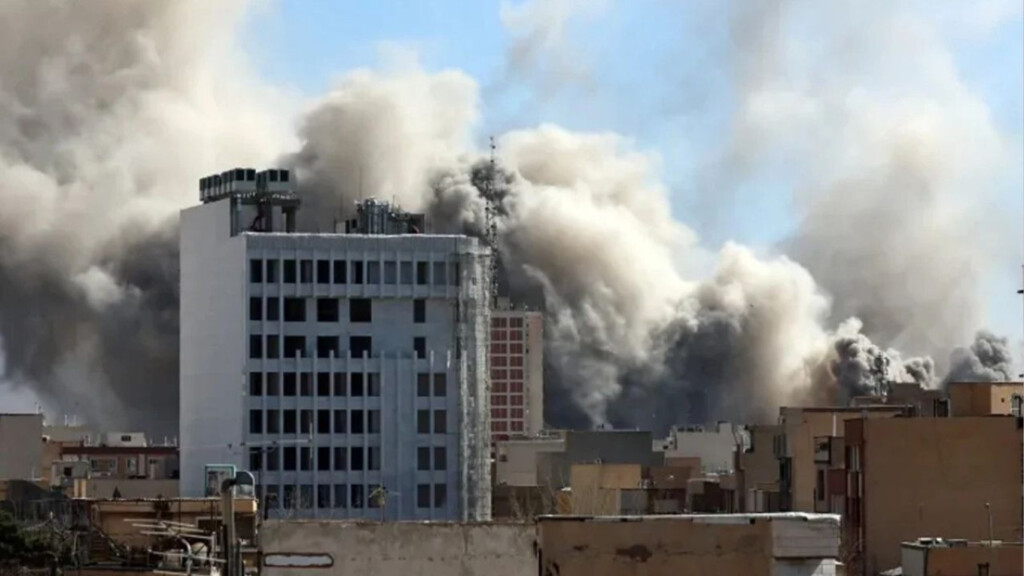
The geopolitical landscape of the Middle East has descended into a state of total belligerence following the reported death of Iran’s Supreme Leader, Ayatollah Ali Khamenei. In the wake of what Tehran describes as a joint US-Israeli aerial assassination, the Islamic Revolutionary Guard Corps (IRGC) has vowed to unleash “the most devastating retaliatory strike in history.” Early reports indicate that Iranian missiles have already targeted US military installations across Qatar, Bahrain, Kuwait, and the UAE, while simultaneous barrages have been launched toward the Israeli heartland.
A Conflict of Endurance
The central question gripping global strategic experts is one of sustainability: how long can Iran endure a direct confrontation with a superpower? While US President Donald Trump has suggested that decapitating the Iranian leadership could end the conflict within days, the reality on the ground hints at a much more protracted and bloody affair. Trump himself has conceded that Tehran appears prepared for long-term resistance, prompting Washington to brace for an extended campaign.
Iran’s resilience is rooted in a sophisticated arsenal of missiles and unmanned aerial vehicles (UAVs), developed over decades with significant Russian cooperation. Tehran currently possesses the largest ballistic missile inventory in the Middle East, featuring the Shahab-3, the solid-fuel Sejjil, and the formidable Fattah-1 hypersonic missile. With a strike range exceeding 2,000 kilometres, every US base in the region—and parts of Southern Europe—falls within their operational reach.
The Irony of Reverse Engineering
The most striking aspect of Iran’s military prowess is its mastery of “reverse engineering” Western technology. For years, Russia has reportedly salvaged high-tech Western weaponry from Ukrainian battlefields—including Javelin anti-tank missiles and Stinger MANPADS—and transported them to Tehran. Iranian engineers have proven exceptionally adept at dismantling these systems to create indigenous clones.
| Weapon Category | Original Western Model | Iranian Equivalent/Variant | Key Capability |
|---|---|---|---|
| UAV / Drone | US RQ-170 Sentinel | Saegheh / Shahed-191 | Stealth reconnaissance and strike. |
| Anti-Tank | US FGM-148 Javelin | Almaz | Top-attack “fire and forget” system. |
| Air Defence | US FIM-92 Stinger | Misagh series | Man-portable infrared homing. |
| Engines | German Limbach L550 | Mado MD550 | Powers the Shahed-136 “Kamikaze” drone. |
The Sino-Russian Strategic Shield
Beyond reverse engineering, Iran’s survival is bolstered by a 20-year strategic partnership with Moscow. While Russia avoids direct legal combat involvement, it has bolstered Iranian skies with the S-400 missile system and provided Yak-130 combat trainer jets. Recent clandestine deals have reportedly seen the delivery of the Russian Verba MANPADS, rendering Iranian airspace increasingly lethal for low-flying drones and cruise missiles.
China plays a similarly crucial role by acting as a conduit for restricted components. Despite international sanctions, Beijing reportedly facilitates the flow of Western-designed engine blueprints and micro-electronics, allowing Iran to mass-produce drones that utilise German or American architectural designs.
Maritime Deterrence and the “Total War”
At sea, the Iranian Navy has transformed the Strait of Hormuz into a potential death trap. By employing “swarm tactics” with fast-attack craft, midget submarines, and Chinese-designed anti-ship cruise missiles, Tehran aims to cripple global energy corridors. Perhaps most innovatively, Iran has converted standard commercial tankers into makeshift drone carriers, allowing them to project air power from the middle of the ocean.
As the “Axis of Resistance” mobilises, the world watches a unique historical irony: the Islamic Republic is challenging American hegemony using the very technological innovations birthed in the West. Whether this leads to the swift victory envisioned by the White House or a decade-long guerrilla quagmire remains the defining uncertainty of 2026.