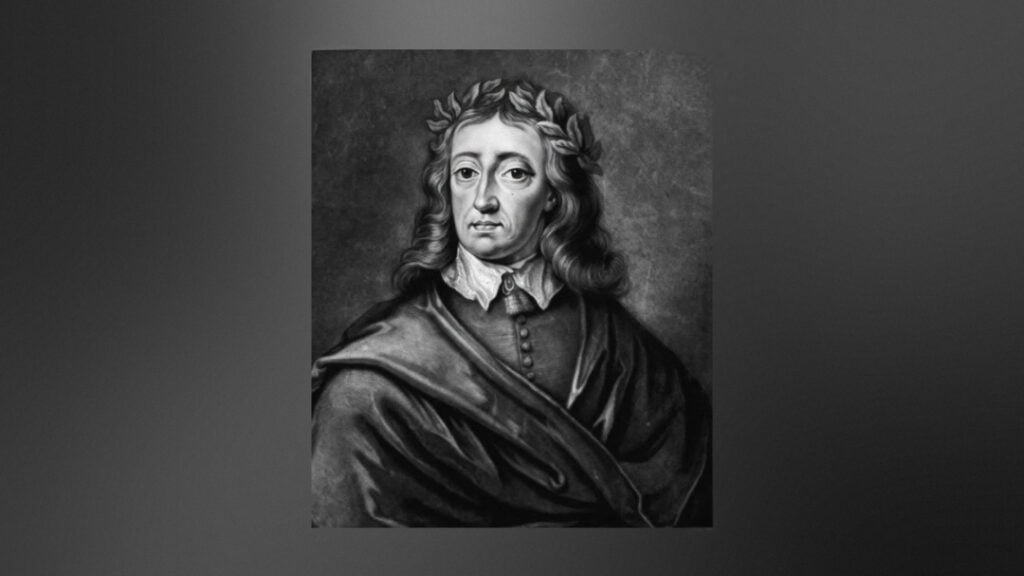
John Milton remains one of the most celebrated figures in the history of English literature. Renowned for his monumental epic Paradise Lost, he was far more than a poet. He was also a philosopher, prose writer, political commentator and an uncompromising advocate of freedom of thought and expression. His literary works explored profound questions of faith, morality, human nature and the struggle between good and evil, while his political writings championed individual liberty, intellectual independence and the right to express dissenting opinions.
Born on 9 December 1608 in Bread Street, London, Milton grew up in a family that encouraged intellectual and artistic pursuits. His father, John Milton Sr, was a musician, composer and writer who played an important role in nurturing his son’s education. From an early age, Milton developed a strong interest in literature, music, philosophy and classical languages.
He attended Christ’s College, Cambridge, where he received a comprehensive education and developed an exceptional command of Latin, Greek, Hebrew and Italian, among other languages. His extensive knowledge of classical literature, combined with his remarkable imagination and intellectual discipline, eventually established him as one of the greatest poets in the English literary tradition.
A Poet Who Took Up the Pen for Freedom
Milton’s life was shaped not only by literary ambition but also by the political and religious turmoil of seventeenth-century England. The country was deeply divided over the authority of the monarchy, the powers of Parliament and the question of religious freedom. These tensions eventually developed into the English Civil Wars, transforming the nation’s political landscape.
While travelling through continental Europe, Milton received news of the worsening political situation at home. He returned to England in 1639, abandoning the prospect of an extended European tour to take part in the intellectual and political debates of his time.
He believed that the struggle against injustice required more than physical resistance. Reason, knowledge and the courage to challenge authority were equally essential. He therefore devoted much of his literary ability to defending political and intellectual freedom.
One of his most influential political writings was Areopagitica, published in 1644. Written as a powerful argument against pre-publication censorship, the work challenged the licensing system that required authors and publishers to obtain official approval before printing books.
Milton argued that people should be allowed to read, discuss and examine different ideas without unnecessary restrictions imposed by the authorities. He maintained that truth could emerge through open debate and that intellectual freedom was essential to the development of a healthy society.
Although his arguments did not immediately bring an end to government censorship, Areopagitica became one of the most influential works in the history of the struggle for freedom of the press. Its principles continue to feature prominently in discussions about freedom of speech, publishing rights and the unrestricted exchange of ideas.
During the English Commonwealth, Milton served as Secretary for Foreign Tongues, a position that involved preparing official government correspondence in Latin. He used his linguistic abilities and intellectual standing to defend the Commonwealth government and respond to political criticism from abroad.
However, the restoration of the monarchy in 1660 dramatically changed his circumstances. With Charles II returning to the throne, Milton’s political position became increasingly precarious. His previous support for the Commonwealth and opposition to absolute monarchy placed him at risk. He was arrested for a period following the Restoration, although he was subsequently released.
By then, he had already lost his eyesight. His political influence had diminished, but his literary ambitions remained undiminished.
Paradise Lost: A Masterpiece Created in Darkness
The most extraordinary chapter of Milton’s literary life was the creation of Paradise Lost, widely regarded as one of the greatest epic poems in English literature.
Milton gradually lost his eyesight and became completely blind by around 1652. Despite this devastating physical setback, he refused to abandon his literary work. Instead, he relied on his extraordinary memory, intellectual discipline and imaginative powers to continue composing poetry.
He dictated his verses to assistants and members of his household, who recorded the lines as he recited them. Through this painstaking process, he produced a work of extraordinary scale and literary sophistication despite being unable to see the words he was creating.
The principal composition of Paradise Lost took place between 1658 and 1663, although the poem underwent further preparation before publication. It was first published in 1667 in ten books. A revised edition appeared in 1674, reorganised into twelve books.
Drawing primarily on the biblical account of humanity’s beginnings in the Book of Genesis, the epic explores the rebellion of Satan, the conflict between Heaven and the fallen angels, the temptation of Adam and Eve, and their eventual expulsion from the Garden of Eden.
Yet the poem is much more than a retelling of a biblical narrative. Milton examines the complexities of free will, obedience, temptation, moral responsibility, faith and the consequences of human choices. Through its characters and dramatic conflicts, the work raises enduring questions about the nature of authority, the limits of freedom and the struggle between good and evil.
Satan’s rebellion, Adam and Eve’s disobedience and humanity’s fall are presented through a vast imaginative framework that combines religious thought with philosophical reflection.
Milton’s own experiences of political defeat, personal hardship and blindness are often considered important influences on the poem’s emotional and philosophical depth. His ability to create such an expansive literary world despite his physical limitations remains one of the most remarkable achievements in literary history.
The Epic Sold for Just Five Pounds
One of the most striking details surrounding Paradise Lost concerns the modest financial arrangement under which it was first published.
On 27 April 1667, Milton entered into an agreement with London publisher Samuel Simmons for the publication rights to the epic. Under the terms of the contract, he received an initial payment of just £5.
The agreement also provided for further payments of £5 when specified sales targets were reached, with additional sums linked to subsequent editions. The first edition was priced at three shillings per copy and consisted of approximately 1,300 copies. It took around two years for the initial print run to sell.
Milton’s financial return was remarkably small compared with the literary reputation the work would eventually acquire. During his lifetime, he received a total of £10 in payments from the first two editions of Paradise Lost.
Following his death, his widow sold the remaining rights to Samuel Simmons for £8. The figures offer a striking contrast between the modest commercial value assigned to the epic at the time and its enduring status as one of the most important works of English literature.
Today, Paradise Lost is studied and discussed across the world for its literary ambition, philosophical complexity and extraordinary poetic language.
Paradise Regained and Samson Agonistes
Milton continued his literary work after completing Paradise Lost. In 1671, he published two further significant works: Paradise Regained and Samson Agonistes.
Paradise Regained explores the temptation of Jesus Christ in the wilderness and his ultimate spiritual victory over Satan. Unlike the expansive narrative and grand scale of Paradise Lost, this poem adopts a more restrained approach, focusing on spiritual strength, self-control, faith and obedience.
Samson Agonistes, meanwhile, is a dramatic tragedy based on the biblical figure Samson. The work portrays the final stage of Samson’s life, including his imprisonment, suffering, loss of physical strength and eventual act of destruction against his enemies.
Through Samson’s personal tragedy, Milton examines themes of sacrifice, redemption, inner strength and the relationship between suffering and spiritual purpose.
His earlier poetry collection, Poems of Mr John Milton, Both English and Latin, was first published in 1645 and reissued in a revised edition in 1673. The collection includes works that demonstrate his command of different poetic forms and his ability to move between personal reflection, classical themes and religious subjects.
Together, these publications illustrate the breadth of Milton’s literary achievement, extending well beyond the epic poetry for which he is best remembered.
Personal Hardship and Final Years
Milton’s final years were marked by considerable personal and political difficulties. The Restoration of the monarchy brought an end to his public service and left him in a vulnerable position because of his earlier political writings.
His blindness further complicated everyday life, while the changing political climate restricted his ability to participate openly in public affairs. Although he was briefly arrested following the Restoration, he was eventually released and spent much of his remaining life away from public attention.
Despite these challenges, he continued to write and remained intellectually active. His dependence on others for reading and writing did not prevent him from producing some of the most enduring works in English literature.
John Milton died on 8 November 1674 at his home in London, aged 65. Historical biographical accounts place his death at his residence in the city. He was buried at St Giles-without-Cripplegate in London, near the grave of his father.
A Legacy That Transcends Literature
John Milton’s contribution to world literature cannot be measured solely through Paradise Lost. His achievements as a poet, political thinker and defender of intellectual freedom secured him a place among the most influential writers of the seventeenth century.
His literary works profoundly influenced subsequent generations of poets, writers and philosophers. His mastery of blank verse, command of classical traditions and ability to explore complex philosophical questions helped shape the development of English poetry.
His political writings also established an enduring intellectual legacy. Areopagitica, in particular, remains an important reference point in debates about censorship, freedom of expression and the right to challenge established authority.
Milton’s life was a remarkable combination of literary brilliance and personal resilience. He experienced political defeat, imprisonment, financial uncertainty and the complete loss of his eyesight. Yet none of these hardships succeeded in silencing his creative voice.
The fact that he composed Paradise Lost after becoming blind gives his achievement an extraordinary human dimension. Through memory, imagination and determination, he created a literary world that continues to captivate readers centuries after its publication.
John Milton demonstrated that physical limitations need not define the boundaries of human creativity. His life stands as a testament to the enduring power of ideas, artistic vision and intellectual courage.
His words continue to illuminate the relationship between freedom, responsibility, faith and human dignity. Centuries after his death, the poet who lost his eyesight remains a guiding figure in English literature, remembered not only for the grandeur of his poetry but also for his unwavering commitment to freedom of thought.
A profound tribute to John Milton, the great poet whose literary vision transcended the darkness of blindness and whose pen became an enduring symbol of intellectual freedom.