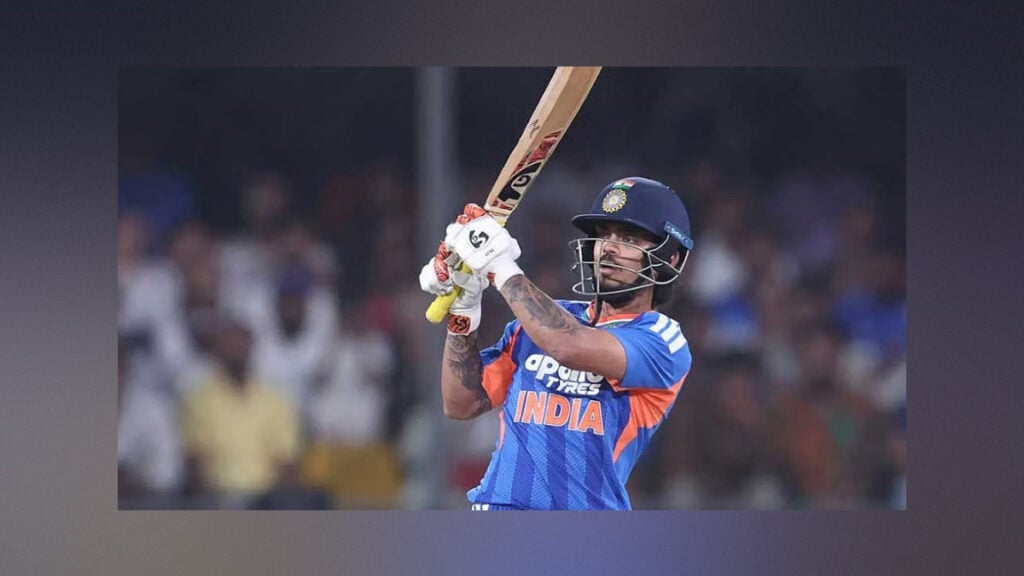
India face an unexpected selection challenge ahead of their second Twenty20 international against New Zealand after aggressive left-handed batter Ishan Kishan was ruled out with a groin injury. His absence could create an opportunity for 15-year-old batting sensation Vaibhav Suryavanshi, who has emerged as a leading candidate to replace him in the playing XI.
The Board of Control for Cricket in India (BCCI) confirmed on Friday that Kishan would miss Saturday’s encounter at Hagley Oval in Christchurch. The 28-year-old sustained the injury during Thursday’s opening match of the five-game series, which India won by four wickets after completing their highest successful run chase in T20 international cricket.
Kishan’s fitness problem had already affected India’s batting arrangements during the opening encounter. Normally occupying the number three position, he was moved down to fifth as the visitors attempted to chase New Zealand’s challenging target of 225.
The change did not produce the desired result for Kishan, who managed just one run from three deliveries before being dismissed.
Tilak Varma was promoted to number three in his place but also struggled to make an impact, scoring six runs from 11 deliveries.
The unexpected adjustment prompted speculation over whether India’s team management had deliberately reshuffled the batting order to counter New Zealand’s bowling attack.
However, batting coach Sitanshu Kotak clarified after the match that the decision had been forced by Kishan’s injury rather than any tactical experiment.
“Kishan has suffered a groin injury. I know there was speculation about the batting-order change, but it was not something we had planned. It happened because of his groin problem. I think he might miss one match,” Kotak explained during the post-match press conference.
Despite the disruption, India successfully completed the demanding chase, securing a four-wicket victory and establishing a new national record for their highest successful run chase in T20 internationals.
The result gave India a 1-0 advantage in the five-match series, although Kishan’s injury has introduced uncertainty over the composition of the batting line-up for the next encounter.
Attention has now turned towards Suryavanshi, whose aggressive batting approach has made him one of India’s most promising young cricketers.
The 15-year-old left-hander has already experienced high-pressure matches while representing India at the Asian Games. He featured in both the semi-final and final as the Indian cricket team secured the gold medal.
However, his opportunities in subsequent international fixtures have been limited.
Suryavanshi did not feature in any of the five T20 internationals against the West Indies and was also left out of the playing XI for the opening match against New Zealand.
Kishan’s injury has now strengthened his prospects of returning to the side.
Both players bat left-handed and favour an attacking approach, making Suryavanshi a potential like-for-like replacement. His inclusion could allow India to retain a similar batting combination without making extensive changes to the order.
Kotak acknowledged that the teenager was among the strongest candidates under consideration, although he stressed that the medical team’s assessment of Kishan’s recovery would determine the final selection decision.
“If Ishan cannot play, meaning he has not fully recovered, which our medical team will confirm, then naturally Vaibhav will be considered as a batter. He is certainly one of the strong options available for selection,” Kotak said.
The possibility of Suryavanshi’s inclusion adds another dimension to India’s preparations for the second match.
Kishan’s attacking instincts and ability to accelerate the scoring rate make him a valuable option in the batting order. Replacing him requires the management to consider not only individual ability but also how the selected player would fit into the team’s overall strategy.
Suryavanshi’s left-handed batting and aggressive style could make him a suitable choice, although the demands of international cricket against New Zealand in their home conditions would present a significant challenge for such a young player.
India will nevertheless enter Saturday’s contest with considerable confidence following their remarkable opening victory.
Chasing 225, the visitors demonstrated the depth of their batting resources to secure a four-wicket win, overcoming the disruption caused by Kishan’s injury.
The successful pursuit highlighted India’s ability to maintain scoring momentum under pressure, an important factor in a format where even a brief period of slow scoring can alter the course of a match.
New Zealand, meanwhile, will be seeking an immediate response after failing to defend a substantial total in the opening encounter.
The hosts had placed themselves in a promising position with the bat but were unable to contain India’s run chase. Their bowling attack will need to produce a more disciplined performance if they are to level the series.
For India, the immediate priority will be maintaining their winning momentum while ensuring Kishan receives sufficient time to recover.
With the visitors already leading 1-0, another victory would put them in a commanding position in the five-match contest.
The second T20I is scheduled for Saturday, 24 October, at Hagley Oval in Christchurch, the same venue that hosted the series opener.
Much of the attention before the match will centre on India’s team selection and whether Suryavanshi receives an opportunity to replace the injured Kishan.
For the teenage batter, selection would offer another chance to demonstrate his ability on the international stage. For India, the challenge will be to preserve the strength and balance of their batting line-up as they seek to extend their advantage over New Zealand.