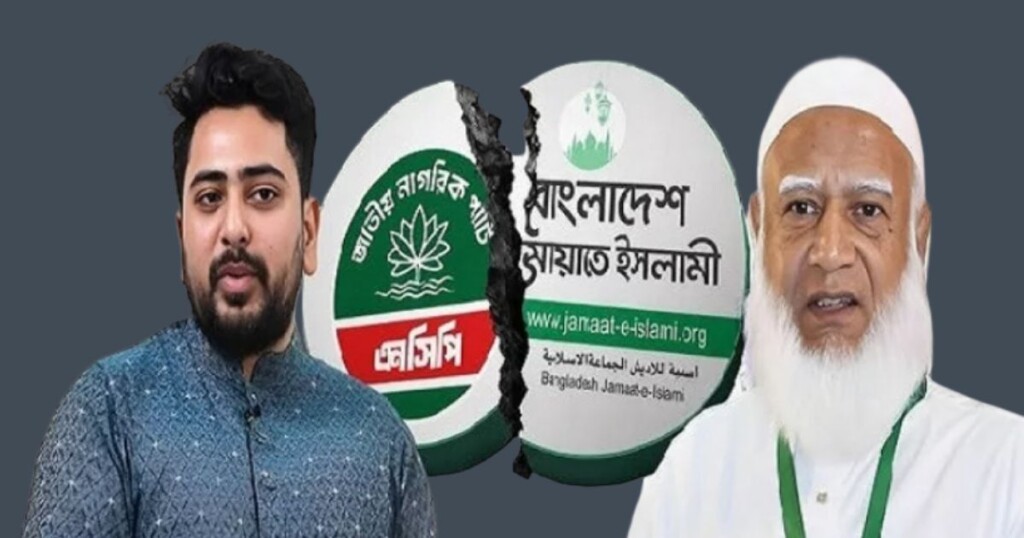
Fresh uncertainty has emerged over the National Citizen Party’s (NCP) position in the political alliance led by Jamaat-e-Islami, as Bangladesh prepares for the 13th parliamentary election. Party sources say the NCP is reviewing both the political advantages and limitations of remaining within the alliance, while also considering whether a different political alignment could better serve its long-term ambitions.
According to sources familiar with the discussions, senior NCP leaders have held several informal meetings with representatives of a number of Islamist parties associated with the Qawmi madrasa tradition. The discussions reportedly covered political reforms, accountability and justice, local government elections and the possibility of establishing a new political platform. No final decision, however, has been taken on whether the NCP will leave the existing alliance or enter into a new arrangement.
The debate comes at a politically sensitive time, with parties preparing for electoral contests and reassessing their alliances. The NCP, which has sought to establish itself as a significant national political force, is understood to be examining whether its current alliance structure is compatible with that broader objective.
Some party leaders reportedly believe that remaining in a Jamaat-led coalition could restrict the NCP’s ability to build an independent political identity and expand its support base beyond the alliance’s existing constituencies. A new political platform, they argue, could provide the party with greater scope to play a leading role and develop a wider national appeal.
The uncertainty has intensified following the decision by Khelafat Majlis to announce its departure from the alliance. The move has prompted renewed speculation about the future shape and cohesion of the broader political grouping.
A member of the NCP’s political council said the issue would be considered at the highest level of the party after the conclusion of its July programmes. The statement suggests that, for now, the party is keeping its options open rather than moving towards an immediate formal break.
At the same time, the NCP is stepping up its organisational preparations for local government elections. The party has already announced the names of potential mayoral candidates in several city corporations. However, party sources indicate that the candidate list could be revised if a new political understanding emerges or if negotiations with other parties lead to electoral adjustments.
Parallel discussions are also reportedly under way among several Islamist parties, with Hefazat-e-Islam Bangladesh taking an initiative to facilitate greater political coordination. The parties concerned have been asked to share their views, while the possibility of forming a new political platform has also emerged as part of the broader discussions.
The developments reflect the fluid nature of Bangladesh’s political landscape ahead of the parliamentary election. Alliances are being reassessed, while parties are weighing electoral cooperation against the need to preserve their own political identities and organisational strength.
Jamaat-e-Islami, however, has sought to play down speculation about a serious rupture within the alliance. Its Assistant Secretary-General Hamidur Rahman Azad said that the NCP’s political position was a matter for the party itself. He also indicated that decisions concerning electoral understandings in local government polls would be based on local political realities.
For the NCP, the coming weeks could therefore prove significant. Whether it remains within the Jamaat-led alliance, seeks a fresh political partnership or attempts to build a broader platform of its own may have implications not only for its electoral strategy but also for the wider alignment of opposition and Islamist forces ahead of the national vote.