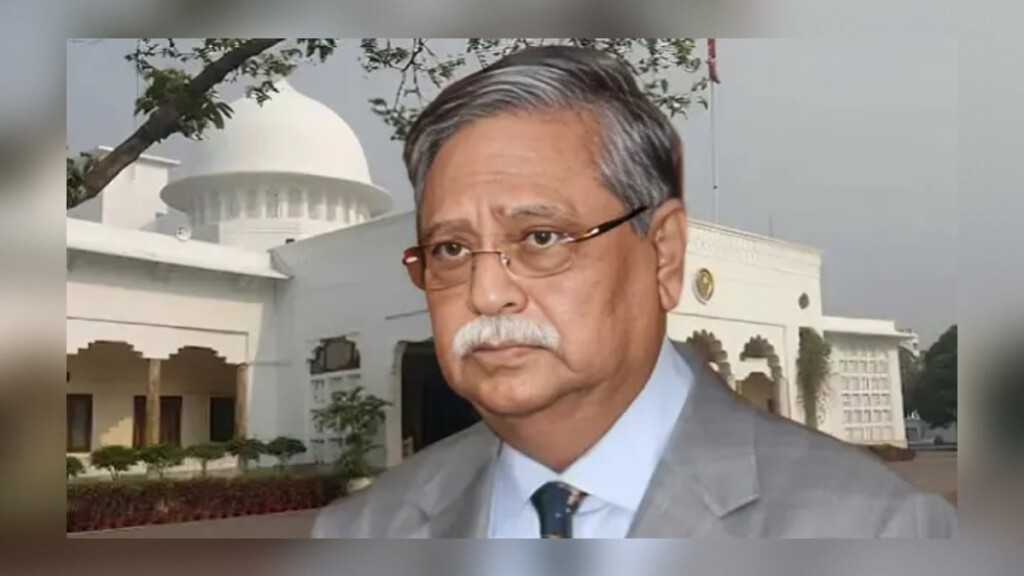
Bangladesh President Mohammed Shahabuddin has resigned from office, bringing an early end to his five-year term and triggering the constitutional process for the appointment of a new head of state. Following the submission and acceptance of his resignation letter, Speaker of Parliament Hafiz Uddin Ahmed announced that he would hold a press conference at the Jatiya Sangsad Bhaban at 5:00 pm to address the development.
Under the Constitution of Bangladesh, the office of the President has now become vacant. Until a new President is elected and sworn into office, the Speaker will serve as Acting President, ensuring continuity in the country’s constitutional framework.
The transition is governed by several constitutional provisions. Article 50(3) states that a President may resign by submitting a signed letter addressed to the Speaker. Article 54 further provides that if the office of the President becomes vacant, or if the President is unable to discharge the duties of the office due to absence, illness or any other reason, the Speaker shall perform the functions of the President until a successor assumes office.
The Constitution also sets a clear timeline for filling the vacancy. Under Article 123(2), if the presidency becomes vacant because of resignation, death or removal, a new President must be elected within 90 days. Article 48(1) stipulates that the President is elected by the members of the Jatiya Sangsad.
As the ruling Bangladesh Nationalist Party (BNP) currently commands a parliamentary majority, political observers expect the party’s nominee to have the strongest chance of becoming the country’s next President. Senior BNP leaders have reportedly been discussing potential candidates for several days, although no official nomination has yet been announced.
The timing of the resignation has also drawn attention because Speaker Hafiz Uddin Ahmed returned to Dhaka from Bangkok earlier on the same day after receiving medical treatment in Thailand. He had travelled to Bangkok on 19 July and was originally scheduled to return on Sunday. Instead, he cut short his visit and arrived in Bangladesh two days ahead of schedule.
Shortly after landing at Hazrat Shahjalal International Airport at around 12:15 pm, journalists asked the Speaker about reports of the President’s possible resignation. At the time, he said he had no knowledge of the matter, explaining that he had been outside the country. He also reminded reporters that, under the Constitution, any presidential resignation must be submitted to the Speaker, who would then assume the responsibilities of the office until Parliament elected a new President within the constitutionally mandated period.
Speculation over President Shahabuddin’s future had intensified in recent days. Political circles had been discussing the possibility of his resignation, while sources familiar with the matter claimed he had become mentally prepared to step down. According to those sources, he met senior officials at Bangabhaban on Thursday and informed them of preparations for his departure from office.
Mohammed Shahabuddin was sworn in as Bangladesh’s 22nd President on 24 April 2023 during the Awami League administration. He had been elected to serve a five-year term, which was due to expire in April 2028. His resignation therefore comes nearly two years before the completion of that term.
Debate over Shahabuddin’s continuation as President had persisted since the July 2024 mass uprising that led to the fall of the Sheikh Hasina government. The discussion became even more pronounced after the BNP formed the government following the 13th parliamentary election. His resignation now formally ends that period of political uncertainty and marks a significant constitutional transition.
With the presidency vacant, attention will now turn to the election of Bangladesh’s next head of state. In accordance with the Constitution, Parliament is required to elect a new President within the next 90 days, while the Speaker will continue to discharge presidential responsibilities until the newly elected President takes the oath of office.