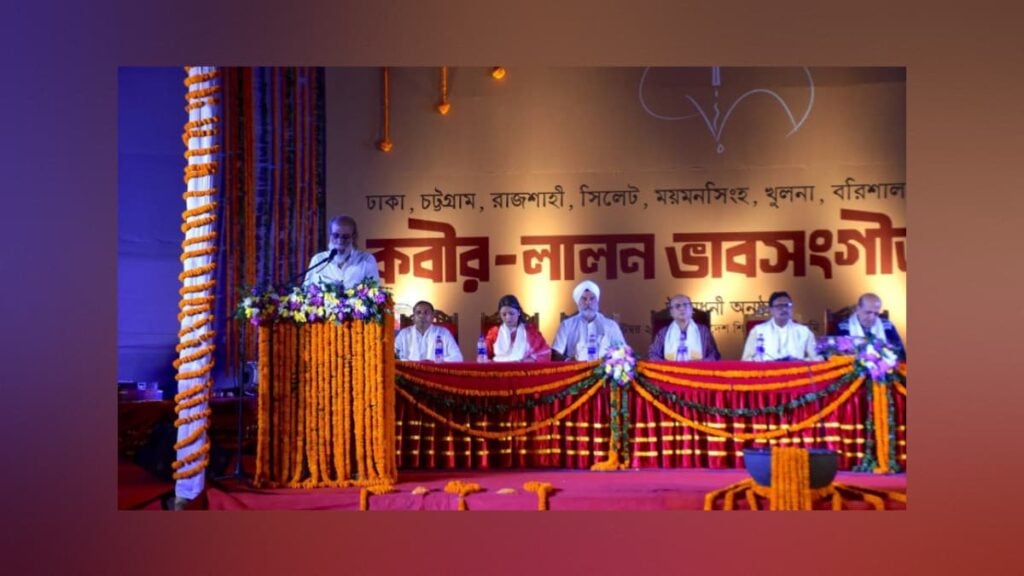
The spiritual music of Kabir and Fakir Lalon Shah has transcended geographical and historical boundaries, earning a universal appeal through its emphasis on humanity, love, self-discovery and freedom from social divisions. Speakers at the sixth Kabir-Lalon Spiritual Music Festival in Rangpur said greater research, discussion and musical practice were needed to introduce the shared philosophical traditions of the two spiritual figures to younger generations.
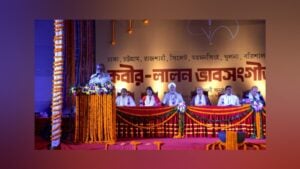
The sixth edition of the festival was held on Sunday at the auditorium of the Rangpur District Shilpakala Academy. Lalon Bishwasangha organised the event with support from the Ministry of Cultural Affairs.
The festival was inaugurated by Professor Dr Md Shawkat Ali, Vice-Chancellor of Begum Rokeya University, Rangpur. He said the musical traditions of Kabir and Lalon had never remained confined to a particular period or geographical region. Their philosophical outlook had crossed temporal boundaries and developed into a form of spiritual music with a universal character.
Professor Ali also highlighted the potential of Lalon’s songs to introduce Bangladeshi audiences to Kabir’s philosophy and musical tradition. Presenting the two figures together to audiences in different parts of the world, he said, could also help clarify the connections between their respective philosophies.
Rangpur District Commissioner Israt Jahan attended the programme as the chief guest. She said the longstanding public interest in the lives, philosophies and spiritual practices of Kabir and Lalon created considerable scope for further research.
A comparative study of their lives, philosophical ideas and spiritual traditions could provide a clearer understanding of both the similarities and distinctive features of their thought, she added.
Rangpur Metropolitan Police Commissioner Md Mahbubur Rashid attended the event as a special guest. Mawlana Abdul Jalil spoke on the philosophical traditions of Kabir and Lalon. The programme was chaired by Abdel Mannan, chief executive of Lalon Bishwasangha and a researcher of Kabir and Lalon.
The second session of the festival focused on music. Under the title ‘From Kabir to Lalon: An Immortal Bridge of Eternal Love’, artists from the Kabir-Lalon Musical Mission performed 20 kalams, or devotional compositions, associated with Kabir and Lalon. Similar musical performances had also been presented at earlier divisional editions of the festival.
Humanity, love, introspection and the rejection of divisions among people occupy a central place in the spiritual music associated with both Kabir and Lalon. Their songs explore questions of human identity and inner consciousness while placing emphasis on a deeper understanding of people and their relationship with one another.
The organisers have combined discussions and research-based presentations with live performances to convey these ideas in a way that is accessible to audiences. The approach allows visitors not only to hear discussions about the two spiritual thinkers but also to experience elements of their philosophy through music.
The festival began in Dhaka on 11 September with a broader plan to organise events across all eight divisions of Bangladesh. As part of the programme, discussions, research-oriented presentations and spiritual music performances are being arranged in different regions. The organisers say the initiative seeks to bring the spiritual and humanist philosophies of Kabir and Lalon closer to younger audiences.
Following the sixth edition in Rangpur, the next programme is scheduled to take place in Chattogram. The seventh edition is expected to be held on 27 October at the premises of the Chattogram District Shilpakala Academy.
The concluding programme representing the Sylhet division is scheduled to take place in Sreemangal. The final event is expected to be held on 30 October at the District Parishad Multipurpose Auditorium.
Through the nationwide series of programmes, the organisers are seeking to present the relationship between the music, philosophy and humanist ideas of Kabir and Lalon on a wider cultural platform. The Rangpur event reflected that objective by bringing together philosophical discussion, research-oriented perspectives and live musical performances.