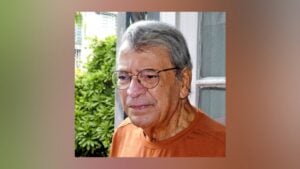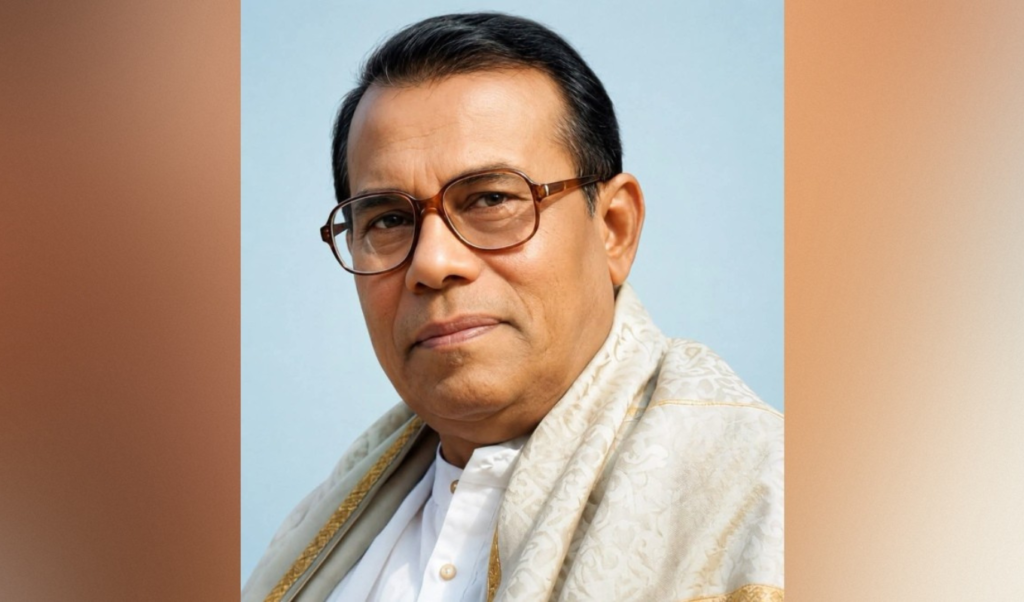
A deeply multifaceted scholar who captured the soil, people, nature, and patriotism of Bengal through poetry, song, and rigorous academic research, Dr Mohammad Moniruzzaman stands as a towering figure in Bangladeshi culture. He was a poet, literary critic, linguist, researcher, university professor, and the lyricist behind numerous timeless songs that remain deeply ingrained in the national consciousness.
His iconic lyric, “Amar Desher Matir Gondhe Bhore Ache Sara Mon” (My heart is filled with the scent of my motherland’s soil), set to music by Abdul Ahad, serves as a poignant reflection of his artistic essence—an enduring expression of love for the homeland.
His deep affection for his native land and its people endowed his lyrics with an effortless simplicity, emotional resonance, and poetic depth. Among his most celebrated compositions are the immortal track “Tumi Ki Dekhecho Kobhu Jiboner Porajoy” and the popular cultural song “Holud Bato Mendi Bato”. During the 1960s, he made substantial contributions to the golden era of Bengali cinema through his songwriting.
Born on 15 August 1936 in the Kharki neighbourhood of Jessore, Moniruzzaman was the eldest of eight brothers born to Mohammad Shahadat Ali and Rahela Khatun. His younger brother, Mohammad Rafiquzzaman, would also grow to become one of Bangladesh’s premier lyricists, continuing a remarkable family legacy in Bengali music.
Moniruzzaman displayed academic excellence from an early age. He completed his Matriculation from Jessore Zilla School in 1953 and his Higher Secondary Certificate from Rajshahi Government College in 1955. Admitted to the Department of Bengali at the University of Dhaka, he earned both his Bachelor’s and Master’s degrees with first-class distinction in 1958 and 1959, respectively.
His professional career began in 1959 at the University of Dhaka, where he initially joined as a Fellow before being appointed Lecturer in 1962. Alongside his teaching responsibilities, he dedicated himself to advanced literary research. He earned his PhD from the University of Dhaka in 1969 and later completed post-doctoral research at the School of Oriental and African Studies (SOAS), University of London.
Promoted to full Professor in 1975, he went on to serve as Chairman of the Department of Bengali at the University of Dhaka. Additionally, he played an active role as a member of the Executive Council of Bangla Academy. Across teaching, linguistic research, poetry, and songcraft, his intellectual presence was distinct and influential.
Beyond academia, Moniruzzaman remained deeply attuned to political and social justice. During the 1971 Liberation War, he aligned himself firmly with the cause of Bengali nationalism and independence. His participation in the Non-Cooperation Movement of March 1971 drew the ire of the Pakistani military regime, placing him at considerable personal risk.
In recognition of his outstanding contributions to Bengali literature and culture, he was awarded the prestigious Bangla Academy Literary Award in 1972 and the Ekushey Padak—one of Bangladesh’s highest civilian honours—in 1987.
He was married to Rashida Zaman, with whom he had two children: Ruhina Hasmin Zaman Karim and Asif Zaman Shuvo.
Dr Mohammad Moniruzzaman passed away in Dhaka on 3 September 2008 at the age of 72. Though decades have passed, his scholarly works, poetry, and patriotism endure within the cultural fabric of Bangladesh, echoing every time his melodies evoke the timeless scent of Bengal’s soil.