Saudi Arabia are stepping up efforts to qualify for the 2028 ICC Men’s T20 World Cup, with a renewed focus on improving cricket standards, increasing international exposure and building a professional environment for the sport.
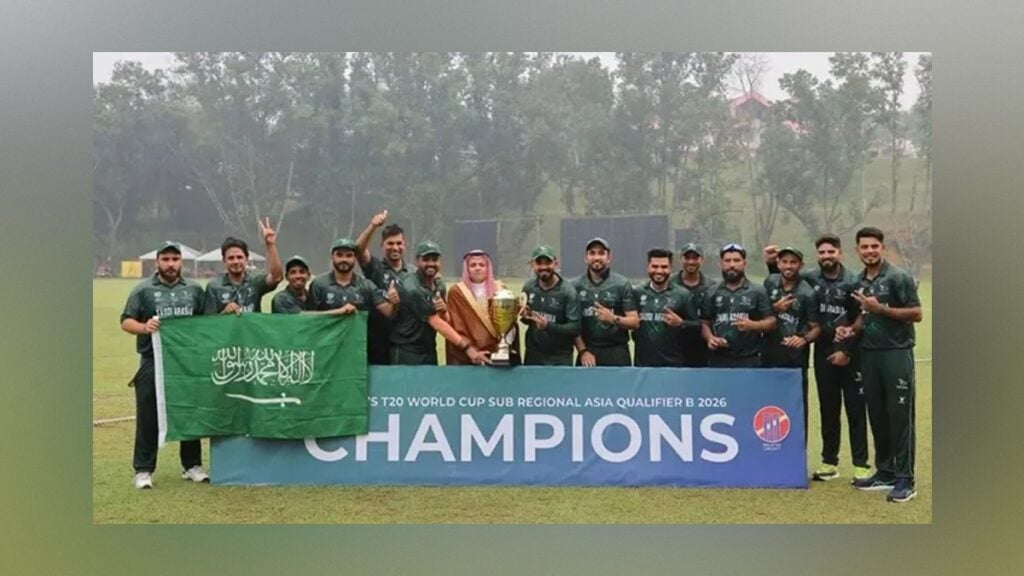
The country’s ambitions received a significant boost after the national team won all five of their matches in the recent Asian sub-regional qualifying tournament. However, despite the impressive run, Saudi Arabia still have several hurdles to overcome before they can secure a place in the global competition.
The qualifying tournament was held in Kuala Lumpur, Malaysia, from 5 to 14 October, featuring 13 teams divided into two groups. Saudi Arabia finished top of Group B with five wins from five matches. Hong Kong and Malaysia also advanced from the group, while Kuwait, Bahrain and Qatar progressed from Group A.
The six teams will compete in the Asian Regional Final in 2027. The top two sides will then advance to the global qualifying play-off, where eight of the 16 participating teams will earn places at the 2028 T20 World Cup.
For Saudi Arabia, the challenge now is to maintain their momentum against more experienced opponents and demonstrate that their recent success can be sustained at a higher level.
Experienced Regional Rivals Pose a Challenge
Despite their strong performance in the qualifiers, Saudi Arabia face a difficult task against established regional competitors. Their previous results against Qatar, Kuwait and Bahrain underline the improvements still required.
Since 2019, Saudi Arabia have played 11 T20 internationals against Qatar, winning only three. They have recorded three victories in seven matches against Kuwait and two wins in six encounters with Bahrain.
The gap in international experience is another concern. Saudi Arabia have played 62 T20 internationals, compared with 134 for Bahrain, 90 for Qatar and 88 for Kuwait.
Regular international competition helps players develop their tactical awareness, improve decision-making and learn to cope with pressure in close matches. Saudi Arabia will need to strengthen these areas if they are to compete consistently against their regional rivals.
Cricket Infrastructure Remains a Major Obstacle
A shortage of international-standard cricket grounds is another significant challenge for Saudi Arabia.
The country does not yet have suitable facilities to host international matches at the required standard, forcing the national team to play most of their international fixtures in Qatar and Oman.
Developing modern cricket grounds could allow Saudi Arabia to host more matches at home and give players greater exposure to competitive cricket in familiar surroundings. It could also help attract local spectators, encourage young people to take up the sport and provide a stronger foundation for domestic competitions.
However, infrastructure alone will not guarantee success. Regular fixtures, quality coaching, player development programmes and opportunities to compete against stronger teams will also be essential.
Plans to Expand International Competition
Iqbal Sikander, general manager of the Saudi Arabian Cricket Federation, has said the country’s cricket structure is becoming more organised.
The federation is focusing on raising playing standards, expanding competitive opportunities and creating a more professional environment for cricketers.
Plans are also being considered to organise bilateral, triangular and quadrangular series to give players more opportunities to compete. Regular participation in such tournaments would allow the squad to test itself against different opponents, improve tactical preparation and build greater consistency.
Cooperation with Pakistan could also support Saudi Arabia’s long-term cricket development. Opportunities to exchange expertise and improve training methods could help strengthen the country’s cricketing structure and prepare players for higher levels of competition.
Franchise Cricket Offers Opportunities for Local Players
Saudi Arabia are also seeking to develop local talent through franchise cricket.
Teams competing in the DP World ILT20 league are required to include at least one Saudi cricketer in their squads. Four of the six Saudi players selected for the 2026 edition have secured places in teams.
Playing in a professional franchise environment gives local cricketers the opportunity to train and compete alongside experienced international players. Such exposure can help them improve their technical skills, understand professional preparation and learn how to perform under pressure.
Ishteaq Ahmed has already provided an encouraging example of the potential within the Saudi squad. On 11 October, he claimed four wickets, including a hat-trick, in Saudi Arabia’s 10-run victory over Hong Kong.
His performance offered a boost to the team and demonstrated the value of providing local players with opportunities to perform in competitive international matches.
Women’s Cricket Also Part of Development Plans
Saudi Arabia are working to develop women’s cricket alongside the men’s game as part of broader efforts to expand participation in the sport.
Creating more competitive opportunities for female players could help establish a stronger foundation for women’s cricket in the country. However, an international women’s tournament and the men’s Dunes T20 franchise league have been postponed because of technical issues.
Holding such competitions regularly would provide players with valuable match experience and help sustain interest in the game. Consistent organisation and long-term planning will be important to ensure that development initiatives translate into meaningful progress.
The Road to the 2028 World Cup
Saudi Arabia’s five-match winning run in the sub-regional qualifiers has strengthened their hopes of reaching the 2028 T20 World Cup. Nevertheless, the team must now prove that it can maintain the same level of performance against more experienced opponents.
Increasing the number of international fixtures, improving cricket infrastructure, expanding professional playing opportunities and investing in player development will be central to the country’s ambitions.
The 2027 Asian Regional Final will be a crucial test of Saudi Arabia’s progress. Strong performances at that stage could take the team closer to the global qualifying play-off and, ultimately, a place at the 2028 World Cup.
For now, the immediate priority is to build on recent success while addressing the gaps in experience and infrastructure. Sustained progress in these areas will determine whether Saudi Arabia can turn their World Cup ambition into reality.