Several young men boarded Dhaka Metro Rail in shorts on Thursday morning in a symbolic protest against the alleged harassment of athlete trainer Sazzad Hossain over his clothing at Farmgate station.
The demonstration, titled ‘Hafpant Pore Metorail-e!’ (On the Metro in Shorts!), was organised at Farmgate Metro Rail Station between 5am and 8am. Organisers invited people who believed that passengers should not be harassed or prevented from using public transport for wearing ordinary sportswear.
The protest followed an incident on 27 September involving Hossain. According to the account cited by the organisers, Hossain had completed his exercise routine and was wearing a T-shirt and shorts when he went to board the metro at Farmgate. A police officer on duty at the station allegedly described his clothing as ‘indecent’ and kept him standing near the ticket-punching machine for about 40 minutes.
The incident prompted discussion on social media about clothing standards on public transport and how such rules, if any, should be communicated and enforced. The organisers subsequently called for a peaceful demonstration in which participants would wear running shorts and T-shirts and travel on the metro as ordinary passengers.
The campaign attracted considerable interest online. By around 10.30pm on Wednesday, 672 people had marked themselves as ‘going’ on the Facebook event, while around 8,200 users had indicated that they were ‘interested’.
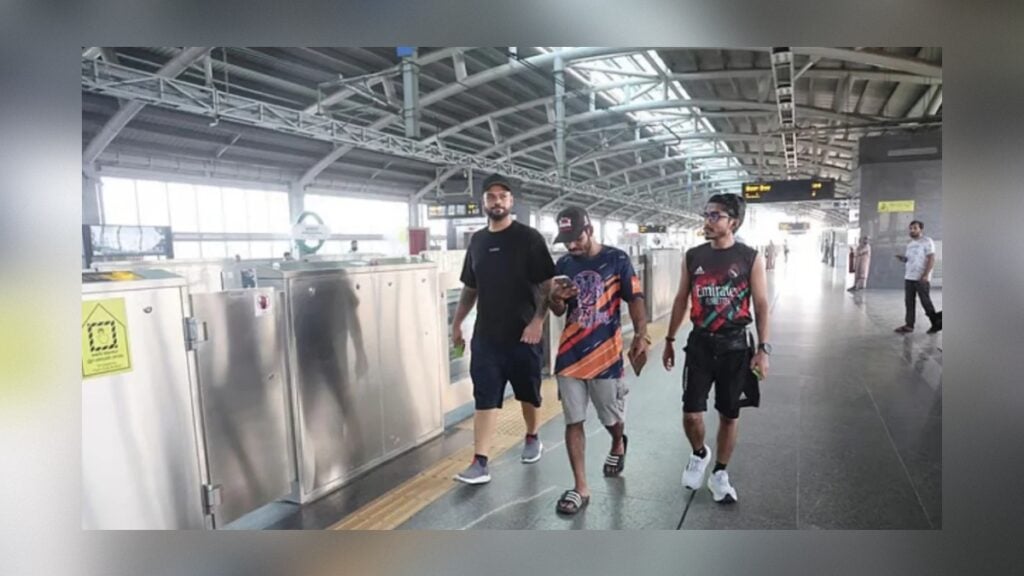
At about 7am on Thursday, three young men arrived beneath the Farmgate station near Anwara Udyan. They were private-sector employee and runner Sagar Majumder, businessman Mahfuzur Rahman and Rakibul Islam.
Majumder said runners commonly wear shorts because they are more comfortable when exercising. He said the incident involving Hossain had raised concerns among runners that they could face similar treatment while using public transport.
“We are runners. Wearing shorts is more comfortable when running, so we wear them,” Majumder said, explaining his decision to join the protest.
He added that, as a runner himself, he could potentially encounter a similar situation at a metro station or elsewhere. The demonstration, he said, was intended to challenge negative perceptions surrounding sportswear and to discourage people from treating ordinary athletic clothing as inherently inappropriate.
Shortly after 7am, Majumder and Mahfuzur entered the metro station wearing shorts. They purchased tickets for Bijoy Sarani, passed through the ticket gates and boarded the train. They travelled from Farmgate to Bijoy Sarani, where they got off and left the station.
Rakibul did not board the train with them. Speaking to The Daily Ittefaq, he said he had come to take part in the protest after learning about the reported harassment of a fellow runner and seeing people he knew express interest in the Facebook event.
At around the same time, two other young men reportedly entered Farmgate station through another gate wearing shorts. Their identities were not immediately known. Witnesses said they bought tickets for Motijheel and boarded the metro.
The incident behind the protest
The demonstration centred on the alleged treatment of Sazzad Hossain on 27 September. After completing his exercise routine that morning, Hossain reportedly went to Farmgate Metro Rail Station wearing a T-shirt and shorts.
According to the report, a police officer on duty objected to his clothing, describing it as ‘indecent’, and kept him near the ticket-punching machine for approximately 40 minutes.
The allegation sparked a wider discussion about whether passengers should be questioned or stopped because of what they are wearing. It also raised questions about the importance of clear rules in a public transport system used by large numbers of people every day.
The organisers’ position is that if particular clothing is not permitted, the restriction should be clearly stated in written rules so that passengers know the requirements before entering a station. They also called for passengers to be treated respectfully when rules are applied.
The Facebook event described the planned action as a peaceful civic protest rather than an attempt to create disorder. Participants were encouraged to wear running shorts and T-shirts and travel on the metro together.
The organisers framed the issue around three demands: opposition to what they described as arbitrary harassment, clearer rules for passengers, and respectful treatment of people using public transport.
Thursday’s demonstration therefore turned a dispute over one passenger’s clothing into a broader public conversation about dress, rules and enforcement on Dhaka’s metro system. For the participants, the shorts were a deliberate symbol: they wanted to show that ordinary sportswear should not, in itself, become a reason for a passenger to face obstruction or humiliation.
The immediate incident remains centred on the allegations surrounding Hossain’s experience at Farmgate. But the unusual protest has ensured that questions about clarity of regulations and how passengers are treated at metro stations remain firmly in the public discussion.