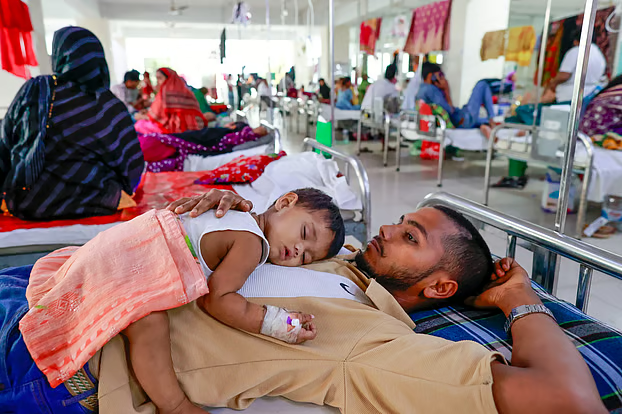
Malnourished children face a dramatically heightened vulnerability to measles, according to a landmark study revealing that sixty-five per cent of young patients hospitalised with the virus suffer from moderate to severe malnutrition. Conducted jointly by the Bangladesh Shishu Hospital and Institute and the International Centre for Diarrhoeal Disease Research, Bangladesh (icddr,b), the research underscores a critical public health crisis currently unfolding across the country.
The findings were officially released on Wednesday during an event held at the Shishu Hospital auditorium. The presentation drew prominent health sector officials, scientists, researchers, and clinicians, alongside State Minister for Health M A Muhit, who attended as the chief guest.
Addressing the gathering, State Minister Muhit stated that the nation is currently grappling with a measles outbreak that has proven difficult to contain. He emphasised that vaccination remains the singular, indispensable tool to halt the transmission, noting a severe structural impediment within the public health workforce. According to official figures, while forty thousand field worker positions exist for immunisation delivery, fifteen thousand remain vacant. Leaving nearly forty per cent of these frontline posts empty makes achieving universal immunisation coverage nearly impossible.
“This current situation stems from multifaceted failures,” Muhit remarked, noting that no single intervention will provide an instant fix. He added that under optimal conditions, restoring total control over the spread of measles will require at least two to three months.
The study investigated three hundred and fifty-four children under the age of fourteen who sought treatment at the Bangladesh Shishu Hospital and Institute between March and July. Researchers examined demographic and clinical histories, collected biological specimens for laboratory testing at icddr,b, and performed genetic sequencing on the viral samples. A total of twelve scientists, researchers, and institutional officials collaborated on the comprehensive project.
Presenting the initial segment of the findings, Professor Mirza Mohammad Ziaul Islam, director of the Shishu Hospital, noted that seventy-one per cent of infected children arrived directly at the facility for care. The remaining twenty-nine per cent were referred after seeking initial treatment at various other hospitals in Dhaka and surrounding districts. Furthermore, slightly over five per cent of the admitted children required critical care in intensive care units (ICUs).
The nutritional assessment focused specifically on three hundred and eight children under five years of age. The data revealed that twelve per cent suffered from severe acute malnutrition, while fifty-three per cent experienced moderate malnutrition, bringing the total proportion of undernourished measles patients to sixty-five per cent. Only thirty-four per cent maintained a normal nutritional status, and one per cent presented with weight above the age-appropriate median.
Breastfeeding habits played a vital role in child immunity. Researchers observed that thirty-eight per cent of the affected children did not receive regular breast milk. Colostrum and exclusive breastfeeding during the first six months of life function as a natural vaccine, providing essential early protection against infectious diseases. Notably, among the eleven children who succumbed to measles during the study period, nine—or eighty-two per cent—had not been exclusively breastfed.
Vaccination coverage analysis reviewed data from three hundred and forty-two children. The findings showed that forty-three per cent of the infected children were under nine months of age, meaning they had not yet reached the eligible age for the first dose. In Bangladesh, the initial measles vaccine is administered at nine months, followed by a second dose at fifteen months.
However, thirty-seven per cent of children who had surpassed the eligible age remained completely unvaccinated. Only fourteen per cent had received a single dose, while a mere six per cent had completed the recommended two-dose schedule. The presence of infections among children who received both doses indicates a pressing need for further scientific investigation into post-vaccination breakthrough infections.
Dr Mohammad Mustafizur Rahman, senior director at icddr,b, presented the genetic analysis of the circulating viruses. He explained that global measles strains comprise twenty-eight distinct genotypes, with genotype B3 predominating in Bangladesh and the wider region. Genetic sequencing revealed only minor mutations, confirming that the virus has not evolved into a more virulent or hyper-transmissible strain. Consequently, viral mutation is not driving the sudden surge.
Dr Rahman referenced a complementary icddr,b study conducted in Kamalapur involving two hundred mothers and two hundred infants to understand maternal antibody transfer. That research found that eighty-five per cent of expectant mothers possess measles antibodies in their blood during pregnancy, and sixty per cent of newborns retain antibodies in their first month of life. However, these maternal antibodies deplete rapidly, vanishing entirely by the sixth month, leaving infants entirely unprotected by nine months of age.
Based on these comprehensive findings, researchers outlined several critical recommendations. These include guaranteeing uninterrupted vaccine supplies, establishing more effective immunisation outreach strategies, expanding clinical and epidemiological research, and actively translating study conclusions into national eradication frameworks. Professor Mohammad Riaz Mubarak, head of epidemiology and research at the Shishu Hospital, delivered the welcome address, while expert panel discussions featured senior institutional figures including Professor Mohammad Monir Hossain, former director Mohammad Mahbubul Haq, and Professor Mohammad Atikul Islam.
Key Findings at a Glance
| Indicator / Metric | Percentage / Proportion |
| Measles patients presenting with moderate to severe malnutrition | 65% |
| Children under 5 suffering from severe acute malnutrition | 12% |
| Children under 5 suffering from moderate malnutrition | 53% |
| Children with normal nutritional status | 34% |
| Children with weight above normal parameters | 1% |
| Fatality cases involving children not exclusively breastfed | 82% |
| Infected children below the 9-month vaccination age threshold | 43% |
| Eligible children who received zero vaccine doses | 37% |
| Infected children who received a single vaccine dose | 14% |
| Infected children who completed the two-dose schedule | 6% |
| Direct admissions to Shishu Hospital | 71% |
| Referred admissions from external facilities | 29% |
What specific strategies can the health ministry deploy to bridge the massive vacancy gap among frontline immunisation field workers?