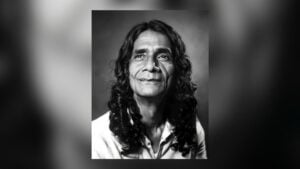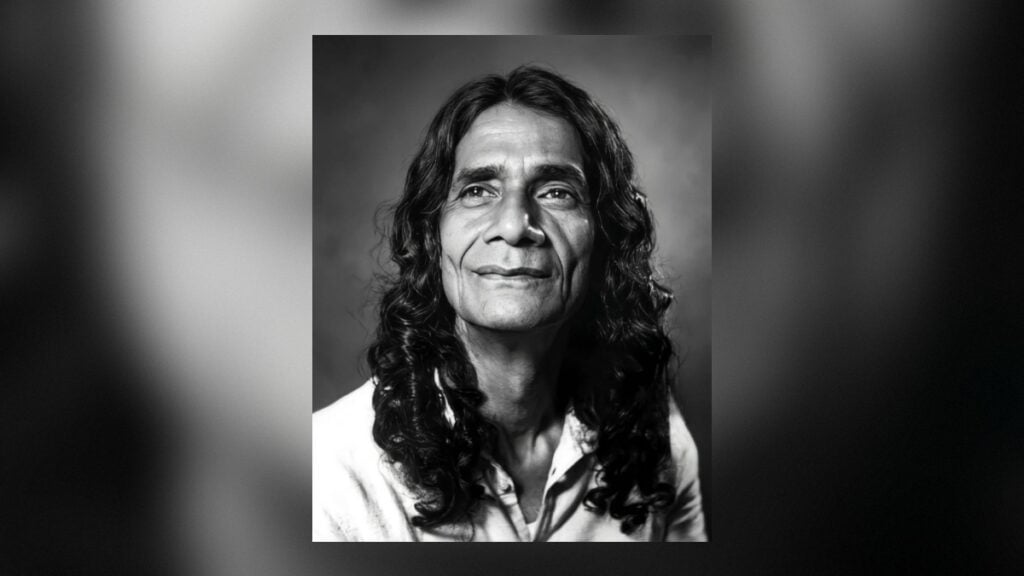
Sultan did more than paint the land and its people. Through his distinctive visual language, he expressed the struggles, aspirations and resilience of those whose contributions to society have often gone unrecognised. His work established rural life and agricultural labour as subjects worthy of artistic grandeur, philosophical reflection and national pride.
His artistic vision set him apart from many of his contemporaries. At a time when the lives of influential individuals and privileged communities frequently occupied prominent positions in art, Sultan placed ordinary working people at the centre of his creative universe.
Early Life and the Roots of His Artistic Vision
SM Sultan was born Sheikh Mohammed Sultan on 10 August 1923 in Machimdia village, in what was then Jessore district and is now Narail district in Bangladesh. His father, Mেছের Ali, worked as a mason, while his mother was named Maju Bibi. Known affectionately as ‘Lal Mia’, Sultan grew up in a family that experienced financial hardship.
Despite these difficulties, he developed a strong interest in drawing from an early age. He helped his father with his work while pursuing his education and spent his spare time sketching and exploring his artistic imagination. The limitations of his circumstances did little to diminish his ambitions.
His early education began at Narail Victoria Collegiate School in 1928, according to biographical accounts. Stories of his childhood describe an exceptional talent that became apparent while he was still a schoolboy. In 1933, while studying in Class Five, he reportedly attracted attention by painting a portrait of local landowner Shyamaprasad Mukherjee.
The incident helped establish his reputation as a promising young artist. However, talent alone could not remove the barriers created by poverty and limited access to formal education. Sultan had to overcome considerable obstacles before he could pursue his ambition of becoming a professional painter.
These early experiences would later become significant in understanding his artistic outlook. Having grown up close to rural working life, he developed a deep awareness of the people, landscapes and social realities that would eventually dominate his paintings.
From Kolkata to the Wider Art World
Driven by his determination to become an artist, Sultan travelled to Kolkata in 1938. There, he met art critic and writer Shahid Suhrawardy, who recognised his potential and encouraged him to pursue formal artistic training.
Sultan enrolled at the Calcutta Art School in 1941. Although the institution provided an introduction to formal art education, his mature style would ultimately emerge from a combination of personal experience, observation and an intimate relationship with the natural world.
The political upheavals surrounding the partition of British India in 1947 transformed the region in which he had grown up. During the years around partition and afterwards, Sultan travelled extensively across India and other parts of the world. His paintings reached audiences beyond the subcontinent, exposing him to artistic traditions and perspectives outside his immediate surroundings.
Yet international exposure did not lead him to abandon his roots. His experiences abroad appear to have strengthened his commitment to the subjects that mattered most to him: the people of Bengal, agricultural labour and the rhythms of rural existence.
For Sultan, the countryside was not simply a picturesque setting. It was a place where human endurance, collective effort and the relationship between people and nature could be understood in their fullest form.
His eventual return to rural Bangladesh reflected this commitment. Rather than making metropolitan artistic circles the centre of his career, he chose to develop a visual language rooted in the lives of ordinary people.
Farmers at the Centre of His Art
Sultan’s most recognisable artistic characteristic was his portrayal of farmers with exaggeratedly powerful physiques. His rural figures often appear muscular, broad-shouldered and monumental, their bodies conveying extraordinary energy and determination.
These figures were not intended merely as realistic representations of individual workers. Their physical proportions carried a deeper meaning. Through them, Sultan expressed the strength of agricultural communities and challenged the social assumptions that associated rural labourers with weakness, poverty or helplessness.
In his paintings, farmers are the protagonists of history. Their labour sustains society, their relationship with the land preserves the foundations of rural life, and their physical strength becomes a metaphor for their capacity to shape the future.
His canvases frequently bring together agricultural workers, cultivated fields, livestock, rivers and the natural environment. These elements form expansive compositions in which human activity and nature are closely interconnected.
The farmers’ powerful bodies are particularly significant. They symbolise not only the physical demands of agricultural work but also a sense of dignity that society has often denied those who perform it. Sultan’s figures seem to emerge from the land itself, embodying its vitality and the enduring relationship between human beings and their environment.
This approach also gave his work a social dimension. By placing farmers at the centre of his compositions, he challenged conventional hierarchies of artistic representation. People who were frequently marginalised in public life became commanding presences on his canvases.
His paintings therefore operate on several levels. They are visual celebrations of rural Bengal, reflections on labour and class, and expressions of an ideal society in which ordinary people enjoy dignity, recognition and opportunity.
Sultan’s distinctive treatment of the human body also gave his work a quality that was immediately recognisable. His figures do not simply occupy the landscape; they dominate it, suggesting that the people who cultivate the earth are central to the survival and progress of civilisation.
A Quiet Life Devoted to Art and Children
In 1953, Sultan returned to Narail, choosing the familiarity of his home region over the attractions of urban life. His decision reflected a preference for working close to the people and landscapes that had shaped his artistic imagination.
He was not interested solely in producing paintings or building a personal reputation. He also wanted to encourage creativity among children and young people, believing that art education could help nurture a more sensitive, imaginative and humane society.
On 10 July 1969, he established the Institute of Fine Art in Narail. The initiative reflected his determination to make artistic education more accessible beyond the major urban centres.
His commitment to children found another expression in Shishu Swarga, established in 1987. The initiative was intended to provide children with opportunities to explore creativity and develop their imaginations in an environment that valued freedom and spontaneous expression.
These projects demonstrated that Sultan’s interest in art extended beyond the production of paintings. He regarded creativity as an essential part of human development and believed that artistic expression could contribute to a more open and culturally enriched society.
His personal life was also marked by unusual interests. He could play the flute and other musical instruments and had a deep affection for animals. Accounts of his life describe a varied collection of animals and birds, including snakes, bears, monkeys, rabbits, mynas and guinea pigs.
His relationship with the natural world was an important part of his character. The diversity of living creatures and the rhythms of rural life appealed to him, reinforcing the connection between his personal outlook and the subjects he explored in his art.
Sultan disliked hostility, narrow-mindedness and conflict. His way of life, like his paintings, reflected a desire for a more generous and humane world.
Recognition and National Honours
Sultan’s contribution to Bangladeshi art eventually received widespread recognition. His honours included several major national awards, reflecting the significance of his artistic achievements.
Among his notable distinctions were:
-
Ekushey Padak (1982): One of Bangladesh’s prominent national honours, recognising contributions to cultural and intellectual life.
-
Resident Artist recognition (1984): An acknowledgement associated with his standing as an artist.
-
Bangladesh Charushilpi Sangsad Award (1986): Recognition from the country’s fine arts community.
-
Independence Award (1993): One of Bangladesh’s highest civilian honours.
Biographical accounts have also associated Sultan with international distinctions, including references to ‘Man of the Year’ from Cambridge University, ‘Man of Achievement’ from the New York-based Biographical Centre and ‘Man of Asia’ from Asiaweek magazine. Such claims should be distinguished from his nationally documented honours when assessing his record of recognition.
Awards alone, however, cannot fully explain his significance. His lasting achievement lies in the artistic language he developed to represent rural communities and in the dignity he bestowed upon people whose labour is fundamental to society.
By making farmers the central figures of his artistic world, Sultan expanded the possibilities of Bangladeshi painting. He demonstrated that the lives of ordinary people could carry the same grandeur, complexity and emotional power traditionally associated with heroic or elite subjects.
An Enduring Legacy Beyond His Lifetime
SM Sultan died on 10 October 1994, aged 71. His death marked the loss of a distinctive voice in Bangladesh’s cultural life, but his artistic legacy has continued to influence how the country understands its rural heritage and working communities.
His paintings remain closely associated with Narail, the countryside of Bengal and the lives of agricultural workers. They preserve a vision of rural society in which physical labour is not a sign of inferiority but a source of strength and collective achievement.
Sultan’s work also offers a broader reflection on the role of art in society. Paintings can do more than capture appearances or provide aesthetic pleasure. They can challenge established perceptions, restore dignity to overlooked communities and encourage people to reconsider the foundations of their history and identity.
His farmers embody this conviction. Their monumental bodies, determined expressions and commanding presence convey an aspiration for a world in which exploitation gives way to fairness and social divisions no longer determine human worth.
The power of his work lies partly in its refusal to portray rural people solely through hardship. Although poverty and social inequality form part of the wider context of their lives, Sultan chose to emphasise their capacity, resilience and potential. His paintings offer a vision of people who are not passive victims of circumstance but active participants in shaping their own destinies.
That vision continues to resonate in Bangladesh, where agriculture and rural communities remain deeply connected to the country’s social and economic identity.
SM Sultan may have passed away, but the people he placed on his canvases continue to stand tall. Through their strength, their labour and their enduring connection with the land, they preserve the artistic vision of a painter who saw greatness in ordinary lives.
His legacy is not confined to the paintings he left behind. It also lives in his commitment to children’s creativity, his devotion to rural Bengal and his belief that art can affirm the dignity of every human being.
SM Sultan remains one of the most distinctive interpreters of the land and people of Bengal—a painter whose work transformed the farmer from a neglected figure into an enduring symbol of strength, self-respect and human possibility.